Billy Crystal still keeps a photograph from 1992. It was taken at a Friars Club roast, where Crystal sat at the dais with Robin Williams directly behind him. For several minutes, Williams had been committed to a single bit: pretending to be Crystal’s foreskin, calling himself “Rumpled Foreskin. ” The room was screaming with laughter.
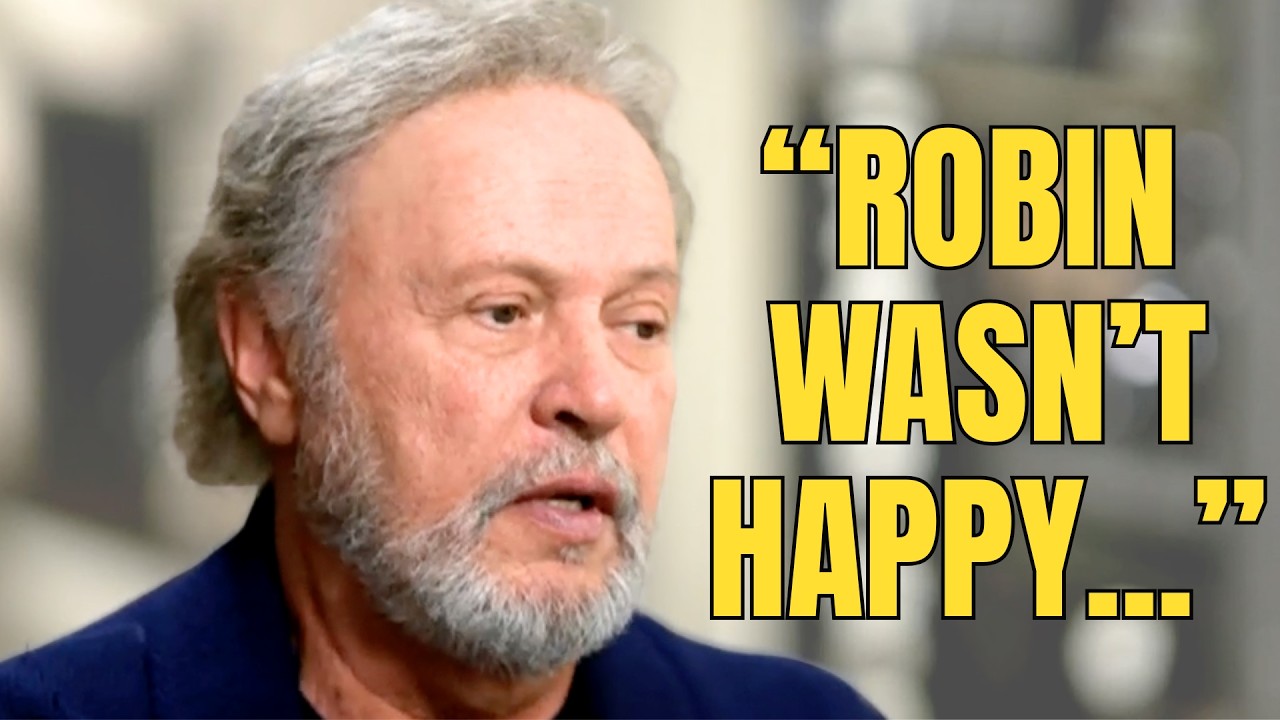
Decades later, telling the story on late-night television, Crystal still could not get through it without breaking into the kind of laughter that exists only between two people who knew each other before either was famous. That is the Robin Williams Crystal carries with him—not the headline or the tragedy the world reduced him to in August 2014, but the friend who would do anything for a laugh while never making anyone feel like the joke. At 78, Crystal still tells that story in rooms full of strangers because he believes someone has to keep saying who Robin was before the public memory of him hardens into just an ending. The two met in the late 1970s on the Los Angeles comedy circuit, two young standups working the same small rooms.
Williams had grown up far from struggling-comic territory. He was born in Chicago on July 21, 1951, to a senior Ford executive, and the family eventually settled in a 40-room farmhouse in Bloomfield Hills, Michigan, with staff on hand. From the outside, the childhood looked charmed. He attended the private Detroit Country Day School, served as class president, and classmates remembered him as warm and hilarious.
But the house was enormous, and his parents were busy. Williams spent long stretches of his childhood essentially alone, with the family maid as his most consistent companion. He later described inventing entire worlds with toy soldiers just to populate the silence. He won a scholarship to Juilliard, one of only two students accepted into the advanced program that year—Christopher Reeve was the other.
Williams walked away in his junior year because the immediate, electric exchange with a live audience pulled harder than formal training could hold him. He landed in the Bay Area comedy scene, then Los Angeles, and his rise was fast. He won a Grammy for Best Comedy Album in 1979 for “Reality… What a Concept.
” He was cast as the alien Mork on “Mork & Mindy” and became one of the most recognizable comedians in America within a single television season. Underneath that success, Crystal found him at parties, at clubs, and at Friars Club roasts, where the two became regular fixtures, destroying each other on stage with the freedom that only exists between comedians who trust each other completely. Crystal has spoken fondly of that period, before everything got complicated, when Robin would show up uninvited and the entire room would reorganize around him within about 90 seconds. Crystal also watched the part that never made it into the magazine profiles.
The late-1970s comedy world ran on cocaine, and Williams, who needed almost nothing external to be the most electric person in any room, fell into it completely. Friends described him taking cocaine from strangers without glancing at who was offering it. The director of “Mork & Mindy” spoke about Robin arriving on set wrecked some mornings, the wreckage of nights that started with cocaine and ended with alcohol. In March 1982, John Belushi died.
Robin had been with him the night before, partying in the same circles that had become almost inescapable in that industry era. Losing a friend to the exact substances you are using changes something. With his first child on the way, Williams quit drinking and drugs decisively. He told People magazine years later that Belushi’s death scared an entire generation in the business straight, at least for a while.
He used to wake up in the backseat of his own car, keys still in the ignition, with no idea how he got there. Then he stopped. What replaced the addiction was cycling. He befriended a bike shop owner named Tony Tom and told him directly that biking was a great deal better than cocaine—that it had, in his own words, saved his life.
The sobriety held for 20 years, during which Williams built the body of work that defined him for a generation. “Good Morning, Vietnam” in 1987 showed what happened when his improvisational genius was given an actual character and stakes. “Dead Poets Society” in 1989 showed the opposite gear: restraint and stillness. “Aladdin” gave his voice room to become something almost elemental, with animators building sequences around his unscripted riffs.
“Mrs. Doubtfire” in 1993 became one of the decade’s most beloved comedies, built on hours of improvisation. “The Birdcage” in 1996 paired him with Nathan Lane, letting his co-star take the loudest moments while he anchored the film’s heart. In 1997, “Good Will Hunting” finally won him the Academy Award after three prior nominations, on a performance of stillness and listening—the park bench scene telling Matt Damon’s character, “It’s not your fault,” becoming one of the most quoted moments in American film.
Through all of it, Billy Crystal was there, not as a casual industry acquaintance, but as one of the people who actually knew him. They were part of a circle that included Reeve, and that friendship survived Reeve’s catastrophic 1995 riding accident. When Reeve woke up paralyzed, facing the possibility of choosing to end his life, Williams showed up at the hospital dressed as a Russian doctor, doing an absurd accent, and made his oldest friend laugh for the first time since the accident. Reeve later said that moment helped him decide to keep living.
They also collaborated publicly on Comic Relief, which Crystal hosted and organized for years alongside Williams and Whoopi Goldberg, raising tens of millions of dollars for homelessness relief. The collaboration ran for over two decades, and Crystal often returns to it when he wants people to understand the actual texture of who his friend was. In 2003, the sobriety broke. Williams was filming a movie in Alaska, isolated, and later identified that feeling of being alone and afraid as the most dangerous possible state for someone with his history.
He told himself it would just be a taste. Within a week, he was buying so much alcohol that he said he sounded like a windchime walking down the street. He went into rehab in 2006. He fell again.
He returned to treatment at the Hazelden Foundation in Minnesota in 2014, just months before the end. What almost nobody understood was that the renewed drinking was not simply a relapse. It was the leading edge of something else entirely. In late 2013, strange symptoms had begun: insomnia, heartburn, a slight tremor in his left hand, rising and inexplicable anxiety.
His wife, Susan Schneider Williams, later wrote about those months in an essay she called “The terrorist inside my husband’s brain. ” By winter, things had become harder to explain away. He was experiencing paranoia, delusions, and memory loss so severe that while filming “Night at the Museum 3,” he struggled to retain his own lines. Susan has written that Robin knew with terrible clarity that he was losing his mind.
He kept the worst of it from almost everyone. By the final months, there was no hiding it: a slow, shuffling gait; trouble finding words mid-sentence; a trembling left hand; a frozen, masklike expression that robbed him of the physical mobility that had always made his face so alive on screen. There was no name for what was happening yet. The diagnosis came after his death: Lewy body dementia, a degenerative brain disease that mimics Parkinson’s in its early stages and produces the exact constellation of paranoia, anxiety, and cognitive slippage that had been dismantling him for nearly a year.
Nobody—neither his doctors nor his family nor Williams himself—had the name for it while there was still time to explain it to him. He thought he was simply losing his mind with no medical reason and no path back. He said good night to Susan on the evening of August 10, 2014. It was the last thing he ever said to her.
He took his own life the following morning. He was 63. The world’s grief was immediate and enormous, but for the people who actually knew him, it was personal. What Crystal has tried to do in every interview since is resist the flattening that happens to people who die in a way the public finds shocking.
He does not lead with the ending. He leads with the foreskin joke, with the years of stand-up rooms and roasts, with the specific electricity of being in Robin Williams’s orbit when nobody was paying for a ticket. Billy Crystal has said that the tragedy of Robin Williams is not simply that he died too young, though he did. It is that the disease took something from him before it took his life—his words, his timing, his ability to trust the instrument that had defined him since he was a lonely kid making up stories for toy soldiers.
And it is that he spent his final year putting on the bravest performance of his career, convincing the world he was simply tired while privately terrified that his own mind was abandoning him. At 78, Crystal carries both versions of his friend. The man who could make 2,500 people howl with laughter pretending to be a body part. The man who quit drugs the morning after a friend died from them and stayed clean for 20 years.
The man who lost a battle that had no name yet. Crystal still tells the story and still laughs every time, because that laugh is the truest tribute he knows how to give.