Salt was once used as currency, paid to Roman soldiers, and fought over by armies and empires. Entire cities were built to secure its supply, and wars were fought to protect access to it. Yet in most modern kitchens, salt is an ordinary shaker sitting on the table, often something people are told to eat less of for health reasons. But the question of when humans first started eating salt reveals a transformation that reshaped human biology, economics, and politics over hundreds of thousands of years.
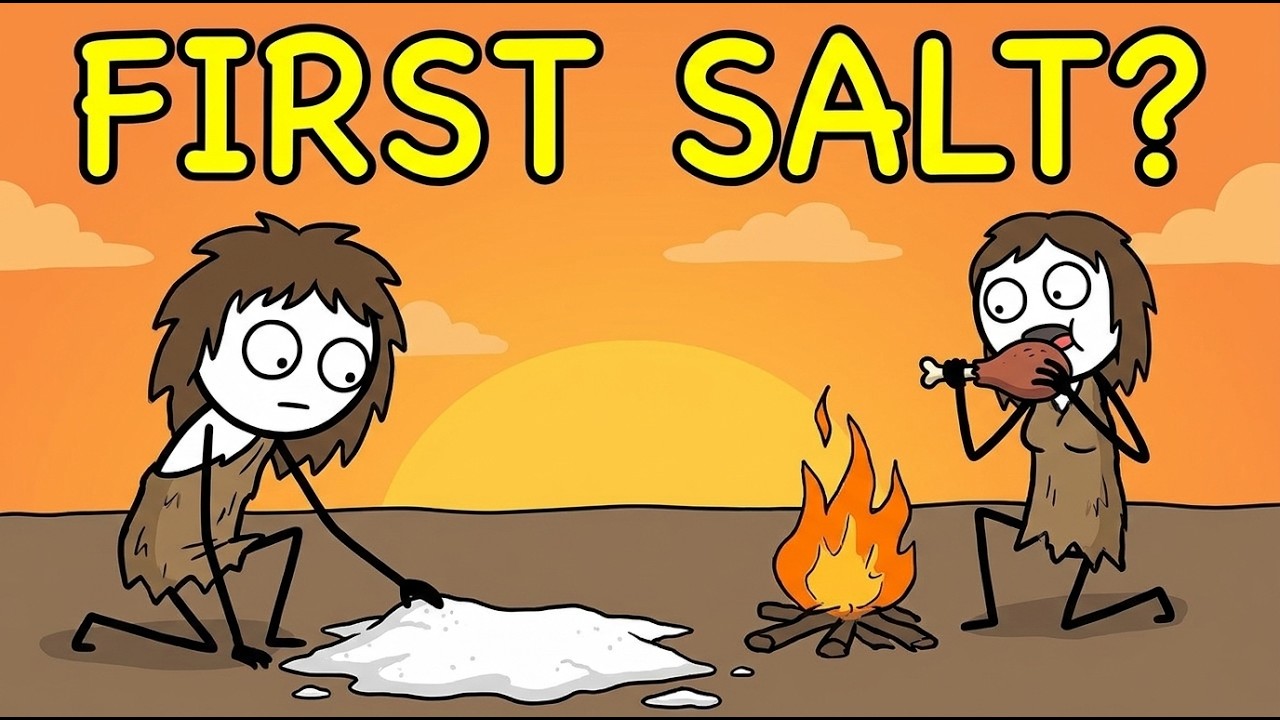
The answer is not a single moment but a process that unfolded across prehistory and into the age of agriculture. To understand it, the starting point is biology. Sodium, the key element in salt, is essential for life. It regulates fluid balance, transmits nerve signals, drives muscle contractions, maintains blood pressure, and enables nutrient absorption.
Every heartbeat and every neuron firing depends on sodium. The body keeps sodium concentration in the blood within a narrow range. Falling below it causes hyponatremia, producing confusion, seizures, and potentially death. Rising above it causes hypernatremia, leading to dehydration and neurological damage.
The body invests heavily in regulating sodium through the kidneys, hormonal systems, and dedicated sodium-sensing neurons in the brain. This elaborate infrastructure exists because sodium availability in ancestral environments was not guaranteed. If it had always been abundant, evolution would not have needed such sophisticated conservation systems. The immediate ancestors of modern humans, the great apes, have low sodium requirements relative to body size.
Chimpanzees and gorillas eat mostly plant-based diets, and fruit, leaves, and stems provide enough sodium to meet their modest needs. The human lineage changed that equation by becoming more active, more carnivorous, and more adapted to open terrain. Hunting and gathering in hot environments produces significant sweating, and sweat contains sodium, roughly one gram per liter. An active hunter-gatherer can lose several grams of sodium a day through sweat.
Meat helped offset those losses. Fresh blood contains significant sodium concentrations, similar to seawater, and organ meats contain sodium as well. The shift toward higher meat consumption in the human lineage was partly a shift toward higher dietary sodium availability. But whether early hunter-gatherers actively sought out salt as a separate substance remains unclear.
Direct evidence does not survive well in the archaeological record, since salt consumed rather than processed leaves no lasting trace. Indirect evidence, however, points to an early awareness. Animals across mammalian species seek salt consistently. Ungulates travel long distances to mineral licks, natural outcroppings of salt that herbivores rely on because plant diets are low in sodium.
Early humans, expert animal observers, would have noticed animals visiting specific locations regularly and eventually investigated. The human tongue can detect sodium chloride at low concentrations, and it produces an immediate rewarding response while meeting a genuine physiological need. The discovery that salt was worth seeking apart from food was probably made many times in many places, as groups followed animal behavior to natural salt sources. The alternative, that early humans ignored salt licks that animals eagerly used for hundreds of thousands of years, is harder to believe.
Natural salt sources take several forms. Inland salt lakes and dried lake beds occur in arid regions across Africa, Asia, and the Americas. The Afar region in Ethiopia, one of the most important regions for early human fossil finds, has significant surface salt deposits. Early hominins there would have had regular contact with exposed salt minerals.
Salt springs also attract wildlife consistently, creating recognizable patterns of high animal density at unusual water sources. Coastal environments provide sodium through sea spray, tidal pools, and marine organisms, meaning coastal populations were probably never sodium deficient in the way interior groups could be. Traditional societies without access to mineral salt developed other methods. Indigenous communities in Papua New Guinea, the Amazon basin, and parts of Central Africa burned specific plant species and consumed the sodium-rich ash as a condiment.
The biochemistry is functionally identical to salting food, only the source differs. These practices show that the drive to supplement dietary sodium was strong enough to produce behavioral innovation even without direct salt sources. The earliest confirmed archaeological evidence of deliberate salt production comes from Lunca in Romania, where brine springs were boiled to extract salt around 6,000 BCE, roughly 8,000 years ago. Production at that scale implies demand that passive collection from natural outcroppings could not satisfy.
It took technological investment in fuel and labor, which only makes sense if people were already dependent on salt in significant quantities. The transition to agriculture was the key inflection point. Hunter-gatherer diets were high in animal products, varied, and provided adequate sodium through food itself. Agricultural diets were dominated by grain crops, which are extremely low in sodium.
A person eating primarily grain has a dietary sodium intake that is a fraction of a hunter-gatherer diet, while physiological requirements remain unchanged. This created a salt gap of several grams per day that had to be supplemented externally. Agriculture also increased population density and required food preservation at scales hunter-gatherer bands never needed. Salt is a preservative.
Salted meat and fish last longer, and salted vegetables can be stored through winter. Salt enabled the food storage that enabled population density, and both functions, dietary supplementation and preservation, drove salt from an occasional pleasant mineral to one of the most strategically important substances in the ancient world. The Roman Empire provides the most commonly cited example. Roman soldiers received a salarium, an allowance for salt, from which the English word salary derives.
The Via Salaria, the Salt Road, was one of the oldest roads in Italy, built to move salt from the mouth of the Tiber to interior populations. The Roman salt trade was state-controlled and taxed, reflecting how central salt had become. But Rome did not start this pattern. Salt trade routes in China date to at least 2,700 BCE.
By the first millennium CE, Saharan salt production drove trans-Saharan trade routes, where salt from the interior was traded weight for weight against gold from West Africa. Salt pans in the Yucatan were important enough to the Maya that control over them shaped political geography. Salt springs in North America were fought over by indigenous nations before European contact. Every complex civilization independently converged on the recognition that salt was essential enough to organize production, control distribution, and tax consumption.
This convergence reflects underlying biological reality: salt is physiologically required, agricultural diets do not provide enough, and whoever controls salt controls something people will pay almost anything for. Salt is not a luxury good. Demand for it does not fall when prices rise. People trade gold for salt because they cannot choose to stop using it.
This made salt the ideal tax base for pre-modern governments and the ideal trade good for merchants. But it also made salt taxation politically explosive. The British salt tax in India was the target Gandhi chose for his first major act of civil disobedience. In 1930, he walked 240 miles to the sea to make salt in defiance of British law, choosing salt because everyone needed it and everyone resented paying the tax on it.
The French Gabelle, the hated salt tax of the ancien régime, was a direct contributor to the grievances that culminated in the French Revolution. For peasants eating grain-based food, the Gabelle was a tax on survival. Taxing salt was taxing the ability to eat. The human craving for salt operates through dedicated sodium receptors in the taste system.
Saltiness is one of the primary tastes, processed through its own neural pathway, and the response to appropriate salt concentrations is immediate and rewarding. Sodium-depleted animals show elevated dopamine release in response to salt, similar to the dopamine response to food in hungry animals. Salt craving is a drive state, motivated, persistent, and satisfied specifically by salt. This drive was adaptive when sodium availability was not guaranteed.
It became maladaptive in the modern environment where sodium is essentially unlimited. The craving that evolved to prevent deficiency now drives consumption exceeding what regulatory systems were designed to handle, contributing to hypertension, one of the leading causes of cardiovascular disease globally. Early humans probably started eating salt hundreds of thousands of years ago, when they were human enough to follow animal behavior to mineral licks, taste what they found, and recognize that it met a need. For most of human prehistory, it remained a supplement rather than a primary source, because hunter-gatherer diets provided enough sodium through food.
The transformation came with agriculture around 10,000 years ago, with the shift to low-sodium grain-based diets and the development of food preservation needs. The salt on the table today is the end product of that entire arc. The craving that makes people reach for it before tasting the food is far older than agriculture. The trade routes, the taxes, the wars, the cities built around salt springs, the word salary, Gandhi’s march to the sea, the grievances of the French Revolution, all of it is built on a simple biological requirement that has remained unchanged across the entire span of human existence.
Sodium is essential. The history of salt is the history of what happened when civilization had to figure out how to keep getting enough of it. The answer was everything.


