Archaeologists have made a landmark discovery at Laos’s Plain of Jars, finding the remains of at least 37 people inside a single massive stone jar, the first time such a burial has been documented within one of the ancient vessels. The find came at site 75, about 70 kilometers northeast of Phonsavan, where researchers excavated an unusually large jar carved from conglomerate rock, standing around 1. 3 meters tall and stretching over 2 meters wide at its base. The jar contained densely packed human bones and teeth, not arranged as complete skeletons but as a jumbled disarticulated mass, a pattern known as secondary burial.
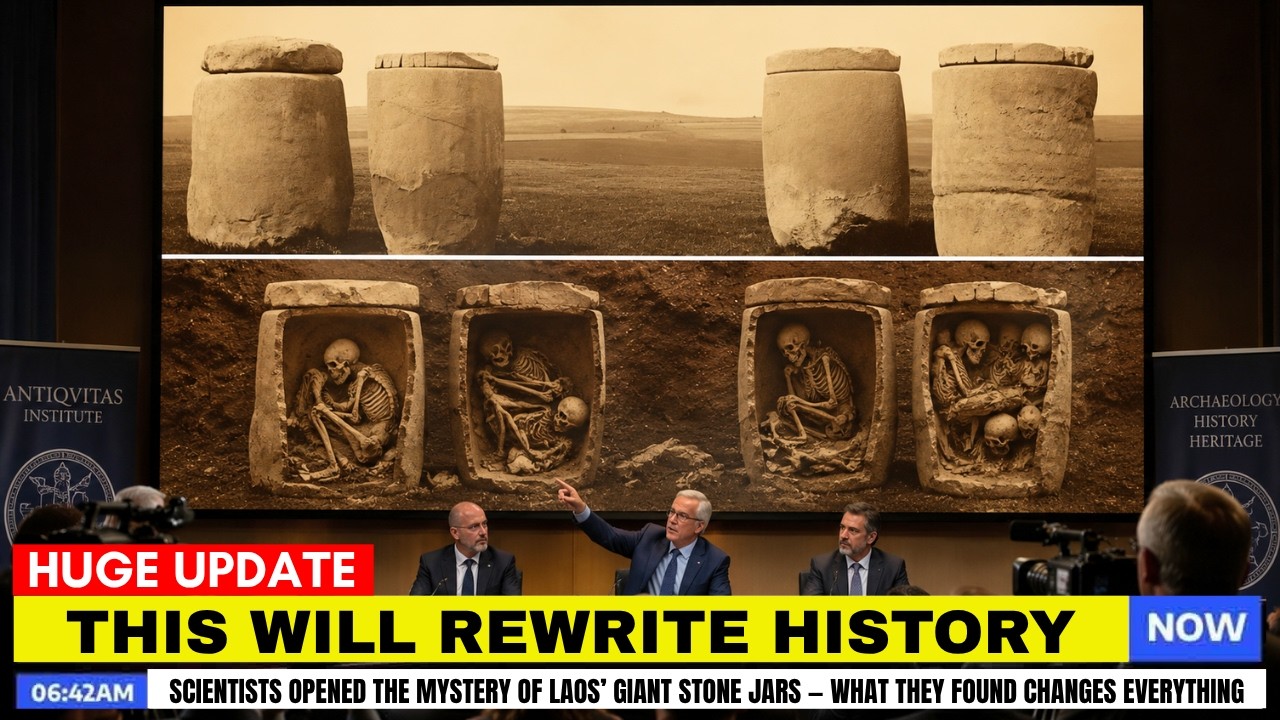
Alongside the remains were burial objects including pottery fragments, stone slabs, an iron knife, a small copper-based bell, and 20 glass beads. Radiocarbon dating placed the interments across roughly 270 years, between approximately AD 890 and AD 1160, indicating the jar was revisited and reused by multiple generations rather than filled in a single event. The individuals ranged from infants as young as 18 months old to adults, representing what researchers describe as an entire community’s worth of ancestors laid to rest together. The disarticulated state of the bones suggests that bodies decomposed elsewhere before being collected and placed in the jar, a practice historically documented throughout Southeast Asia.
A cluster of seven smaller stone jars found about 500 meters away contained no human remains, leading researchers to suggest they may represent an earlier stage of the burial process. This points to a multi-stage mortuary ritual in which the dead passed through different phases before reaching a final resting place in a larger communal jar. The pattern suggests the jar functioned as an ancestral shrine, with families returning repeatedly to place their dead beside relatives who had passed decades or even centuries earlier. The discovery provides the strongest evidence since research began on the Plain of Jars that at least some of these vessels served a mortuary purpose tied to long-term remembrance practices.
The findings were published in 2026 in the journal Antiquity by a team guided by Nicholas Skopal, connected to James Cook University and the Australian National University. The peer-reviewed study confirmed the reliability of the dating and interpretation. The Plain of Jars, a UNESCO World Heritage site since 2019, consists of thousands of carved stone vessels scattered across the highlands of northern Laos. Some weigh more than 30 tons and stand over 10 feet tall, carved centuries ago without modern machinery from sandstone, granite, limestone, and conglomerate.
French archaeologist Madeleine Colani conducted the first major survey in the 1930s, proposing that the jars were linked to ancient funerary practices. She based this on burial pits, carved stone discs, cremated bone fragments, and grave goods found in the surrounding landscape. Her mapping and numbering system remain the basis for archaeological research today. However, decades of excavations produced jars that were mostly empty or contained only fragmentary debris, causing doubt about the funerary theory.
In 1994, research by Professor A. Nitta and Lao archaeologist Bounxay Souliyamkhong suggested the jars might function as commemorative monuments rather than physical containers, since burial pits appeared to have been dug after the jars were placed. Alternative theories persisted, suggesting the jars may have stored food or wine, collected rainwater, or marked military victories. Local legends told of giants brewing rice wine in the jars, colorful tales that added to the site’s mystique but lacked archaeological support.
A major turning point came in 2016 when Australian and Lao researchers launched the Plain of Jars Archaeological Research Project, a comprehensive study combining mapping, GPS data, radiocarbon dating, and geological analysis. The collaboration united experts from the University of Melbourne, the Australian National University, James Cook University, and the University of Otago with Laos’s Ministry of Information, Culture, and Tourism. The survey documented more than 20 previously unknown jar sites, showing the true scale of the tradition extended far beyond the recognized UNESCO property. The project’s early excavations also uncovered remains of at least 18 individuals, mostly infants and children, buried in pits surrounding a well-known site near Phonsavan.
Yet none of the excavated jars themselves contained human remains. Excavations at site 75 from 2022 to 2024 finally changed that, providing what researchers call the closest thing to a “smoking gun” for these monuments. The prolonged reuse of the jar over nearly three centuries implies a communal or family lineage maintained a continual ancestral tradition, returning to the same vessel to honor their dead. The glass beads found with the remains suggest connections extending far beyond the plateau, with similar beads pointing toward trade links reaching South India and Mesopotamia.
This indicates the society was not isolated but engaged in long-distance exchange networks. Despite the breakthrough, many questions remain. The jars themselves are generally dated between roughly 500 BCE and 500 CE, meaning the remains at site 75 date from centuries later. This significant gap suggests many jars may have stood unused for long periods before being incorporated into burial rituals, with the reasons for this delayed reuse unclear.
Researchers also still wonder why some sites contain hundreds of jars while others hold only a few. Differences in social structures, clan territories, or cultural practices may explain the variation, though no definitive answer has emerged. Transportation remains another mystery. Many jars were carved far from their current locations, with geological evidence tracing stone sources to distant quarries.
Moving multi-ton objects across rugged terrain without wheels or draft animals required extraordinary communal effort, but the exact methods, whether rolling systems, wooden sledges, or rope-assisted hauling, remain uncertain. The region itself presents ongoing challenges. The Plain of Jars lies in one of the most heavily bombed areas on Earth due to bombing campaigns during the Vietnam War. Millions of unexploded cluster munitions still contaminate many jar fields, limiting excavation and tourism.
Clearance work is slow and costly, leaving many sites inaccessible decades after hostilities ended. The UNESCO World Heritage designation was shaped by these realities, balancing cultural preservation with the necessity for ordinance clearance. Only a fraction of known jar sites have been thoroughly excavated. Researchers now plan DNA analysis on the recovered remains to determine whether the 37 individuals were related, which could confirm or challenge the idea that the jar served as a family tomb.
Isotope analysis will examine teeth and bones to reveal where the deceased spent their childhoods, potentially showing whether they lived locally or came from distant places. Further radiocarbon dating and broader excavations at other jar sites are planned to understand how widespread and consistent the burial tradition was across the region. Identifying multiple undisturbed jars like the one at site 75 could fundamentally reshape understanding of this ancient landscape. The artifacts, including the iron knife, copper bell, and glass beads, will undergo closer examination.
The imported beads hint at connections reaching thousands of kilometers away, raising questions about the plateau’s role in ancient trade routes. New surveys continue to discover previously unknown jar fields in areas still contaminated by unexploded ordnance, suggesting more discoveries may be waiting beneath the surface. Each new find will help fill gaps in the story and refine research priorities. The combination of archaeological excavation, DNA analysis, isotopic studies, and artifact research promises a multi-dimensional understanding of the Plain of Jars, moving the narrative beyond speculation toward tangible scientific evidence about who these people were and how they honored their dead.
The site 75 discovery remains a proof of concept that detailed insight is possible. The stone giants of Laos, silent for centuries, are finally beginning to reveal the human story they have guarded, one that may grow richer as technology advances and research expands.