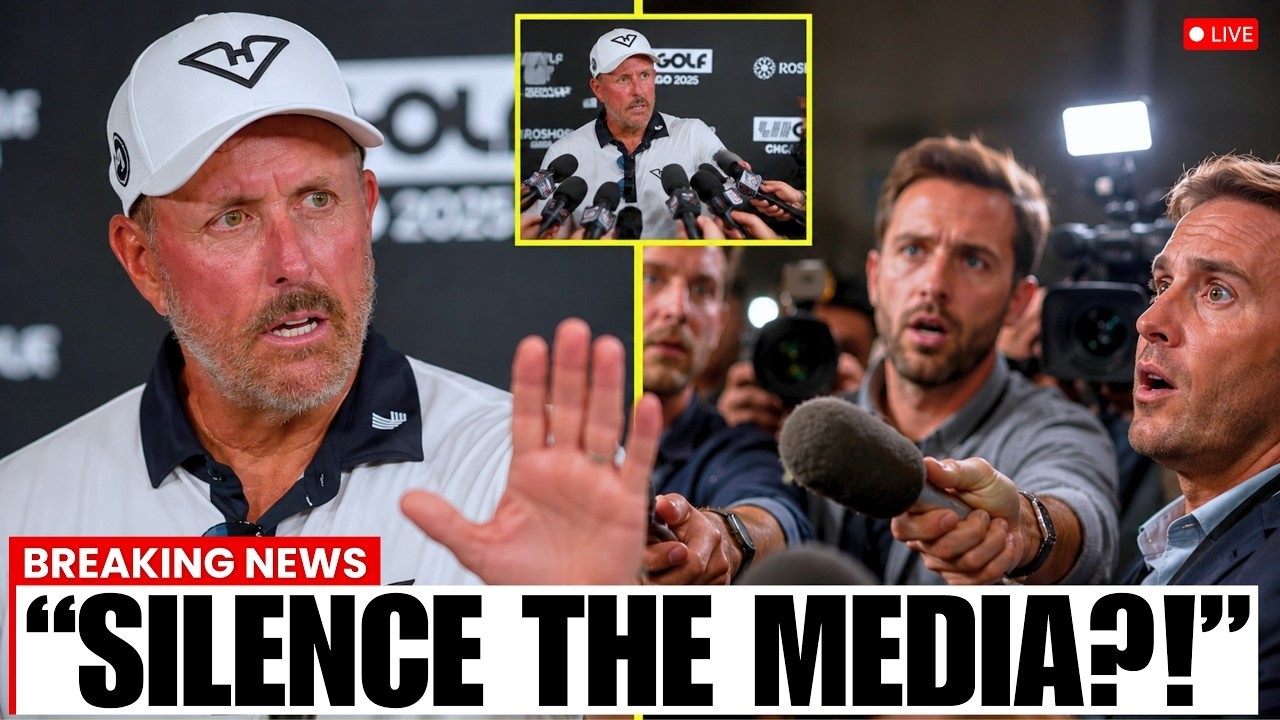
The silence lasted six days, and in the modern news cycle, that is an eternity that can swallow a legacy whole. When Phil Mickelson finally broke his quiet on July 1st, the golf world expected a definitive denial or a dignified retreat. Instead, they got a counterattack so poorly calibrated that it detonated the last shred of his defensive perimeter, leaving the six-time major champion exposed to a firestorm that shows no signs of abating.
The most damaging element was not the accusation itself, but a single word buried in the statement his own legal team drafted, a word that has now become the anchor of every headline written about him.
 The sequence of events began on June 26th, 2026, when journalist Alan Shipnuck published a lengthy, heavily sourced report on the Scratch Golf platform. The report detailed allegations tied to three private clubs in Southern California, naming Ashley Perez, the ex-wife of tour player Pat Perez, as a central figure. It included anonymous sources describing behavior that was difficult to read, and alleged that Mickelson once paid a club employee five hundred dollars to drive his car around a course to fool a phone tracker into showing he was golfing while he was elsewhere.
The report was built on accusation, not courtroom verdicts, but it was sourced and published with the weight of a journalist known for his access to the sport’s inner sanctum.
For six days, Mickelson’s camp offered nothing. No statement, no denial, no context. In 2026, silence is not a neutral act; it is a vacuum that the internet fills with speculation, outrage, and recycled clips.
Every hour of quiet allowed the story to metastasize, transforming from a specific allegation into a broader narrative about a man hiding from accountability. By the time the statement landed, the story was no longer about what happened in June; it was about why the most famous golfer of his generation was unwilling to face the microphone.
When the statement finally arrived, it was not a flat denial. It was an offensive maneuver designed to shrink the story, but it achieved the exact opposite. The report was dismissed as an anonymously sourced drive-by shooting, a phrase critics immediately torched because portions of the story were fully on the record.
The reporter was attacked, whispers of a conspiracy involving PGA Tour interests were floated, and lawyers were engaged to send legal letters. Every move was calculated to intimidate, but every move made the story larger, pulling in news outlets that had never covered a golf scandal before.
And then came the sentence that changed everything. Near the end of the statement, his own team wrote that Mickelson apologizes for his behavior while insisting it should not be read as confirming every claim. That single word, apologizes, became the fulcrum on which the entire defense collapsed.
 It was not a categorical denial. It was not a claim that the events never happened. It was an admission of something, wrapped in a legal disclaimer that tried to preemptively neuter its own impact.
The moment the golf world read that word, the story stopped being about the accusation and became about an apology that was never supposed to count as one.
The backlash arrived in five distinct waves, each one more damaging than the last. The first wave came from the outlet itself, as editor Ben Boskovic went on the record immediately, stating that the publication stood by its reporting, every word. The second wave saw the story escape the sports pages entirely, with BBC, Fox News, USA Today, The New York Post, and The Mirror all picking it up.
Suddenly, people who had never watched a hole of golf had strong opinions about Phil Mickelson, and those opinions were uniformly negative.
The third wave was the most psychologically brutal, as social media split clean in half, but both sides asked the exact same question. If it is not true, why not just deny it? That question, repeated millions of times across platforms, became the drumbeat that drowned out any attempt at nuance.
The fourth wave was the reopening of the archive, as commentators revisited Shinnecock in 2018, where he putted a moving ball on the 13th green and took a two-stroke penalty, and the 2022 split from the PGA Tour. Every past controversy was reframed as a pattern of behavior rather than an isolated incident.
 The fifth wave was the most painful of all, because it came from his own side. Bryson DeChambeau, his teammate on the LIV Golf circuit, defended Phil loudly and at length, insisting on his character and his contributions to the game. But every word of that defense kept the story alive for another news cycle.
The man tried to put the fire out, and every hand that reached for the hose was holding gasoline. The defense did not extinguish the flames; it fed them, providing new angles for talk shows and new quotes for articles.
Weeks later, in August, the situation worsened when an old LIV post resurfaced, showing Phil arguing that LIV would never get world ranking points because of Monopoly rules and television obligations. Outlets hammered the take as laughable, using it to paint him as out of touch with the realities of the sport he once dominated. Three months, and not one clean news cycle.
The man who used to own Sundays on the leaderboard could not buy a quiet Tuesday in the press.
This story is bigger than one golfer, because it illustrates what happens when power meets the press and loses the room. Phil Mickelson spent thirty years teaching fans to believe in impossible shots, from the flop shots over parking lots to the leap at Augusta. The cruelest part of this narrative is that the golf was never the problem.
The handling was. Six days of silence, five escalating moves, and one word that will now follow him in every interview, every broadcast, and every mention, forever.
 Some fans will never forgive him, and some will defend him until the end. Most are stuck somewhere in the middle, sad about the whole thing because they remember the magic and know they will never watch Phil the same way again. That is not a scandal; that is a loss.
Legacies are rarely destroyed by the moment we are attacked. They are destroyed by how we answer. A report landed, and Phil had one job, to own the moment or step away from it.
Instead, his own team handed the world a word that sounded like a confession wearing a lawyer’s suit.
The question now is whether the real mistake was the silence, the statement, or the belief that the internet would eventually just forget. The answer is likely all three, compounded by a fundamental misreading of the public’s appetite for accountability. In an era where every word is parsed and every silence is scrutinized, the old playbook of legal threats and media attacks no longer works.
It only makes the target larger. Phil Mickelson, the most lovable chaos agent golf ever produced, has learned that lesson in the most public and devastating way possible. The story is not over, and it may never be, because the word apologizes does not expire.
It lingers, waiting to be quoted in the next article, the next broadcast, the next mention of his name.