The instinctive recoil you feel at the thought of grilling a lion steak is not a social construct or a passing culinary fad; it is the echo of a survival mandate written into your genetic code over millions of years. While the global food industry has normalized the consumption of cows, pigs, and chickens, the absolute absence of apex predators from our menus is a biological wall, not a cultural preference. This is a story about energy, poison, and the silent evolutionary war that shapes every meal you have ever eaten.
The question is deceptively simple: why do we universally reject the meat of the lion, the wolf, or the tiger? The answer begins with a brutal law of physics known as the 10% rule. When a deer consumes grass, it only retains a fraction of the sun’s energy that the plant captured.
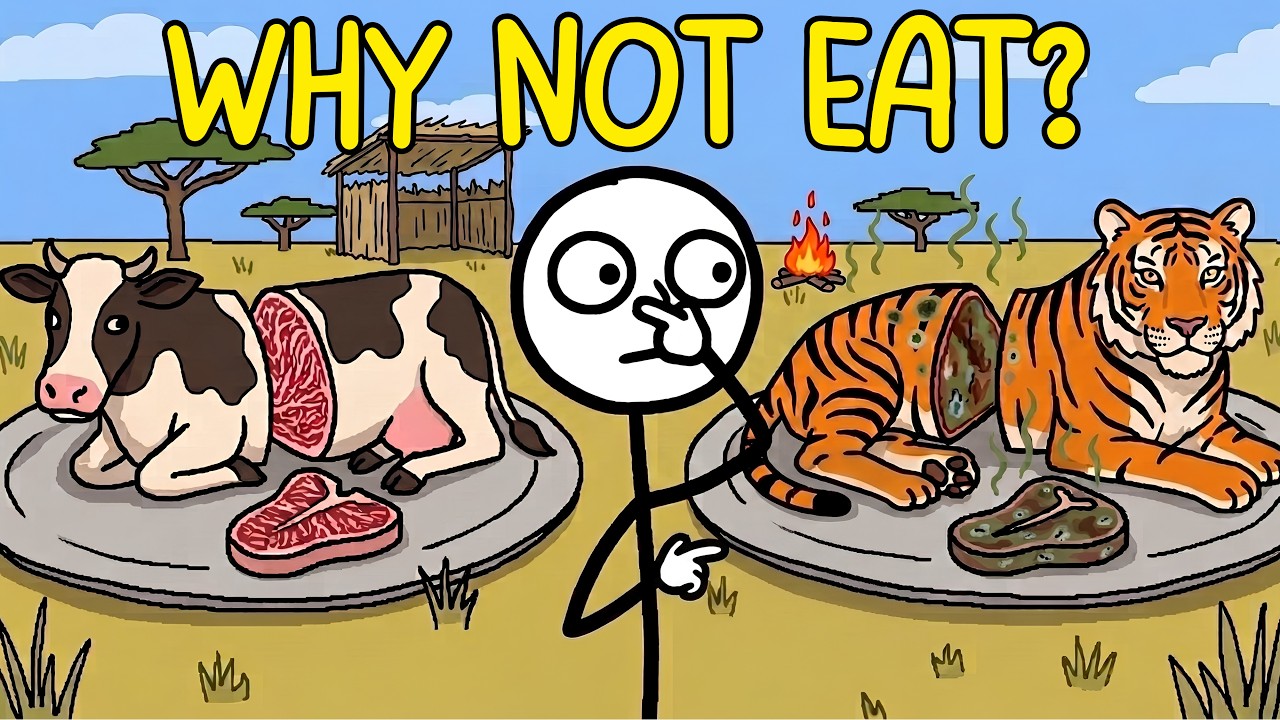 When a lion consumes that deer, it loses another 90% of that energy to heat, movement, and basic metabolic function. The apex predator is, therefore, a biological dead end for caloric efficiency.
This mathematical reality dictated the survival strategies of early humans. A prehistoric hunter facing a 400-pound lion was risking immediate death for a meal that would yield far less usable energy than hunting the herbivore that the lion itself was stalking. The danger was immense, but the caloric return was terrible.
The math was clear: prey animals were the only rational target for a species that needed to conserve energy to survive.
But the energy deficit is only the opening act of this biological 𝒹𝓇𝒶𝓂𝒶. The true danger of predator meat lies in a process called biomagnification, a silent accumulation of toxins that transforms top-tier carnivores into walking toxic waste dumps. Pollutants like heavy metals and industrial chemicals enter the food chain at the microbial level, absorbed by plankton and plants.
These toxins do not disappear; they are stored in the fat tissue of the creatures that consume them.
As smaller fish consume these contaminated organisms, the toxin concentration in their bodies rises. When a larger fish eats thousands of those smaller fish, it inherits all of their accumulated toxins. By the time you reach the top of the food chain, the concentration of mercury, lead, and PCBs is not merely higher; it can be millions of times higher than the baseline in the environment.
Eating an apex predator is effectively consuming a compressed archive of every pollutant in its entire ecosystem.
 The scientific documentation of this phenomenon is chilling. In the 1960s, researcher Charles Wurster observed the collapse of eagle populations around the Great Lakes. The eagles were not being poisoned directly; they were eating fish.
However, those fish had absorbed the pesticide DDT from the entire aquatic food web below them. The toxin concentrated so severely in the eagles that their eggs became brittle and cracked before hatching, driving the species to the brink of local extinction.
This is the invisible load carried by every lion, bear, and orca on the planet. They are living archives of everything they have consumed over a lifetime. While a single bite of lion meat might not 𝓀𝒾𝓁𝓁 you instantly, the chronic accumulation of these synthetic and heavy metal toxins in your own body would be catastrophic.
Your liver and kidneys are simply not equipped to process the biological baggage of a creature that has spent decades at the top of the food chain.
Beyond the chemistry, there is a more immediate biological threat lurking in the muscle tissue of carnivores: parasites. Predators frequently consume raw flesh, and their digestive systems and muscles are host to organisms that have evolved alongside that lifestyle for millions of years. The most notorious of these is Trichinella, a parasitic roundworm that lives in the muscle tissue of carnivorous animals.
When a human consumes undercooked bear meat, a historically documented source of this parasite, the larvae hatch in the intestine and migrate into the bloodstream and muscle tissue. The result is trichinosis, a disease characterized by severe muscle pain, high fever, and swelling. In historical cases, this infection was frequently fatal.
 Every culture that consumed bear meat learned through brutal trial and error that it required extensive cooking, not for flavor, but for survival.
This brings us to the most profound layer of the mystery: the evolutionary psychology of disgust. Researchers like Paul Rozin at the University of Pennsylvania have spent decades studying human food aversion. They discovered that the disgust response to carnivore meat is not learned.
It appears in children who have never been told about toxins or parasites, and it manifests identically across isolated cultures with no shared history.
This is not a coincidence; it is natural selection at work. Our ancestors who felt a gut-level revulsion to predator meat avoided the parasites and toxins that killed those who did not. The individuals who found the idea of eating a wolf unappetizing survived to reproduce.
They passed down that instinctive aversion, hardwiring it into our neural circuitry. That feeling of “wrongness” you experience is the accumulated wisdom of thousands of generations who died so you wouldn’t have to.
The exceptions to this rule prove its validity. Humans do consume predatory fish like tuna and swordfish, but we do so with caution, monitoring mercury levels. We eat alligator and bear, but only with rigorous preparation and an understanding of the risks.
 These animals sit lower on the food chain or are consumed rarely enough that the toxic load remains manageable. The rule is not absolute, but the gradient is clear: the higher the predator, the greater the danger.
The apex predators—the lions, tigers, and orcas—represent the absolute limit of this biological calculus. They have spent entire lifetimes concentrating the chemical and parasitic load of the entire world below them. To consume them is to consume the sum total of their ecosystem’s pollution.
Your body recognizes this threat on a pre-rational level, a defense mechanism so old it predates the evolution of language itself.
The food on your plate today is the result of a million-year-old optimization algorithm. The chicken, the cow, and the salmon are not arbitrary choices; they are the species that sat low enough on the food chain to be safe. They are the survivors of a brutal selection process where the wrong choice meant death by poisoning or parasitic infection.
Your culinary tradition is a testament to the survival logic of your ancestors.
The predators you never consider eating are not just dangerous to hunt; they are dangerous to consume on a cellular level. The entire ecosystem was designed to keep you away from them, and evolution ensured that you would feel that danger as a visceral disgust. The next time you sit down to a meal, remember that you are not just eating food; you are participating in a biological contract that has kept your lineage alive for eons.