For most of human history, the bathroom was not a room. It was a direction—away from the sleeping area, away from the water source, to somewhere private enough that a person could squat and finish the situation without becoming vulnerable to predators. There was no porcelain, no flushing mechanism, no scented air freshener. Yet ancient humans faced exactly the same biological problem modern people do, and their solutions changed more dramatically than almost any other ordinary behavior in history.
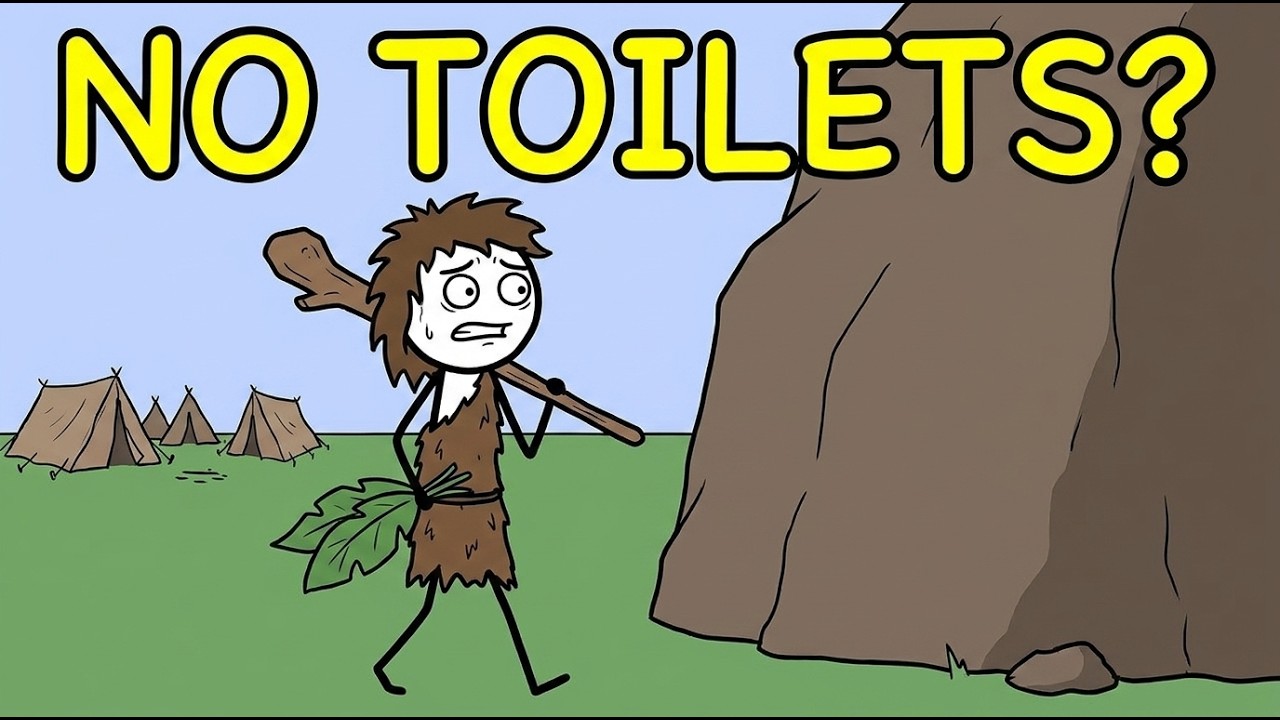
Small hunter-gatherer groups could rely on distance and constant movement. If a camp covered a wide area and relocated regularly, waste could be left beyond the living space to decompose under sun, insects, and weather. This was not perfectly safe—human feces can carry bacteria, protozoa, viruses, and parasite eggs, and rain can wash contamination toward streams—but low population density limited the danger. One person defecating behind a distant tree is a local inconvenience.
Thousands of people doing it around the same settlement for generations is urban planning. Early humans developed practical rules long before understanding microbes. They could see that certain places became foul, notice that drinking downstream from a heavily used camp was unwise, and learn from smell, flies, spoiled water, and repeated illness even when the cause remained invisible. Many communities likely designated informal defecation areas: the edge of a campsite, a patch behind vegetation, a dry cave chamber, a gully, or a place downwind.
Customs varied with climate, terrain, predators, water access, and cultural ideas about privacy and pollution. Archaeologists struggle to reconstruct these habits because open-air defecation rarely leaves a visible structure. Surface feces normally decompose, scatter, or absorb into the soil. Evidence survives mainly under unusual conditions—dry caves, deserts, frozen environments, waterlogged pits, and mineral-rich deposits.
These preserved specimens are called coprolites or paleo-feces, and they are among the most informative objects in archaeology. They reveal what people actually ate, which plants they gathered, which medicines they used, and which parasites lived inside them. Coprolites from Oregon’s Paisley Caves helped provide direct evidence of humans in North America more than 14,000 years ago. Other samples have preserved seeds, bone fragments, pollen, hair, intestinal worms, and even human DNA.
The location of these deposits sometimes suggests that people reused particular areas. At some sites, waste appears clustered away from hearths and activity zones, implying the spot functioned as a designated toilet. At others, it is mixed with ash, bones, and broken tools—evidence that ancient people usually treated feces as ordinary waste, not as an object requiring its own sacred building. As for what ancient people wiped with, certainty collapses.
Soft leaves are the obvious answer, but they rarely survive archaeologically. Moss, grass, bark, animal fur, snow, smooth stones, shells, water, sand, cloth scraps, and bare hands all are possible. Water was probably common where readily available and remains the standard in many societies today. In arid regions, people conserved water and relied on dry materials.
The truth is that no universal prehistoric wiping technique existed; most materials decomposed, and the surviving evidence comes from later societies that manufactured specialized objects. Body position is better understood. The seated toilet posture is relatively recent; for most of history, people squatted. Deep squatting stabilizes the body without furniture and changes the angle between the rectum and anal canal, generally allowing easier defecation.
The human body arrived with a built-in toilet stand. Civilization later added a chair and convinced everyone to fold themselves at 90 degrees. Privacy is harder to reconstruct. Modern assumptions that ancient people never cared who saw anything are wrong in many cultures.
Ideas about shame, modesty, gender separation, danger, and ritual purity can exist without walls. Someone might leave camp alone, walk in groups for safety, or use different places by gender. Sick, elderly, or pregnant individuals might require assistance at night, when bad weather, injury, or predators made a short trip into darkness dangerous. In such cases, a container near the shelter—any basket lined with absorbent material, ceramic vessel, wooden container, or shallow pit—could serve temporarily until the contents were dumped outside.
Then humans began to settle. Agriculture created permanent villages, larger populations, domesticated animals, stored food, and a completely new relationship with waste. Hunter-gatherers could leave a contaminated campsite; farmers had fields, houses, and grain stores and needed to stay. At Çatalhöyük in modern Turkey, thousands of people lived in a dense settlement beginning around 9,000 years ago.
Houses were packed together with rooftop entrances and few streets between them. No household toilets from the early period have been identified; human waste appears to have been deposited in outdoor middens—large dumping areas containing food refuse, ash, animal dung, broken objects, and feces. Residents may have walked to these areas or used containers emptied later. This created organization, not safety.
Researchers examining preserved feces from Çatalhöyük discovered eggs from human whipworm. Whipworm spreads when eggs passed in feces mature in soil and are later swallowed through contaminated food, water, or hands. The parasite’s life cycle depends on a human accidentally eating microscopic evidence of another human’s bathroom visit. Dense settlement made that easier.
Waste lay near houses, people handled food nearby, children played around living areas, domesticated animals added their own feces, and flies moved freely. This was part of a larger transformation sometimes called the Neolithic disease transition. Eventually, people began constructing dedicated toilets. Some of the earliest known examples appeared in Mesopotamia during the 4th millennium BCE—seats or platforms positioned over pits, drains, or vertical shafts.
Waste might fall into a cesspit lined with pottery rings or brickwork, allowing liquids to seep into the ground while solids accumulated. This resembles a primitive septic system. In some homes, toilets connected to drains that carried waste toward larger channels; others emptied into pits that had to be cleared manually or abandoned when full. Technology varied by wealth and location.
An elite household could afford a private installation; poorer residents used containers, shared spaces, or the edges of settlements. The Indus civilization developed some of the ancient world’s most extensive urban drainage systems. Cities such as Mohenjo-daro and Harappa contained planned streets, wells, bathing areas, covered drains, and household wastewater channels. Many homes had washing platforms; some contained small rooms interpreted as toilets where waste passed through vertical chutes into street drains or collection containers.
Brick-lined channels moved water away from houses, and access openings allowed sections to be cleaned. Sanitation features appeared throughout residential neighborhoods, not just in palaces, but the system still required constant maintenance, and a covered channel does not become hygienic through architecture alone. In Scotland, the Neolithic settlement of Skara Brae had stone-lined drains running beneath its houses more than 4,000 years ago, with small cells connected to them sometimes interpreted as indoor toilets. The interpretation is plausible but not certain; a drain proves that people deliberately moved liquid through the settlement but does not automatically prove a flushing toilet in every house.
Still, Skara Brae demonstrates that Neolithic communities engineered water flow beneath domestic spaces. Humans were no longer merely choosing where to deposit waste; they were altering the landscape to carry it away. Ancient Egyptian toilets ranged from simple containers to stone or wooden seats positioned over removable vessels. Some wealthier homes possessed limestone toilet seats with a sand-filled container beneath that could be emptied later.
Ordinary Egyptians probably relied on pots, outdoor locations, or simple pits. Every non-flushing toilet creates the same final question: who empties it? The answer was usually someone with less power. Servants, enslaved workers, laborers, and low-status waste collectors carried containers, cleaned pits, and moved sewage beyond wealthy households.
Ancient sanitation did not eliminate contact with feces; it transferred that contact down the social hierarchy. The toilet could be private for the person sitting on it because the unpleasant part of the system happened afterward to someone else. In Iron Age Jerusalem, stone toilet seats found in elite estates indicated wealth, since a dedicated toilet was not standard for every family. Sediments beneath two toilets dating to roughly the seventh and early sixth centuries BCE contained evidence of Giardia, along with earlier findings of roundworm, whipworm, tapeworm, and pinworm.
These were people with proper seats, and they still suffered from organisms spread through fecal contamination. The lesson appears repeatedly: a toilet is not the same as sanitation. A toilet gathers waste; sanitation safely separates that waste from human contact, drinking water, food, insects, soil, and crops. If a cesspit leaks beside a well, the user enjoys a comfortable seat above an invisible disaster.
The Greeks and Romans pushed communal toileting into a more social form. Many Roman cities contained public latrines with rows of stone or wooden seats positioned over channels, commonly without individual partitions. Water moving beneath them carried waste toward drains or sewers, while a shallow channel near the user’s feet may have provided water for cleaning. Privacy was limited; a visit could involve conversation, business, gossip, and jokes.
Romans did understand privacy—private chamber pots and household toilets existed—but public latrines were shared spaces within a culture that drew social boundaries differently. Some were elaborate, with marble seating, painted walls, statues, columns, and fountains. The system had serious weaknesses: not every latrine connected to a continuously flowing sewer, some emptied into cesspits, drains could block, sewers could back up, and decomposing material produced gases including methane and hydrogen sulfide. Popular history often presents the Roman sponge on a stick—a sea sponge attached to a wooden handle, rinsed and handed to the next user—as communal toilet paper.
The object is called a xylospongium or tersorium. The evidence for its exact use is ambiguous. Ancient texts mention sponge-tipped sticks, but some scholars argue they may have functioned like toilet brushes, cleaning the latrine surface rather than the person. No complete Roman sponge stick has survived with an instruction manual; the wooden handles and organic sponges decomposed.
Romans may have used water, wool, cloth, or leaves instead. The shared sponge remains possible but should not be treated as a confirmed empire-wide subscription service. Ancient Greeks and Romans may also have used smooth pebbles or rounded pieces of broken pottery known as pessoi. Some ceramic fragments carried the names or images of disliked individuals, allowing users to combine personal hygiene with political commentary.
Medical texts recognized that harsh wiping materials could cause irritation, making ancient bathroom humor revolve around a genuine strategic decision: clean thoroughly, but remain on speaking terms with your own skin. In ancient China, archaeologists found more direct evidence of specialized hygiene tools. At a roughly 2,000-year-old relay station on the Silk Road, researchers examined wooden or bamboo sticks wrapped with cloth. Preserved fecal material remained on them, confirming they had been used for anal cleaning.
Microscopic analysis revealed eggs from several intestinal parasites, including Chinese liver fluke—a parasite that normally occurs far from the dry region where the sticks were found, suggesting an infected traveler carried it along the Silk Road. A person ate contaminated raw or undercooked fish in one region, became infected, traveled hundreds of kilometers, used a latrine, and unknowingly left archaeologists evidence of ancient globalization. Trade routes moved silk, spices, ideas, religions, and worms. After collection, waste could still become useful.
Human feces contain nitrogen, phosphorus, and other nutrients valuable to crops. Many societies transported night soil from towns to fields as fertilizer, sometimes mixed with ash, soil, straw, or animal manure. This created a nutrient cycle—food entered the city and waste returned to farmland—but it was biologically dangerous. If feces were applied without sufficient composting, parasite eggs and pathogens could survive, and vegetables grown in contaminated soil could return them to humans.
Waste removal improved the smell of urban neighborhoods while distributing infection through agriculture. Humans had invented recycling before discovering why some materials require additional processing. Ancient sewers faced the same contradiction. The Romans built aqueducts, baths, drains, public toilets, and large sewers; the Cloaca Maxima carried water and waste through Rome.
This infrastructure managed flooding and made dense urban life more practical, but archaeological studies have not found a clear collapse in intestinal parasites under Roman rule. Whipworm and roundworm remained common, and warm communal bath pools could collect oil, dirt, sweat, and microorganisms. Public infrastructure can improve comfort without eliminating disease when nobody understands the fecal-oral route, germ theory, parasite life cycles, or water treatment. Romans could move sewage magnificently; they could not see what remained on fingers, food, flies, and shared water.
This is why the history of the bathroom is not a simple march from dirty caves to clean cities. Small mobile groups sometimes enjoyed a natural sanitary advantage because they produced little concentrated waste and frequently left. Early settlements created bigger disease risks; toilets improved convenience and privacy but concentrated contamination; drains moved the problem, often toward rivers used by downstream communities. The bathroom became more advanced before the science did.
Ancient humans were not stupid or comfortable living in filth. They recognized smell, disgust, pollution, and the need to separate waste from daily life. Many societies developed rules and linked excrement with ritual impurity. What they lacked was knowledge of microscopic transmission.
A river could look clean while carrying disease; a well could taste normal after contamination; a luxurious toilet could sit above an infected cesspit. The danger was invisible, patient, and very small. Even so, the solutions ancient people created were remarkable. They dug designated pits, carried chamber pots through dark houses, laid brick drains beneath streets, shaped seats from stone and wood, developed washable cleaning tools, employed workers to empty cesspits, returned waste to farmland, and constructed sewers large enough for a person to enter.
Every stage was an attempt to answer the same question: how do thousands of humans live together without drowning in the biological consequences of being human? Using the bathroom has two separate parts. The first is removing waste from sight; the second is making it harmless. Ancient civilizations became very good at the first.
The second required microbiology, protected water supplies, sewage treatment, plumbing traps, ventilation, handwashing, and the radical idea that clean-looking water may contain things capable of killing you. Modern sanitation turned the bathroom from a physical place into an invisible network. Press one handle, and carefully treated water carries everything into a hidden system maintained by people you will probably never meet. The final luxury is not the ceramic seat, the paper, or the lock on the door; it is the ability to finish, flush, and immediately stop thinking about where any of it goes.
Ancient humans never had that privilege. Their waste remained near enough to smell, carry, bury, reuse, step around, or discover returning through contaminated water. Beneath every polished toilet is the same ancient solution, expanded across an entire civilization: keep human waste away from humans.
A simple rule—it only took thousands of years and an astonishing amount of evidence left in old pits to understand how far away was far enough.