Every nerve signal in the human body runs on sodium—every movement, heartbeat, and sensation depends on it. The body cannot produce sodium on its own and has zero tolerance for running out. If blood sodium drops too far, cells absorb water and swell, the brain is affected first, and the result can be confusion, seizures, and death. Salt is as non-negotiable to the body as oxygen.
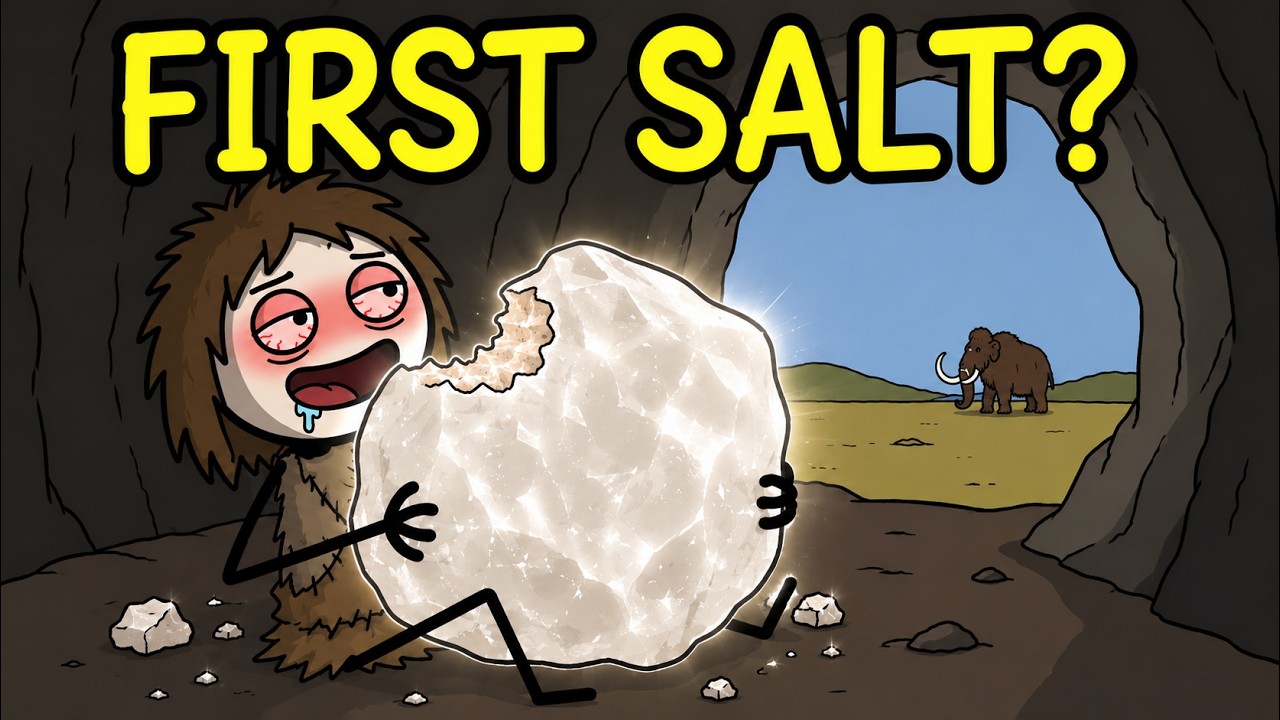
For roughly three million years, no human had to go looking for salt. Early hunters got a steady supply from meat, since animal blood is nearly identical to seawater in sodium concentration. A single large kill covered an entire group’s needs without anyone consciously noticing. Salt was simply already there, silently satisfying a craving baked into the nervous system.
Everything changed around 10,000 years ago with the advent of farming. Diets shifted from being 60 to 80 percent animal-based to being built primarily on grain—wheat, barley, and millet. These crops are edible, but they are not salty. Pre-agricultural humans consumed an estimated 768 mg of sodium per day; a grain-based diet could drop that by close to 90 percent almost overnight.
The craving that had run invisibly for millions of years suddenly had nothing to work with. Agricultural communities had to actively seek salt out, and their method of discovery was not particularly flattering. They followed animal tracks. Herds of elephants and deer will walk miles to mineral-rich springs where sodium leaches out of the ground.
Early farming groups noticed these trails, followed them, and tasted whatever the animals were licking. The deer did not know why it went there, and neither did the people following it, but the result was the same: deliberate salt discovery. Some of the earliest evidence of salt processing dates to around 6,000 BC, when people in present-day Romania boiled spring water to extract salt. Archaeologists found remnants of a brine boiling operation at Poiana Slatinei.
The method was simple: fill a clay pot with spring water, apply fire, wait for the water to evaporate, and collect the crystals. Someone figured this out around 8,000 years ago and accidentally changed what a human settlement could become. Salt was now portable—producible in one location, stored, and traded. The earliest known salt harvesting is also believed to have occurred at Lake Yuncheng in the Chinese province of Shanxi around the same period.
These populations had never heard of each other but arrived at the same method independently. Salt also unlocked food preservation. Sodium draws moisture out of foods, drying them and making it possible to store meat without refrigeration for extended periods. The ancient Egyptians were the first to realize this potential, and they applied the same chemical principle to the dead.
They used natron, a naturally occurring salt compound, to preserve human bodies, packing them in the mineral for 40 days to mummify them. It worked on the same principle as salting fish; the Egyptians just applied it to royalty. By the time writing was invented, salt had already restructured the ancient world. The first roads built by the Roman Empire were built to transport salt.
The Via Salaria, a 240 km road from Rome to the Adriatic coast, was one of many ancient salt roads in Europe. The word “salary” descends from the Latin “salarium,” a term that originated in the Roman military. Roman soldiers needed salt to preserve their meals on campaign, and the salarium became their regular payment. Historians still debate whether soldiers received actual salt or a cash allowance to buy it, but the link between salt and compensation permanently shaped how we talk about earning a living.
The word “salad” also derives from Romans salting their greens and calling it “herba salata. ” Sauce and sausage trace back to the Latin “sal. ”
The most revealing evidence of how much ancient humans reorganized their world around salt belongs to a settlement in what is now northeastern Bulgaria. The prehistoric complex of Provadia—named Solnitsata, which translates directly to “the salt works”—hosts the remains of the oldest salt production center in Europe, with activity from 5,500 to 4,200 BC.
It was not built near a river, a fertile plain, or a military choke point. It was built on top of the only rock salt deposit in the entire Eastern Balkans. Three successive stone fortification systems were built around the settlement, effectively making it the first European mint. They built walls around their salt.
Production at Solnitsata increased from 25 kg per kiln load at 5,500 BC to 4,000 to 5,000 kg by 4,700 to 4,500 BC. Archaeologists believe this salt trade revenue explains something that had puzzled researchers for decades. The Varna Necropolis, located roughly 70 km away and dating to around 4,300 BC, contains over 3,000 gold objects—currently recognized as the oldest confirmed gold treasure in human history. The prevailing explanation is that the wealth buried there came from salt trade.
The first gold in human history was purchased with salt, not military conquest or agricultural surplus. Perhaps the most uncomfortable evidence of what ancient salt work physically looked like comes from a mine in the Austrian Alps. An axe made from staghorn dating from 5,000 BC showed that miners were already trying hard to extract salt from Hallstatt, making it the oldest operational salt mine in the world. What makes Hallstatt distinct is what the salt preserved inside it.
In 1734, a miner working an active salt tunnel came upon a human body preserved in the rock. The corpse was wearing Bronze Age clothing and carried Bronze Age tools. Salt had kept it intact for 3,000 years. Because of the preservative nature of the salt, implements, parts of clothing, and even the bodies of miners have been discovered.
In 2002, archaeologists discovered a wooden staircase deep within the mine dating to 1,344 BCE—the oldest wooden staircase in Europe. Miners used specialized cowhide and wooden frame backpacks designed to distribute the weight of 30 kg salt blocks across the hips and shoulders. Some of them died anyway, and the salt kept their bodies. Preserved human feces found in the mine showed that 91% of samples from both the Bronze Age phase (1158 to 1063 BCE) and Iron Age phase (750 to 662 BCE) contained intestinal parasite eggs.
The miners were working underground in the dark, carrying 30 kg of salt on their backs while infected with worms, in a mountain where accidents would preserve you perfectly until an 18th-century miner found you. The ancient world did not have a comfortable relationship with salt—it had a desperate one. Every crystal tapped out of a shaker traveled a longer road than almost anything else in a modern kitchen. Someone in Romania boiled spring water for it 8,000 years ago.
Someone in Bulgaria built stone walls around a kiln to protect it. Someone in Austria carried it up a staircase on their back until the mountain came down on them. That chain of effort, running from a Neolithic brine spring to a Bronze Age mine shaft, built the infrastructure of civilization long before anyone wrote it down.


