The molecular flags on your red blood cells are not a biological footnote or a hospital formality; they are a 20-million-year-old war record, etched into the most abundant cell in your body by parasites, plagues, and the ghosts of extinct human species.
This is the startling conclusion of a new wave of genetic and anthropological research that has finally answered a question so basic it has been largely ignored: why do humans have different blood types at all? The answer, emerging from studies of ancient DNA, primate genetics, and modern epidemiology, is that the A, B, AB, and O system is not a random biological quirk. It is a sophisticated, ancient defense mechanism, honed by an invisible war that has been raging inside our circulatory systems since long before our genus Homo even existed.
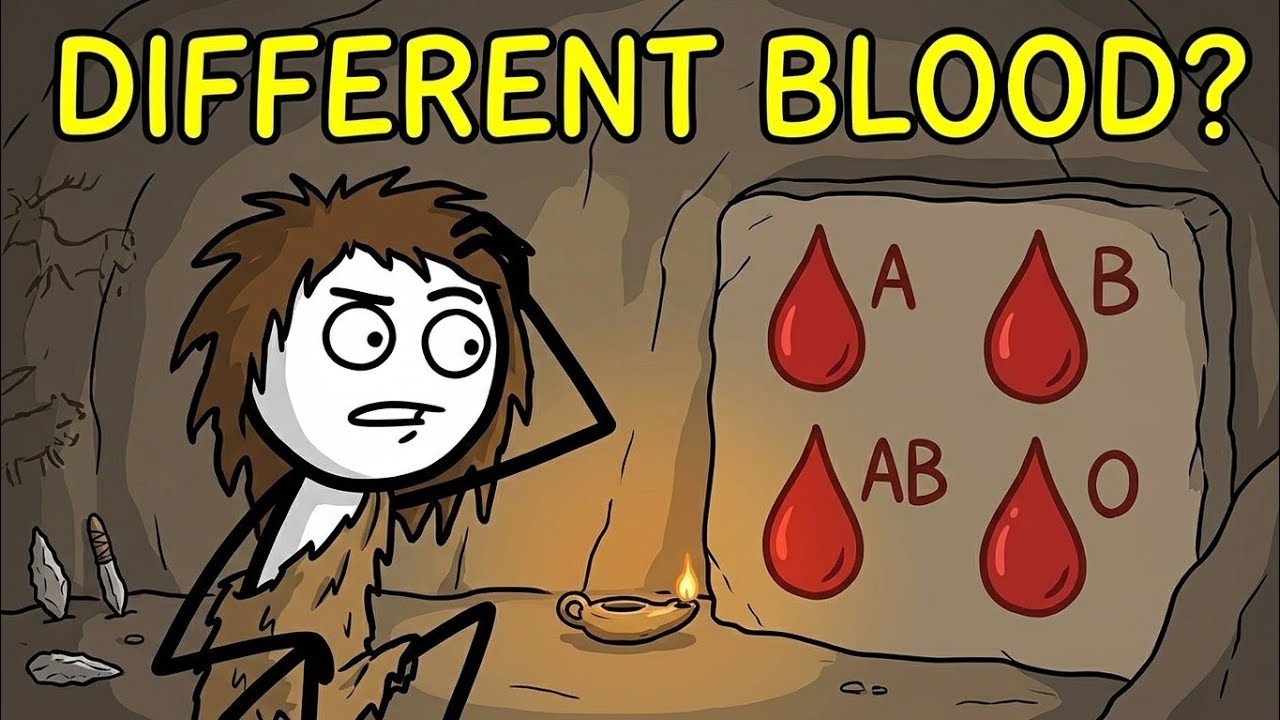 The revelation that blood type diversity is a survival strategy, not a medical inconvenience, is forcing a radical rethink of human evolution. It suggests that the very blood coursing through your veins is a direct inheritance from a common ancestor that lived 20 million years ago, and that its specific configuration was dictated by the pathogens that tried to 𝓀𝒾𝓁𝓁 your ancestors.
The story begins not in a laboratory, but in the deep evolutionary past. A landmark genetic study published in the Proceedings of the National Academy of Sciences by researcher Laura Segurel and her colleagues at the University of Chicago has provided irrefutable evidence that the A and B blood group variants did not evolve independently in different primate species. Instead, they were inherited from a single, shared ancestor that lived roughly 20 million years ago.
By comparing a specific stretch of DNA within the blood type gene across humans, chimpanzees, bonobos, gorillas, orangutans, and multiple monkey species, the team traced the evolutionary relationships of those sequences back through the primate family tree. The conclusion was unambiguous: the A and B blood groups are a shared, ancient capability that has been maintained across tens of millions of years of independent evolution.
This means your blood type is older than Homo erectus. It is older than the split between the human and chimpanzee lineages that occurred roughly 6 million years ago. It has been running continuously inside primate bodies for longer than most mammalian species currently alive on Earth have existed.
But the most profound implication is this: if these variants have been maintained for that long, across that many species and environments, they must be doing something critically important. Evolution is relentlessly practical. Molecular features that cost energy to produce and provide no survival advantage are eliminated.
They do not persist for 20 million years out of inertia.
The purpose of this ancient molecular machinery is now clear: it is a defense system against pathogens. The immune system maintains a precise internal registry of what is self and what is not self. Anything bearing unrecognized molecular flags is treated as a potential invader and attacked.
Your blood type antigen is registered as self from the very beginning of your immune development. But here is the critical consequence: your immune system automatically generates antibodies against the flags it does not carry.
If you are type A, your immune system produces anti-B antibodies, standing soldiers permanently on guard against type B antigens. If type B blood enters your system, those antibodies launch an immediate, potentially fatal attack. This is the core machinery of transfusion medicine.
But the immune system did not evolve this aggressive capability because it was anticipating surgical procedures. It was preparing for something far older and more dangerous: pathogens.
 Many parasites, bacteria, and viruses carry molecules on their own outer surfaces that bear a structural resemblance to the antigens displayed on human red blood cells. This creates one of the most elegant, ruthless games of molecular mimicry in nature. If a pathogen’s surface molecule looks sufficiently like a type A antigen, a person with type A blood is at a serious disadvantage.
Their immune system has been trained since before birth not to attack type A antigens, so when a pathogen arrives wearing a convincing type A disguise, the immune system hesitates. The pathogen gets a potentially decisive free pass.
However, a person with type O blood has never made that concession. They carry anti-A antibodies constantly, and when they encounter that same pathogen wearing a 𝒻𝒶𝓀𝑒 type A disguise, there is no hesitation. The attack is immediate.
Different pathogens, different mimicry, and different vulnerabilities. This is the hypothesis at the core of blood type evolution: blood type diversity persists because it creates population-level immune diversity. In a world where pathogens are constantly shifting their surface molecules to evade detection, a population with varied blood types is harder to completely devastate than a population where everyone has the same blood type.
The clearest and most rigorously studied example of this dynamic in action is malaria, specifically Plasmodium falciparum, the most lethal malaria parasite species. The parasite has a particularly vicious survival strategy called rosetting. When the parasite infects red blood cells, those infected cells begin sticking to uninfected red blood cells, clumping into clusters called rosettes.
These rosettes can obstruct the tiny blood vessels of the brain, causing cerebral malaria, one of the most deadly complications characterized by coma, seizures, and death.
The parasite constructs these rosettes using the antigen molecules on the surface of red blood cells as structural anchors. Specifically, the A and B antigen structures help hold the rosettes together, making them larger, stickier, and more obstructive. Type O red blood cells do not carry those antigen structures, making the rosettes smaller, less cohesive, and more likely to break apart.
A rigorous matched case-control study of 567 Malian children found that type O blood was present in only 21% of severe malaria cases, compared to 44 to 45% among children with uncomplicated malaria and healthy controls. This translates to a 66% reduction in the odds of developing severe malaria if you are type O.
This massive life-or-death survival advantage, played out across thousands of generations in the malaria-endemic regions of sub-Saharan Africa, is likely one of the primary reasons type O is both the oldest major blood type variant and still the most globally common blood type today. Type O did not win because it was the superior blood type in some universal sense. It became dominant because the most dangerous parasite in the ancient African environment happened to be significantly worse at killing people who had it.
 But the story becomes considerably more complex as humans migrated out of Africa. A study published in Scientific Reports examined genetic data from 22 ancient Homo sapiens individuals who lived between 46,000 and 16,500 years ago, alongside DNA extracted from 14 Neanderthal specimens. The researchers traced how blood group genetic variation shifted as these populations moved.
They found that the process was not passive. As human populations entered new environments, they encountered new pathogens, and the blood type variants that were advantageous in those new environments were selected for, sometimes rapidly.
The study identified a crucial bottleneck and diversification period on the Persian Plateau, a broad highland region between the Zagros Mountains of modern Iran and the surrounding areas. Genetic and archaeological evidence points to a population of early Homo sapiens who, after leaving Africa, spent roughly 15,000 years there. This was a genetic incubator, a pause in the outward migration where both random genetic drift and local selective pressures had time to generate new diversity before populations pushed further into Eurasia.
This pattern repeated itself further along the migration routes. When populations moved into East Asia, into northern Europe, into South and Southeast Asia, each new environment brought new pathogen pressures. The blood type frequencies shifted to reflect local realities.
Today, type O dominates globally because malaria shaped early humans before they left Africa. Type A is most common in Central and Northern Europe, where the disease landscape selected for something other than the anti-malaria advantage of type O. Type B forms a distinctive geographic belt stretching from northern India through Central Asia and into northern China.
Every cluster on the blood type map is a fingerprint of ancient disease, a geographic record of survival pressed into the population’s DNA.
And then there are the Neanderthals. Thanks to advances in ancient DNA extraction and sequencing, researchers have now successfully decoded the blood type genetics of several Neanderthal individuals. The findings, published in PLoS One by a team at Aix-Marseille University, revealed a darker story.
While Neanderthals had type O and carried alleles producing A and B variants, their Rh system was peculiar. They encoded partial forms of the RH antigens, antigen structures that were missing specific molecular components present in the complete wild type forms found in most modern humans.
Partial antigens are immunologically problematic. A person who carries a partial antigen can sometimes generate an immune response against the complete version of that antigen. For Neanderthals living among other Neanderthals, all carrying the same partial RH variants, this likely was not a problem.
 Then modern Homo sapiens arrived. They began interbreeding with Neanderthals. Suddenly, Neanderthal mothers were potentially carrying hybrid fetuses that had inherited complete RH antigens from their Homo sapiens fathers, antigens the Neanderthal mothers’ immune system might partially read as foreign and attack.
Pregnancies failing. Hybrid offspring dying. Reproductive success among Neanderthals, already stressed by competition and possibly by climate change, crashing further.
The Neanderthals’ blood types were not just different from ours. They may have been part of the reason interbreeding with us was ultimately more dangerous for them than for us.
The same trade-offs that played out in ancient environments are still running inside modern human bodies. Type O protects against severe malaria but creates elevated vulnerability to severe cholera. A gastrointestinal outbreak in Scotland in 1996 found that 87.
5% of patients who died were type O. Type A individuals face elevated risk from certain cardiovascular conditions and some cancers. The associations keep accumulating in medical literature, from blood type and COVID-19 severity to blood type and gastric cancer rates.
Your blood type is not a solved story. It is an ongoing one. Every red blood cell in your body carries on its surface a molecular record of your ancestors’ worst enemies.
The specific antigen flags on those cells were shaped across millions of years by the parasites that killed people who had different flags, by the plagues that swept through ancient populations and left behind only the people whose blood happened to be the wrong target, by the migrations across land bridges and through disease incubators on ancient plateaus, and by the interbreeding events between species whose blood was incompatible in ways that echo faintly even now.
The reason ancient humans had different blood types is the same reason you have the blood type you have. Because in some environment, at some point in your lineage’s history, the specific combination of molecular flags on your red blood cells was what the most dangerous pathogen of the moment was worst at attacking. Your ancestors carried that combination.
They survived when others did not. They had children. The flags passed forward.
Your blood type is a 20-million-year-old record of survival compressed into the surface of the most abundant cell in your body.