A 2009 genetic study reconstructed the family tree of the Spanish Habsburgs, tracing roughly 3,000 relatives across 16 generations, and calculated the inbreeding coefficient for each king. Charles II, the last of the line, scored a staggering 0. 254—a figure higher than that of a child born from a brother-sister union. His parents were uncle and niece, but his score was amplified by two centuries of the dynasty repeatedly marrying close relatives, stacking loop upon loop of shared ancestry.
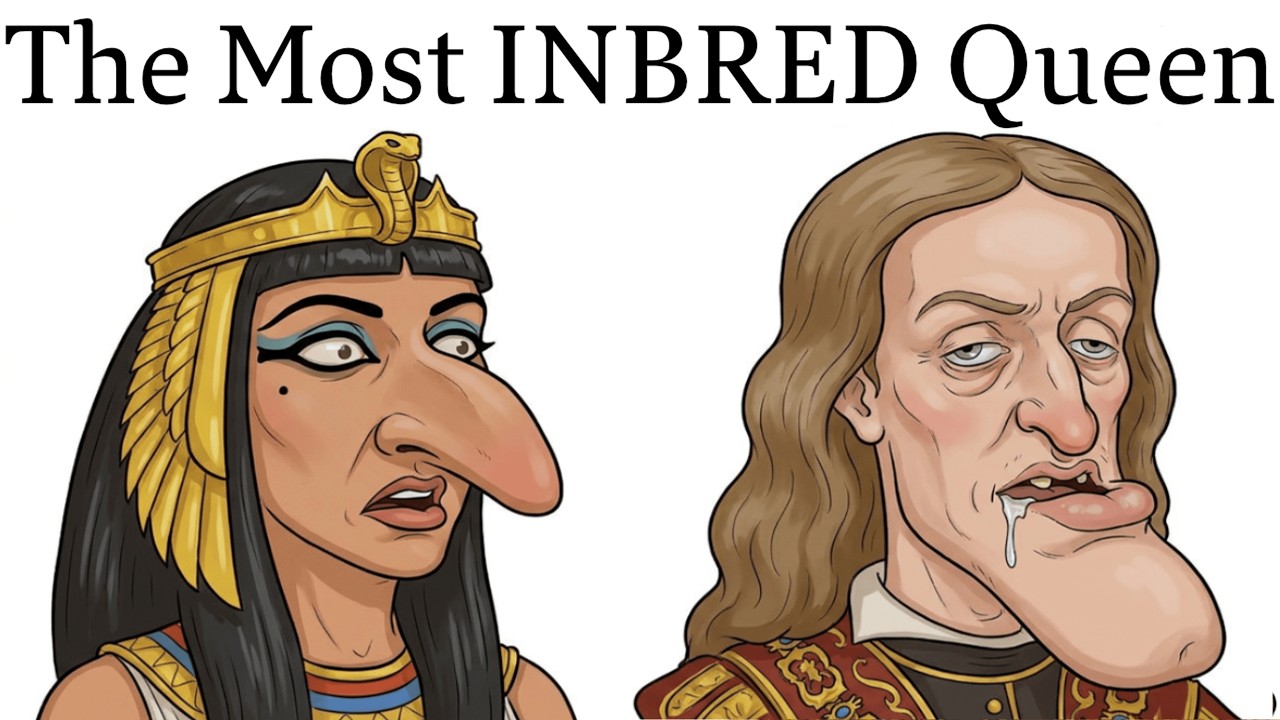
The Habsburgs embraced this strategy deliberately, viewing themselves as the pure Catholic defenders of Europe. The result was the infamous “Habsburg jaw,” a protruding lower jaw and heavy lip visible across generations of royal portraits. A 2019 study analyzing those paintings confirmed the link: the worse the jaw deformity, the higher the individual’s inbreeding coefficient. Charles II, known as “the Bewitched,” bore the genetic brunt of this policy.
He could not chew properly or speak clearly, walked late, suffered constant illness, and produced no heirs. Geneticists believe he carried two recessive disorders that only surface when parents share a recent ancestor. The toll was deadly for the dynasty overall: only about half of Habsburg children survived to age ten, while roughly 80% of children in nearby ordinary villages did. When Charles died in 1700, his doctors performed an autopsy, partly because they still suspected sorcery.
The resulting account was gruesome and exaggerated—claiming a heart the size of a peppercorn and a head full of water. His death without an heir ended the Spanish Habsburg line and triggered the War of the Spanish Succession. This is where Cleopatra enters the comparison. Her family, the Ptolemaic dynasty, took inbreeding much further than the Habsburgs.
For nearly 300 years, they married full siblings as official policy, not scandal, to imitate the gods, keep power internal, and preserve their Greek bloodline. The dynasty founder’s descendants turned sibling marriage into a house style, with some rulers marrying their sisters and even their own daughters. Cleopatra’s father was Ptolemy XII, known as “the Flute Player. ” Her mother, however, remains a genuine historical mystery.
A woman named Cleopatra V, wife of Ptolemy XII, disappears from all records shortly after Cleopatra’s birth. Historians cannot even confirm her exact relation to her husband—she may have been his full or half-sister, or a cousin. This single missing link prevents a definitive calculation of Cleopatra’s own coefficient. An online figure of 0.
45, or 45%, is often cited for Cleopatra. That number is not from a peer-reviewed study. It comes from amateur reconstructions that assume the worst-case scenario and stack every known Ptolemaic incestuous marriage on top. It is a plausible ceiling, but not a measured fact.
Charles II’s 0. 254 rests on a complete, verified family tree; Cleopatra’s rests on a guess about a mother who vanished from history. She left no tomb and no DNA for modern science to settle the question. The honest conclusion is that Cleopatra’s family was more inbred than Charles II’s.
The Ptolemies used a far more concentrated method, sibling marriage as a default, for a longer period. Whether she personally surpassed his exact score depends on her mother’s identity, which remains unknown. If her parents were full siblings, she likely outscored him by a comfortable margin. If they were cousins, she may not have.
Yet here is the striking contradiction: Cleopatra should have been a wreck. She was the opposite. Ancient sources, even critical ones like Plutarch, describe her as mesmerizing and brilliant. She reportedly spoke many languages, was the first of her Greek dynasty to learn Egyptian, and held her kingdom independent while Rome swallowed everything around it.
She allied with Julius Caesar and Mark Antony, bore four children, and ruled with ruthless effectiveness. Her portraits show a strong, formidable face, not a broken one. Several theories could explain this. A high inbreeding coefficient is only a probability of harm, not a guarantee; she may have simply drawn a better genetic hand.
Another brutal idea is “genetic purging,” where lethal gene combinations are repeatedly exposed and eliminated over generations, leaving a survivor line already filtered of its worst flaws. Or her mother may simply not have been a close relative, meaning her coefficient was never as extreme as assumed. The comparison reframes an old assumption. Charles II, the proven king of genetic ruin, could barely chew his dinner and ended a dynasty.
Cleopatra, who came from a lineage that inbred harder and longer, nearly conquered the ancient world. The title of “most inbred royal” remains forever split between a measured certainty and an unsolvable mystery.


