Time appears to accelerate as people age, but the explanation is not simply a matter of perception—it is rooted in how the brain constructs the experience of duration. Researchers point to a mechanism based on memory density: the brain estimates how long a period lasted by counting the distinct memories it generated, not by tracking objective hours. The ratio hypothesis, which suggests a year feels shorter because it represents a smaller fraction of a total lifespan, captures part of the effect but fails to explain its irregularity. A year filled with new experiences feels longer in retrospect than a year of routine, regardless of the person’s age.
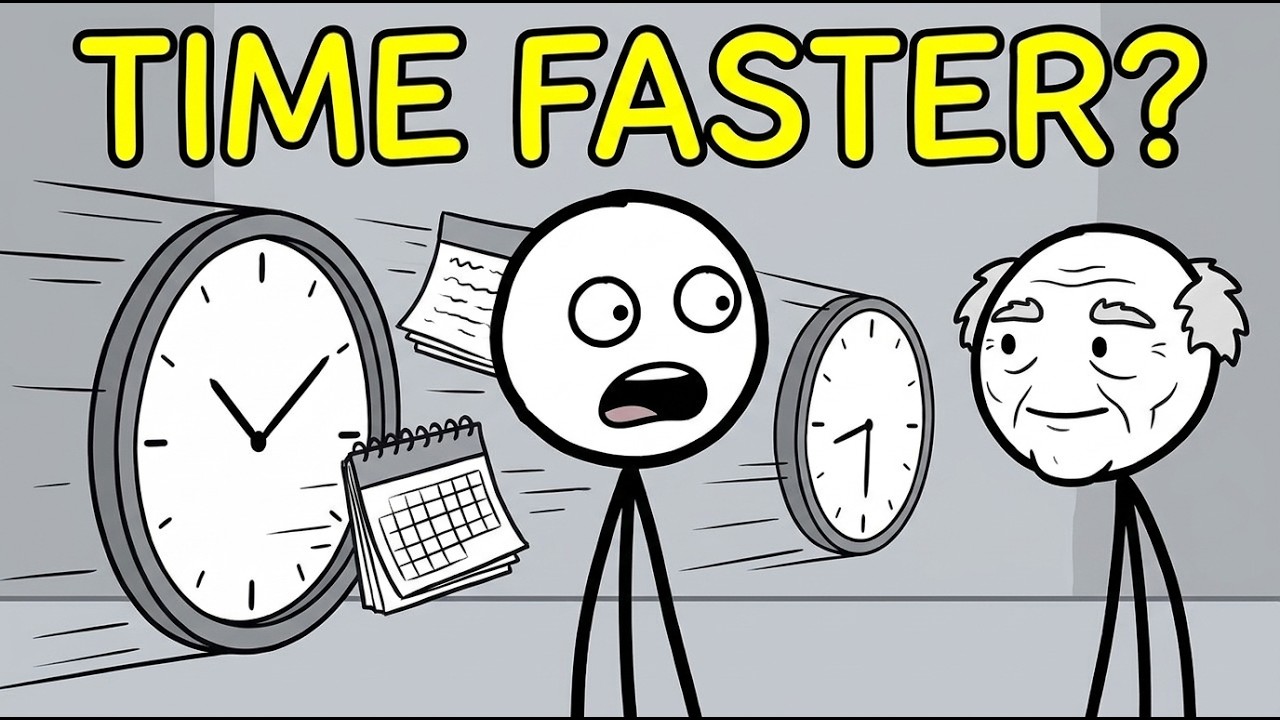
The variable is not age itself but the number of distinct, encoded memories produced. Children experience time as expansive because nearly everything is novel. First experiences—riding a bike, starting school, tasting unfamiliar food—require detailed encoding because the brain has no prior model to rely on. Adults, by contrast, process familiar routines through prediction and pattern recognition, generating few new memories.
Commutes and routine workdays pass without leaving durable traces, so the retrospective brain concludes they were brief. This creates a paradox central to time perception research. Boring, monotonous experience feels long in the moment because attention has nothing to distract it from the passage of time, yet it feels short in retrospect because it produced no distinct memories. Engaging, immersive experience feels short in the moment because attention is absorbed, but it feels long and substantial in the rearview mirror because of the rich memories it generated.
Attention is the direct lever in this process. Mindfulness—the deliberate focus on present experience—increases the likelihood that an experience will be encoded as memory. Studies of mindfulness practitioners report they perceive time passing more slowly and have more detailed autobiographical memory for recent periods. Chronic distraction, including near-constant phone use and multitasking, systematically reduces attention, producing fewer memory traces and thereby accelerating the subjective passage of years.
The mechanism differs from what many expect: the brain has no single dedicated clock. Time perception is distributed, context-dependent, and largely constructed after the fact rather than recorded in real time. Emotional intensity also shapes how time is remembered. The amygdala, which processes emotional significance, modulates the hippocampus, which forms explicit memories.
Strong emotions—fear, joy, grief, love—produce stronger encoding and therefore more durable memories. A week containing major emotional events contains more memory traces than a week of pleasant routine, which is why it feels longer when recalled. Social context plays a distinct role. Deeply engaging social interaction generates rich, durable memory traces.
Loneliness and social isolation, conversely, reliably produce disregulated time perception; without social anchoring, the sense of time becomes fluid and erratic. Reduced social engagement—working from home, consuming entertainment individually, diminished community participation—compounds the effects of routine and distraction on perceived time. Time acceleration also carries consequences for identity. When years blur into indistinguishable routines, the self can feel static not because it is not changing, but because routine produces few markers of change in the autobiographical narrative.
The same deficit that makes time feel compressed makes life feel as though nothing significant is happening; the intervention is identical for both. The research converges on practical, countercultural implications. The lives that feel longest are not the most comfortable or efficient but those containing the most variety, novelty, and challenge. Learning a new skill generates consistent novelty because ability changes with each session.
Travel works through unfamiliarity—not distance or cost—so a weekend in an unfamiliar nearby town can generate the memory density that makes time feel substantial. Novelty can be introduced into ordinary life at no financial cost: a different route to work, an unfamiliar cuisine, a conversation with a stranger, a genre never read, a physical skill attempted for the first time. Each injects novelty into days that would otherwise pass on autopilot. The compression of time is not inevitable.
It results from specific conditions—declining novelty, diminished attention, reduced social engagement—that are partly under individual control. The summer at age eight felt eternal because everything was a first time. This is the closest thing the neuroscience currently supports to slowing time down: choosing to generate more first times at any age.