The carefully constructed fairy tale that launched the most enduring icon in Hollywood history began to crumble on May 3rd, 1952, when a headline in the Hollywood Reporter shattered the studio’s most sacred fiction. The world learned that Marilyn Monroe, the orphan girl with the tragic backstory, was not an orphan at all. Her mother, Gladys Pearl Baker, was alive, working as a nurse in a small rest home in Eagle Rock, a woman whose life had been a brutal, decades-long war against madness, loss, and the very machinery that would later erase her existence.
The official biography, released in 1946 when the star was just a contract player, had declared her parents dead. It was a convenient lie, a clean origin story designed for a public that preferred its stars to rise from nothing, unburdened by the messy, terrifying truth of a family tree riddled with mental illness and institutionalization. While the world saw the platinum blonde bombshell, the real woman behind the name was a product of a lineage of trauma that began long before she was born, a story of a mother who was beaten, betrayed, and broken by a system that offered no refuge.
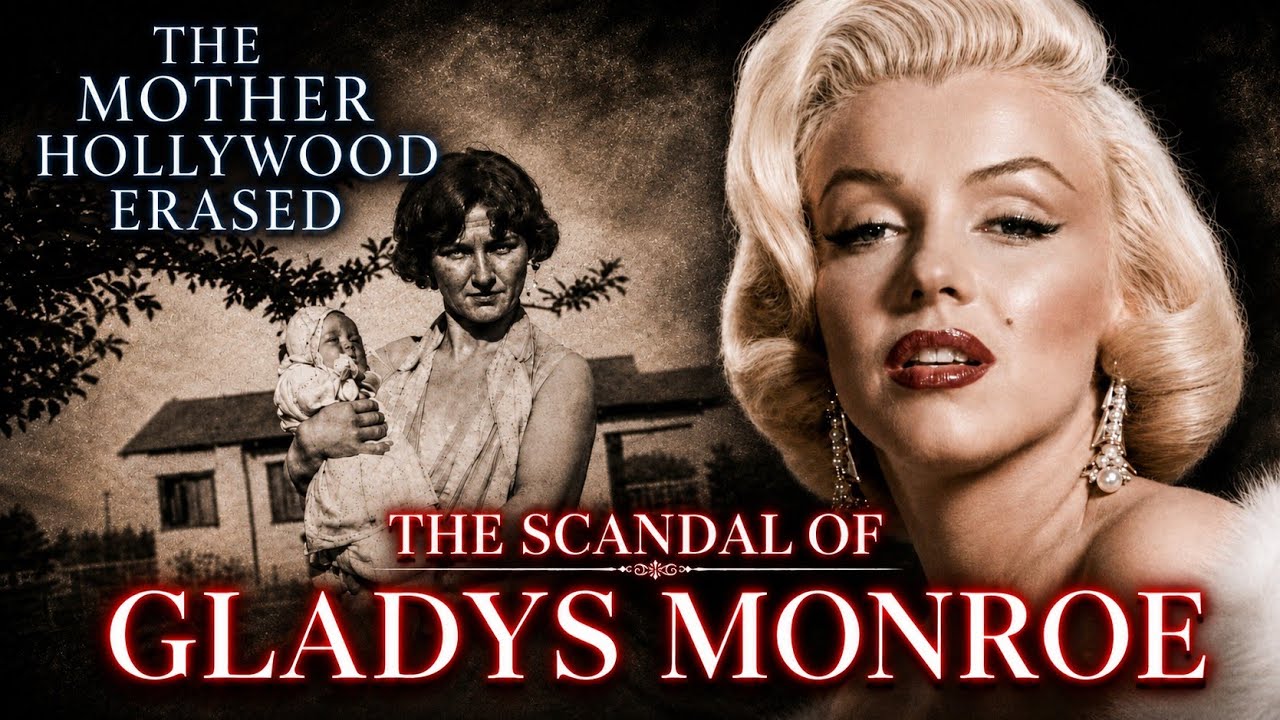 Gladys Pearl Monroe was born in 1902 in a Mexican border town, a child of a volatile mother and a father whose mind was destroyed by illness, leaving a legacy of hereditary madness that would haunt the family for generations. By the age of 14, Gladys was married to Jasper Baker, a man a decade her senior, a union forged on falsified documents that erased her childhood and delivered her into a nightmare of domestic violence. She bore him two children, only to have them kidnapped and taken to Kentucky, a loss that would echo through her life and into the life of the daughter she hadn’t yet imagined.
Working as a negative cutter in the silent film industry, Gladys found a semblance of independence, but her personal life remained a storm. A brief marriage to Martin Mortensen ended in divorce after just four months, a casualty of the mood swings and sudden darknesses that were already taking hold. It was at Consolidated Film Industries that she met Charles Stanley Gifford, a charismatic foreman who refused to claim the child she conceived with him.
In June 1926, alone and abandoned, Gladys gave birth to a girl she named Norma Jean, a child who would be sent to a foster home just two weeks later, beginning a cycle of displacement that would define her daughter’s early years.
The first years of Norma Jean’s life were spent in the strict, evangelical household of Ida and Wayne Bolender, where she found stability but not the unconditional love she craved. Gladys, living across the street, watched from the margins, her visits growing more erratic as her mental state deteriorated. The trauma of losing her son Jackie to tuberculosis, a death she learned of only after it was over, broke something inside her.
“Why wasn’t it you?” she screamed at her young daughter, a moment of raw, unfiltered grief that severed the fragile bond between them forever.
The collapse came in January 1934, when Gladys was committed to Norwalk State Hospital, the same institution that had held her own mother just six years prior. Norma Jean, just seven years old, watched her mother being led away, a moment that would be seared into her memory. The diagnosis was paranoid schizophrenia, a label that would follow Gladys for the rest of her life and cast a long, terrifying shadow over her daughter’s own fears of motherhood and madness.
What followed for Norma Jean was a brutal odyssey through the Los Angeles foster care system, a circuit of relatives, family friends, and finally, the Los Angeles Orphans Home Society. It was a world of rejection and 𝓪𝓫𝓾𝓼𝓮, where she was molested by a boarder, slapped by her mother for complaining, and ultimately told she was a “mental case” by the very people meant to protect her. The only reprieve came from Anna Lower, a great-aunt who offered the first true glimpse of unconditional love, teaching the young girl that she was beautiful and worthy, a lesson that would carry her through the darkest years.
By 1942, at just 16, Norma Jean was married to James Dougherty, a marriage arranged by her guardian Grace Goddard to prevent her from being sent back to an orphanage. The marriage was a pragmatic solution, not a love story, and it quickly dissolved when Dougherty enlisted in the Merchant Marine. It was during this time, working on an assembly line at Radioplane Company, that a photographer discovered her, and the transformation began.
By 1946, she was Marilyn Monroe, a name chosen by a studio executive, a persona built on a foundation of lies.
The studio’s publicity department worked tirelessly to craft her image, erasing her past and her family. But the truth could not be contained forever. When the story broke in 1952, Marilyn, recovering from surgery, did what she had learned to do best: she controlled the narrative.
She admitted her mother was alive, that she had been in a state hospital, and that they had never had a “normal relationship.” It was a masterful piece of damage control, but it opened a door that could never be closed again.
Gladys, now aware that her daughter was a star, began writing letters, pleading for love and recognition. “Please, dear child, I’d like to receive a letter from you,” she wrote. “I’d like to have my child’s love instead of hatred.”
But the connection was too fractured, the pain too deep. By 1953, Gladys was committed to Rockhaven Sanitarium, a private facility where Marilyn paid the bills but could not bring herself to visit. The money crossed the threshold; the daughter could not.
The final years were a tragic dance of missed connections. Marilyn, terrified of becoming her mother, avoided the visits that might have offered closure. When she finally did visit in June 1962, it was a disaster.
Gladys refused her medication, offered prayer instead of pills, and asked a question that cut to the bone: “What life? What room? What house?
What version of myself is waiting out there?” Six weeks later, Marilyn Monroe was dead, and Gladys was not at the funeral.
In the aftermath, Gladys escaped the sanitarium, a dramatic flight that landed her in a church basement before being transferred to Camarillo State Hospital. It took her other daughter, Bernice, five years to secure her release and bring her to Florida. There, Gladys lived out her final years, a frail woman on a tricycle with a red flag reading “Danger,” a poignant symbol of a life that had been a constant warning to others.
She died in 1984, buried near Marilyn but not beside her, a final separation in a life defined by them. The world remembers the icon, but the tragedy of Gladys Pearl Baker is the truth that Hollywood fought to hide: the star was born from a mother’s shattered mind, and the machinery that created Marilyn Monroe erased the woman who gave her life.