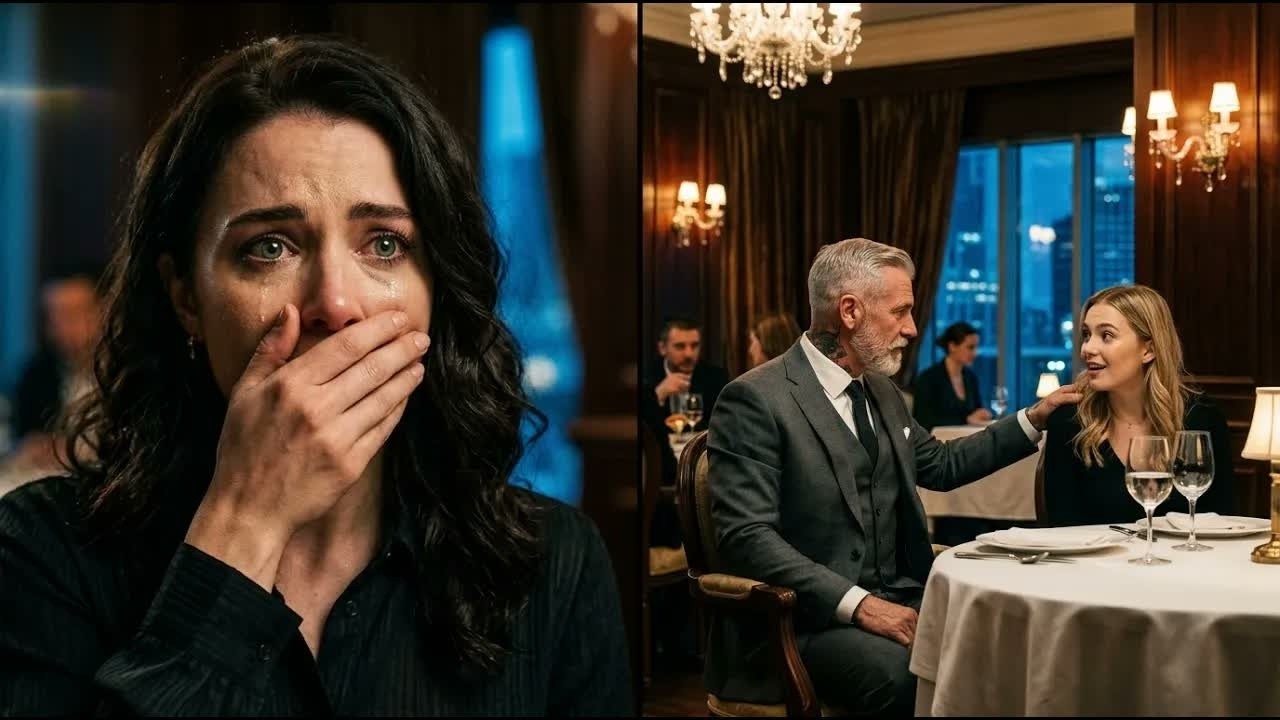
I woke up the morning after the funeral and Harold’s reading glasses were still on the nightstand. I couldn’t bring myself to move them. After thirty-nine years of marriage, those glasses sitting beside the alarm clock felt like the last evidence that he had been real, that our life together had meant more than a name carved into granite at Hillside Memorial. I was sixty-eight years old and had no idea what came next.

The house in Clarksville, Indiana felt enormous without him. Not because it was large, it was a modest two-bedroom on Sycamore Street with a kitchen that had needed new countertops for a decade, but because Harold had filled it so completely. His voice, his laugh, the way he cleared his throat before saying something funny. All of it gone at once.
A stroke, the doctor said, fast and merciless. He was here on a Tuesday and gone by Thursday, and I never got the chance to tell him I loved him one last time because I’d been arguing with the insurance company in the hospital hallway when it happened. My daughter drove up from Nashville and stayed for ten days. She helped me sort through Harold’s clothes, cooked meals I barely touched, and tried not to cry in front of me.
But she had her own family, her own life. My son called twice a week from Portland, reliable as clockwork, but phone calls are not the same as presence. They are a reminder of presence, which is almost worse. What saved me in those first hollow months was routine.
I had worked at the Clarksville Public Library for twenty-two years as head of reference services. When I retired four years before Harold died, I thought I was walking into a golden chapter. Travel, grandchildren, mornings without alarm clocks. Instead, I walked into a chapter I hadn’t prepared for.
So I went back part-time, three days a week. The library director, a patient woman named Donna, put me back at the reference desk without making a fuss, and for that small mercy I was more grateful than she will ever know. It was the medication situation that introduced me to Marcus. Harold had managed our prescriptions.
Every month, same pharmacy, same order, and Harold would drive over to pick everything up. After he died, I realized I had no idea how half of it worked. My blood pressure medication, my calcium supplements, my thyroid prescription. Suddenly these things that had run themselves for years required my attention.
My daughter set me up with a home delivery service. Once a month, a driver would bring everything to my door. The first time Marcus came, I almost didn’t answer. I was still in the habit of fear that a woman alone in a house develops faster than she expects.
But I looked through the curtain and saw a heavy-set man in his mid-fifties in a blue company shirt holding a white paper bag with the pharmacy logo, looking entirely bored. His truck was parked in my driveway in plain sight. I opened the door. “Everything okay in there?
” he asked, because I had apparently taken long enough looking through the curtain that he’d grown curious. “Fine,” I told him. “I’m just careful. ”
He nodded like that made perfect sense.
“Patricia Hensley? ”
“That’s me. ”
He handed me the bag, had me sign the electronic tablet, and that was that. I thought nothing more of it.
But Marcus came back the next month, and the month after that, and gradually, the way these things happen, we began to talk. Not deeply at first. He’d comment on the weather. I’d ask if he needed water for the road.
He mentioned one October afternoon that the leaves on my sycamore were the best color he’d seen all season, and I told him Harold had planted that tree the year we moved in, that it had been a sapling he could have snapped with one hand. Marcus stood on my porch steps and actually looked at it for a moment, the way people rarely take time to look at things anymore. “That’s a good looking tree,” he said. “You can tell someone loved it.
”
I had to look away for a second after he said that. He started lingering an extra few minutes each month. He was the kind of man who seemed accustomed to brief human connection, the driver who keeps people company for a moment before moving on. He told me he covered three counties, that he saw a lot of elderly people living alone on his route, that the ones who had nobody to check on them sometimes didn’t open the door for days at a time.
He said it matter-of-factly, without drama, but I heard what was underneath it. “You worry about them,” I said. “Occupational habit,” he replied. Then, after a pause, “I just notice things.
”
In November, I started leaving a thermos of coffee on the porch railing on his delivery days. I’d check the schedule, he always came between eleven and noon. I’d have it ready, labeled with a piece of masking tape that said “Marcus” in black marker, and I’d slide the front window open so I could hear when the truck pulled up. The first time he found it, he stood there looking at it, then looked toward the window.
I waved. He picked up the thermos and held it up like a small toast before tucking it under his arm. The next month he returned it clean with a thank you written on a piece of pharmacy notepad paper taped to the lid. After that, I started sitting on the porch when the weather allowed.
We’d talk while he finished his coffee. I learned about his life in pieces. He’d grown up in Jeffersonville, just across the bridge. Spent twelve years working for a logistics company before they downsized, and he had to reinvent himself at forty-five, which he described without bitterness as an education in humility.
He’d never married. He had a younger sister in Louisville he was close to, and an elderly mother in a care facility in Sellersburg he visited every Sunday without fail. “She doesn’t always know me anymore,” he said one afternoon, cradling the thermos in both hands. “But I go anyway.
”
“Of course you do,” I said. He looked at me with a kind of quiet relief that made me think not everyone had told him that. By December he was staying twenty minutes, sometimes thirty. We talked about books.
He was a reader. We talked about the town, about what it had been and what it was becoming. We talked about his mother, about my children, about the strange grief of holidays that keep arriving whether you’re ready for them or not. “You make this job much better, Patricia,” he told me one cold Friday.
“You make this house feel less quiet,” I told him back, and I meant it. I should have noticed something was wrong before Marcus told me. Looking back, there were signs I had dismissed as coincidence or my own aging forgetfulness. A voicemail from a number I didn’t recognize that I’d deleted.
A letter from my insurance company that I’d set aside to deal with later and then couldn’t find. A call from a man named Derek Howell who identified himself as my new account manager at Summit Life and said he just wanted to introduce himself. I gave him ten minutes of conversation because I was lonely and he was pleasant, and he said all the right things about making sure my coverage was still optimized at this stage of my life. Afterward I remember thinking that Harold had always handled the insurance, that I was still learning the edges of what I didn’t know.
The Tuesday it changed started ordinarily. I was on the porch with my coffee when Marcus’s truck turned onto my street. I noticed right away that he was early. It was barely 10:30.
He pulled up faster than normal, and when he got out, he left the truck running. He walked to the porch steps and stopped. He wasn’t carrying my delivery bag. “Patricia,” he said, and his voice was different.
Careful in a way I hadn’t heard from him before. I set down my coffee. “I need to talk to you about something,” he said. “Can I come up?
”
He sat in the chair across from me, the one that had been Harold’s, which I never invited anyone to sit in. He put his forearms on his knees and leaned forward and looked at me with the particular expression of someone who has been deciding whether to say something for a long time. “Do you know a man named Derek Howell? ” he asked.
I blanked. “The insurance man. He contacted you,” Marcus said. It wasn’t a question.
“He called about two months ago. Said he was my new account manager at Summit Life. ”
“Why? ”
Marcus pressed his mouth together, then reached into his jacket pocket and put a folded piece of paper on the porch railing between us.
“I’ve been doing this route for six years,” he said, “and I’ve been watching something happen on it for the last eight months. I didn’t say anything sooner because I wasn’t certain enough. I’m certain now. ”
I didn’t touch the paper.
I looked at his face. “Three of the women on my route,” he said, “all widows, all over sixty-five, all living alone. Donna Ferris on Maple Ave, Ruth Chadwick out on Route 11, Mildred Porterfield over in Borden. In the last year, each of them had the same experience.
A new account manager calls out of the blue, very friendly, very knowledgeable. Tells them their coverage needs a review now that they’re single income households. Helps them update their paperwork. ”
He paused, looked at the railing.
“Ruth’s daughter called the pharmacy last month asking if we knew anything about her mother’s life insurance policy. Apparently, the beneficiary had been quietly changed eight months ago. Right around the time she got her call from her new account manager. Donna Ferris tried to access her policy online in September and found her login credentials didn’t work anymore.
”
The coffee in my stomach had gone cold. “I’ve picked him up,” Marcus said. “Derek Howell. Twice, when his car was in the shop.
He uses a car service sometimes, and my brother-in-law drives for them. That’s how I first heard the name. The second time, my brother-in-law called me because he’d left something in the car. A legal pad fell under the seat, and on that legal pad were names and addresses.
I knew before he said it. Your name was on it, Patricia. ”
The elm tree at the corner bent in the wind again, slow and indifferent. “There’s more,” he said quietly.
“Last week I went past Ruth’s place. Her daughter had asked me to keep an eye out since Ruth doesn’t drive anymore and sometimes doesn’t pick up her phone. There was a dark blue sedan parked in Ruth’s driveway at eight in the morning. It was there for over an hour.
I wrote down the plate. I have a contact at the DMV, nothing official, just someone I’ve known since high school. The car is registered to a Derek Howell, Clarksville, Indiana. ”
“What was he doing at Ruth’s house for an hour?
” I asked. “Getting her signature,” Marcus said. “That’s my guess. She’s eighty-one and she lives alone and she trusts people who seem like they know what they’re doing.
That’s the whole system, Patricia. He finds women who are newly widowed or newly alone, who haven’t taken over their own finances before. He presents himself as helpful. He gets access.
He redirects policies, changes beneficiaries, sometimes cashes out accounts early, pockets the difference. ”
“Elder fraud,” I said. The words felt like gravel in my mouth. “Insurance-specific elder fraud, yes.
It’s harder to track than people think because the victims often don’t discover it until they actually need the money. By then, the paperwork trail is months or years old. ”
I thought about the letter from my insurance company I hadn’t been able to find. “He called me two months ago,” I said again, slower this time.
“He was very helpful. He asked me a lot of questions about Harold’s policies, whether I’d reviewed my own coverage since he called it a life transition. ”
“Did you receive any paperwork to sign after that? ”
I thought.
“There might have been a form. I’m not sure. I put so much in the pile. ”
Marcus stood up from Harold’s chair.
“Patricia, I need you to listen carefully. Do not sign anything else. Do not take any more calls from that number. And today I’d like you to call your actual insurance company, the main customer service number on the back of your insurance card, not any number Derek Howell has ever given you.
Ask them to review your account for any changes made in the last six months. ”
“How long have you been tracking this? ” I asked. “Since Ruth’s daughter called,” he said.
“Four months. ”
“You’ve been protecting us,” I said. He looked away briefly toward the elm tree, then back. “I should have put it together faster with Donna.
She mentioned the call to me in passing. I thought nothing of it. By the time I understood the pattern, Ruth had already been visited. I’ve been trying to build enough of a picture to be useful before I said anything.
I have the legal pad. I have the plate number. I have dates from my delivery logs when each woman received their initial call, cross-referenced with when their account issues started. ”
He reached into his jacket again and set down a worn spiral notebook.
Six months of notes. “Why do you pay attention like this? ” I asked. “I mean you clearly have for a long time.
Why? ”
He was quiet long enough that I thought he might not answer. “My mother,” he said finally, “before she was in the care facility, when she was still at home, still sharp enough to seem fine, a man came to her door selling investment products. Very legitimate seeming, very patient.
She was seventy-two and she’d lost my father and she was lonely, and he came back four times over six weeks. By the time I found out about it, she had handed him forty-three thousand dollars, her entire savings outside of social security. He had a real company name, real paperwork, a real license in another state. The investigation took two years.
She never got the money back, and she deteriorated fast after that. But I have always believed that if one person along the way had paid more attention, asked one more question, written something down, my mother would be different today. ”
“I understand,” I said. “I don’t just notice things for your sake, Patricia.
I notice things because nobody noticed for her. ”
We went to the police that afternoon. Marcus knew enough to ask for the financial crimes unit, which in a town our size meant a detective named Shirley Brant, who had been doing white-collar investigations for fifteen years. She listened to Marcus’s notebook without interrupting once.
She asked precise questions. She had, she told us without elaboration, heard similar patterns before. She reviewed the legal pad, wrote down the plate number, the dates, the addresses. She made one phone call while we were sitting there, and when she hung up, she said she would like to speak with the other three women as soon as possible.
In the meantime, I was to contact my insurance carrier directly from a verified number tonight. “You’re the fourth name on that list,” she told me. “Which means he either hadn’t gotten to you yet, or he had and was returning for something more. ”
I found the form that night in the pile on the kitchen table.
A single page on Summit Life letterhead, which looked correct. A form authorizing an account review and updates to my policy contact information. My signature was not on it. I had set it aside and, in the disordered grief of those months, never gotten back to it.
For once, my inability to keep up with paperwork may have protected me. Detective Brant moved quickly after that. Ruth’s daughter provided bank records showing policy-adjacent transfers. Donna’s daughter had saved a voicemail from Howell that gave investigators his real phone number.
Mildred, the sharpest of the four of us at eighty years old, had kept every piece of paper he’d ever sent her in a shoebox under her bed and handed it to Detective Brant within twenty minutes of being called. Howell was not operating alone. There was a woman at a real insurance brokerage in Louisville who was processing the fraudulent paperwork and taking a cut. Between the four women on Marcus’s route plus additional victims in two other counties who emerged once the investigation opened, the total losses exceeded half a million dollars.
Harold’s life insurance, the policy that would come to me, had been flagged for a beneficiary review, but the change had not yet been processed. Detective Brant told me I was three to four weeks from potentially not knowing that my policy had been gutted. I sat with that for a long time. Howell was arrested on a Thursday morning.
His accomplice was arrested the same day. The local news covered it briefly and then moved on. But the four of us, Donna, Ruth, Mildred, and I, knew what it meant. Ruth cried when her daughter called to tell her.
Mildred said only, “It’s about time,” in a tone that suggested she had been waiting for justice her entire life. Marcus brought me my prescription the following month as he always had, and I had coffee waiting on the railing. He sat in Harold’s chair without me having to invite him. “You should have told me sooner,” I said, not as a criticism, just as a fact.
“I know. ” He turned the thermos in his hands. “I kept second-guessing myself, thinking maybe I was overreacting, maybe I was seeing a pattern that wasn’t there. ”
“You weren’t.
”
“No. ” He was quiet for a moment. “I almost didn’t say anything at all. I have this habit of assuming someone else will handle it, someone more official, someone with actual authority.
It took me years to understand that most of the time there is no one else. There’s just whoever is paying attention. ”
“You were paying attention,” I said. “Because of my mother.
” He set the thermos down. “Though if I’m honest, you helped, too. These months of sitting here, of you treating my job like it matters, it makes you want to be the person someone is counting on. ”
I thought about Harold’s glasses still on the nightstand, which I had finally moved to the dresser drawer.
Not to get rid of them, but to carry them differently. “It makes perfect sense,” I said. The charges were formally filed. Fraud, forgery, elder financial abuse, a list of counts long enough that Howell would be unlikely to practice anything resembling financial advising again.
Detective Brant thanked me for coming in promptly. I thanked her for taking Marcus’s notebook seriously. “There’s a reason I took it seriously,” she said. “He had six months of documentation.
That kind of evidence doesn’t come from someone who showed up with a hunch. That comes from someone who cared about getting it right. ”
The four of us met at my kitchen table the following Saturday. Donna was seventy-one and hadn’t slept well in weeks.
Ruth was seventy-nine and had brought a coffee cake. Mildred was eighty and had driven herself. We sat together for three hours and talked about our husbands and our finances and our children and our fury and our relief. At some point we stopped being four strangers who had almost been destroyed by the same man and became four women who were going to look out for each other going forward.
“We look out for each other now,” Mildred said, cutting the second piece of coffee cake. “The rest of you call me if something feels wrong. I have good instincts and I am not sentimental about making noise. ”
None of us argued with her.
Marcus came to the trial. He had been subpoenaed as a witness and gave his testimony precisely and without embellishment. The spiral notebook entered into evidence, every date confirmed by his delivery records. I watched the jury watching him.
They could see what I had seen in those months of porch conversations, a person without drama or agenda simply reporting what he had noticed because he believed it was true. Howell was sentenced to eleven years. His accomplice received six. Their financial licenses were permanently revoked.
On the drive home from the courthouse, Marcus stopped for gas and I waited in the passenger seat watching the gray November afternoon through the windshield. He had offered to drive. I had accepted, and somewhere between offering and accepting, we had both understood that we had made a different kind of arrangement, the kind that doesn’t need to be named. “My daughter wants to come for Thanksgiving,” I told him when he got back in.
He looked at me sideways. “I told her she should stay the whole week,” I said. “That I had people for her to meet. ”
He was quiet for a moment, then said, “I’d like that.
”
“Your mother,” I said. “Does she have good days sometimes? ”
“Some Sundays, yes. She’ll know me for a little while.
She likes when I read to her. ”
“I was a librarian for twenty-two years,” I said. “I have opinions about what to read to people. ”
He laughed.
It was the first time I’d heard him really laugh, not the quiet, polite version he gave to my porch stories, but a real one that surprised him as much as it surprised me. “I want to tell you something,” he said, more serious now. “You never made me feel like I was just the delivery driver. Every single month, you made me feel like a person worth talking to.
That sounds small when I say it out loud, but it isn’t. ”
“No,” I said. “It isn’t small at all. ”
I know what loneliness does to people.
I know what it does because I have lived in it, and because I have watched what it did to my mother, and because I have seen it day after month after year on every face that opens a door for a medication delivery and is clearly grateful just to have a reason to speak to someone. Loneliness is the condition that makes all of this possible. The howls of the world would have no purchase if people weren’t so hungry for a kind voice and a face that seemed to care. But the opposite is also true.
A person who feels seen will see others. A person who is treated with dignity learns to extend it. Marcus’s mother lost everything, and Marcus learned to watch. And watching saved Donna and Ruth and Mildred and me.
And I left a thermos of coffee on a porch railing and told a tired man that his job mattered, and that small fact sat in him until the moment it needed to become something more. I think about the chain of it, how long and how fragile and how dependent on ordinary choices made by ordinary people going about their ordinary lives. How any link could have broken and the chain would have fallen apart. How many chains, invisible around us, are holding things together right now that we will never know to thank.
Harold would have liked Marcus. He had a gift for recognizing people who were solid in the way that doesn’t announce itself. Quiet, consistent, paying attention when everyone else has moved on. He would have enjoyed that porch conversation, the books, the ease of two people who don’t need to fill silence to feel connected.
I think about that sometimes. Not with sadness, or not only with sadness. Also with something like gratitude. Gratitude that the life Harold and I built together made me someone who brings coffee to a delivery driver.
That small thing. That nothing thing. Turned out to matter. I’m sixty-nine now.
I still work at the library three days a week. Mildred calls me every Sunday without fail. Ruth’s daughter sends me a Christmas card. Donna and I have lunch at the diner on Route 111 once a month, and we’ve started bringing other women from the neighborhood.
Widows mostly. The ones you see picking up their mail alone. Marcus still delivers my prescriptions. He stays longer now.
Sometimes through lunch. His mother had a good Sunday recently, recognized him immediately, held his hand the whole time, asked him to read to her from a collection of short stories I had lent him. He called to tell me that. His voice lighter than I had ever heard it.
Last week a new woman moved into the house at the end of my street. I saw the moving truck from my porch. Watched her direct movers with the efficient exhaustion of someone doing everything herself. Later, I walked down with a container of soup and knocked on her door.
She looked at me like I had appeared from somewhere she hadn’t expected kindness to come from. “My name is Patricia,” I said. “I live three houses up. I’ve been in this neighborhood for twenty-two years.
And I know everyone worth knowing. Welcome. ”
She took the soup with both hands, and her eyes went bright for a moment, in the way people’s eyes do when something unexpected is exactly what they needed. I know that look.
I have worn that look. I know what it means to be in a dark chapter and have someone show up at the door with something warm and simple and ask nothing of you but to receive it. Pay attention to each other. That’s all it is, really.
In the end, that is the whole of it. Pay attention to the people moving through your days, the driver who comes every month, the neighbor who picks up her mail alone, the new woman on the street directing a moving truck by herself. Pay attention because you may see something they can’t see from where they’re standing. Pay attention because visibility is not a small thing.
It is the thing. It is how we keep each other.