A man was drowning off the coast of New Zealand, exhausted and taking on water, when a pod of dolphins appeared and began circling him. He assumed the worst. Instead of attacking, the dolphins were keeping sharks away and herding him toward shore until he made it to safety. He survived with no clear explanation for what had happened.
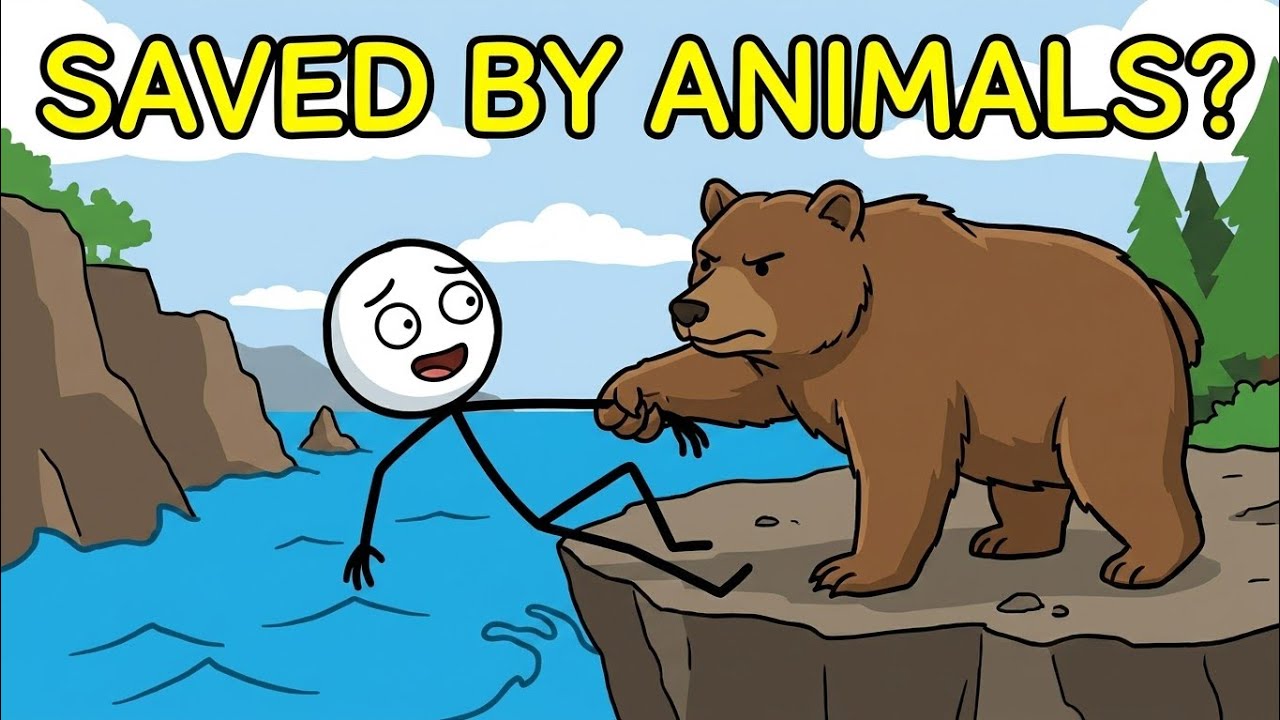
But that story is not an isolated event. Documented cases of animals endangering themselves to protect humans appear across species that share almost nothing in common, from the ocean to the forest to the family home. The question is not whether this happens. It clearly does.
The real question is why a wild animal would ever bother. Evolution does not generally reward altruism toward other species. An animal that spends energy or takes on risk to protect a creature outside its own species should, in theory, be at an evolutionary disadvantage compared to animals that conserve their resources. Yet the documented record is full of animals doing exactly that.
Dogs are the most familiar example. They pull owners out of burning houses, lie on unconscious people to keep them warm, and alert families to gas leaks or seizures long before symptoms become obvious. This behavior is rooted in roughly 15,000 years of domestication that rewired dog psychology around a core idea: humans are pack. Wild wolf packs already practice cooperative defense, protecting injured members and sharing food.
Dogs simply extended that instinct toward the humans who took over the role of pack. Dogs are not unique. Elephants have repeatedly been observed shielding injured people from predators and standing between a human and an aggressive animal. In parts of Africa and Asia, elephants have formed protective barriers around lost or injured children until rescuers arrived, behavior that mirrors how herds protect their own calves.
Elephants have such strong protective instincts that they have been observed mourning their dead and returning to the bones of deceased herd members years later. Birds show a different version of the same pattern. Crows and other corvids have been documented loudly and persistently alerting humans to nearby predators the person had not noticed. Once a crow identifies a human as a non-threat, or even a beneficial presence, its alarm calls function less like generic noise and more like a targeted warning system.
Gorillas offer one of the strangest documented cases. Multiple incidents at zoos and sanctuaries have involved a child falling into a gorilla enclosure. Instead of chaos, a powerful adult male gently positioned itself between the frightened child and the rest of the group, sometimes adjusting the child’s position to keep them comfortable until help arrived. Researchers trace this to alloparenting, the same instinct that drives primate social structure.
A small, fragile, clearly distressed human child triggers enough of the same recognition cues to flip a gorilla’s behavior from threat response to protecting the baby mode. A large amount of this behavior is not about an animal recognizing human specifically. It is about recognizing patterns: vulnerability, distress, smallness, helplessness. These are patterns that an animal’s own species has spent millions of years evolving protective responses toward.
Humans occasionally trigger those same patterns, by accident or through relationship building, and the ancient protective wiring fires anyway. Marine animals provide some of the most dramatic examples. Whales have been observed protecting divers and swimmers from shark attacks, positioning their bodies between the human and the predator, sometimes nudging swimmers toward the surface or toward boats. In one famous case, a humpback whale appeared to deliberately shield a marine biologist from a tiger shark, tucking her under a pectoral fin and guiding her through the water until the danger passed.
Researchers point out that humpback whales are already known for interspecies altruism. They have been recorded charging at orcas mid-hunt to disrupt an attack on an unrelated seal. If a species is already wired to intervene on behalf of random seals, intervening on behalf of a struggling human swimmer stops looking like an anomaly. Social cooperative species in general seem far more likely to extend protective behavior across species lines than solitary ones.
Animals that live in groups, practice cooperative defense, and coordinate as a unit already have the cognitive machinery to recognize vulnerability in another creature and respond to it. Solitary predators rarely show this behavior, not because they are crueler, but because their evolutionary toolkit never built out the wiring for cooperative protection. Reciprocity built over time through repeated positive interaction is another layer. There are well-documented relationships between specific wild animals and specific humans, often researchers, rangers, or long-term caretakers, where the animal shows repeated protective behavior toward that one familiar person.
This behavior does not show up nearly as reliably toward strangers. The animal has effectively filed that specific human under “one of mine,” the same protective category it would extend to a member of its own group. This connects to mutualism. A wild animal that is repeatedly fed or treated gently by a specific human gains something tangible: reduced risk, easier access to food, reduced stress.
Over time, its nervous system recalibrates around the idea that this particular human is worth protecting. It is not necessarily conscious gratitude as humans understand it, but behaviorally, it ends up looking remarkably similar. Some protective behavior is simpler than deliberate rescue. Many prey animals have hypersensitive threat detection systems, and their alarm responses can incidentally alert nearby humans to danger.
Geese, notoriously loud and persistent, have been documented alerting entire households to home invasions or fires. This is not necessarily a conscious decision to save a human. It is a prey animal doing what prey animals do when startled, with a human happening to benefit from the spillover. But some cases are harder to explain that way.
Search and rescue dogs dig through rubble well past the point of physical exhaustion. Horses refuse to move forward onto unstable ground even when strongly urged by riders. This suggests some animals factor human safety into their own decision-making, sometimes above their own immediate comfort. One evolutionary theory researchers use is called kin selection spillover.
Protective instincts evolved to help an animal’s own genetic relatives survive, but they do not always come with perfectly precise targeting. An animal’s brain might be wired to protect anything that triggers cues like smallness, vulnerability, distress, or familiarity, rather than firing only for blood relatives. The same circuitry that evolved to help an animal’s own offspring can extend toward something else entirely, including humans. Domestication has broader ripple effects.
Many domesticated and semi-domesticated species, including certain breeds of cattle, horses, and even some farm pigs, have been documented showing unusually protective behavior toward familiar humans during emergencies. This behavior is noticeably absent in their wild counterparts. The longer and more positively a species has coexisted with humans, the more likely individual animals are to extend genuine protective behavior during a crisis. Humans have also deliberately shaped this outcome.
Thousands of years of breeding selected for dogs that show loyalty and protectiveness, horses that respond well to human cues, and working animals based on exactly the traits now celebrated in viral videos. Some of the phenomenon is not purely animals spontaneously deciding to be heroic. It is partly humans accidentally engineering the outcome they keep being surprised by. That explanation does not cover everything.
Wild dolphins, wild whales, and wild elephants in non-captive settings have not been selectively bred by humans. Their instinct to intervene on behalf of struggling humans seems to be a naturally occurring overlap between existing social instincts and the patterns of vulnerability that a drowning or distressed human displays. Humans are not specifically targeted beneficiaries. They are more like fortunate bystanders who occasionally fit close enough into the existing pattern to get pulled into the protective net.
Oxytocin is part of the biology behind this. The bonding hormone plays a major role in caregiving behavior and protective instincts across many mammal species. Studies on dogs show oxytocin levels rise in both the dog and its owner during positive interaction, mutual gazing, and gentle touch, creating a biochemical feedback loop that reinforces the bond. The same hormonal machinery that makes a mother fiercely protective of her offspring can be activated by a bonded human instead, and the resulting protective behavior looks remarkably similar.
There is also a fascinating category involving animals saving humans from non-predator threats: drowning, fire, structural collapse. These cases have no fight-off-the-bad-guy component. They require the animal to assess a threat that often is not even alive, such as rising floodwater, smoke, or an unstable structure, and then take physical action. This level of abstract threat recognition suggests a sophisticated ability to generalize danger into a broader concept of environmental risk, closer to genuine problem-solving under pressure applied on behalf of someone else.
Group size and social structure matter. Highly social animals tend to show protective behavior far more reliably than solitary ones. An animal that relies on group cooperation for survival has a deeply reinforced mental category for “creature worth protecting. ” Solitary animals never get the repeated practice, so even if they bond with a specific human, that bond rarely generalizes into broad reflexive behavior.
Animals do not save humans because they have worked out some deep philosophical appreciation for the species, and not because humans have earned some universal cosmic gratitude. The track record does not support that conclusion. They save because in a moment of crisis, a human’s combination of vulnerability, distress signals, and proximity happens to line up with protective instincts evolution built for entirely different purposes. Humans are not the intended target.
They are accidental beneficiaries of millions of years of cooperative, protective evolutionary architecture. Humans have created the conditions that make this behavior possible. Every time a person responds to an animal in distress with patience instead of panic, every time a community chooses coexistence over conflict, every time a researcher spends years quietly building trust with a wary wild population, the likelihood of one of these protective moments increases. Humans are not passive recipients of animal generosity.
They are occasionally active participants in building the circumstances that make rescue behavior possible. A dog dragging an unconscious owner out of a burning house, a pod of dolphins forming a protective ring around a struggling swimmer, a gorilla gently cradling a fallen child: these are not grand mysterious gestures of interspecies love. They are ancient, deeply wired survival instincts doing exactly what they were built to do, with humans occasionally standing close enough to be the ones they end up saving.