Modern silence is an illusion. Even in a quiet room, the hum of a refrigerator, the distant drone of traffic, or the electronic buzz of a laptop charger creates a constant artificial white noise that most people have learned to tune out. But roughly 50,000 years ago, those sounds did not exist. For early humans, the world was defined by an intense, high-definition silence that served as a primary survival tool.
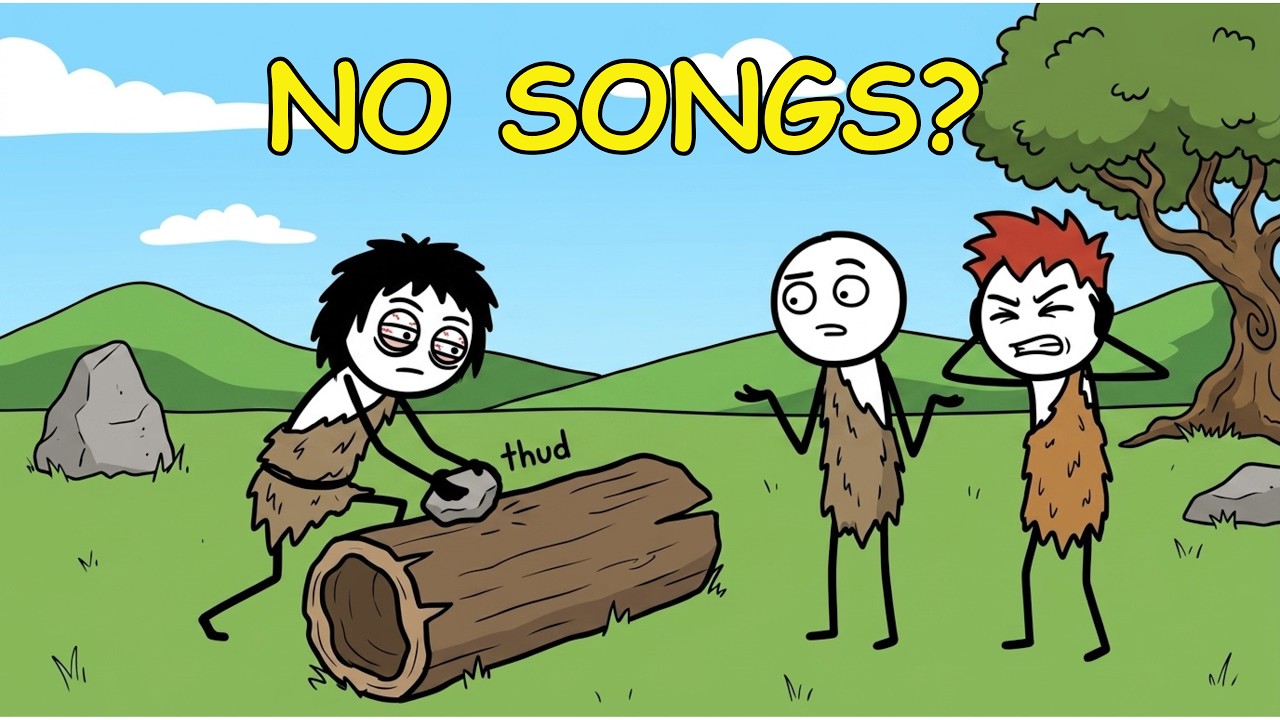
Before music existed, sound was a matter of life and death. Every snap of a twig, every shift in the wind, and every rhythmic thud of a distant herd was critical data. In that era, humans lived in a state of deep listening, analyzing the acoustic environment with the precision of a modern audio engineer. They had to distinguish between the rustle of a breeze and the rustle of a predator moving through dry grass.
The question of why hunter-gatherers, living on the edge of survival, began making sounds that carried no practical meaning is central to understanding human evolution. The answer lies partly in biology. Around 200,000 years ago, a major anatomical shift occurred with the descent of the larynx. This change increased the risk of choking, but it also created an elongated throat cavity that acts as a resonance chamber, a development researched extensively by cognitive scientists like Philip Lieberman.
This anatomical change allowed for complex speech and singing, but the hardware for music may have existed long before the software for language. For tens of thousands of years, early humans likely possessed the vocal capacity for complex melodies, yet they primarily used their voices for basic grunts and alarm calls. The gap between biological potential and cultural use is a key part of the mystery. Early human life was likely more social than commonly assumed.
Without digital entertainment, the primary source of stimulation was other people. This social foundation may explain the rise of “motherese,” a melodic, rhythmic speech used by mothers with infants across every culture. Researchers like Anne Fernald at Stanford University have studied this phenomenon, noting that it likely began as a way to keep babies calm and safe while mothers worked with their hands. These vocal reassurances were survival beacons, not songs.
Human rhythm is also rooted in biology. The heartbeat and the natural metronomic quality of walking provide an internal click track. This led to the first real instrument: the body. When groups of humans moved together, their footsteps naturally synchronized, a phenomenon known as entrainment.
This synchronized movement released endorphins and oxytocin, creating a collective bond. Evolutionary psychologist Robin Dunbar of Oxford University argues that music emerged as a substitute for social grooming. As human groups grew larger, individuals could not groom everyone they needed to trust. Rhythmic movement became a way to bond the entire tribe at once, turning a group of individuals into a single cohesive unit.
The first concerts were not performances; they were collective bonding sessions. One of the most significant archaeological finds is from the Geissenklösterle Cave in Southern Germany, where researchers discovered flutes made from mammoth ivory and swan wing bones. Carbon dating places these sophisticated instruments at roughly 43,000 years old, during the middle of the last ice age. The makers of these flutes took time to drill precise holes to create a pentatonic scale, suggesting that music served as “technology for the soul,” offering psychological relief from constant survival stress.
The ability to create a pure, melodic tone that did not exist in nature was a form of magic that allowed early tribes to relax, imagine, and dream. This raises the question of why this capacity developed in humans and not in other primates. Chimpanzees can drum on trees and enjoy resonance, but they lack rhythm in the human sense. Humans have a unique neural connection between the auditory cortex and the motor cortex, making us feel the need to move to music.
Music activates nearly every part of the brain simultaneously, functioning like a full-body workout for the mind. This has led evolutionary biologists to consider music a “spandrel,” a byproduct of other useful traits. As brains became adept at processing complex sounds for language and coordinating movement for endurance running, the collision of these systems may have produced music. Charles Darwin theorized that music was tied to sexual selection.
In the animal kingdom, birds sing to attract mates, and gibbons duet to announce a relationship. Darwin argued that human music began as a form of proto-language during courtship, demonstrating a healthy brain, good lung capacity, and ample free time. This prehistoric signaling was a precursor to the modern rock star trope. The “Hm theory,” proposed by archaeologist Steven Mithen, suggests that early humans communicated using a language that was holistic, manipulative, multimodal, musical, and mimetic.
In this world, there was no distinction between a song and a sentence. Anger was expressed through a sharp, descending pitch, while a request for help used a rising, melodic tone. This musical communication likely lasted for over a hundred thousand years. Certain musical intervals appear to be hardwired into human brains.
The perfect fifth, an interval found in almost every musical tradition on Earth, is based on a mathematical ratio of sound waves that mimics the natural harmonics of the human voice. This suggests that music is not just a cultural invention but a discovery of the laws of physics applied to the human body. In cultures without writing, music served as a critical information storage system. Anthropologists have studied how indigenous cultures use songlines to navigate thousands of miles of desert, encoding every landmark and water hole into a song.
For most of human history, music was the hard drive of the species, serving as history books, maps, and legal systems. The neurochemical power of group singing is profound, with heart rates literally synchronizing. A 2019 study published in Science, led by Samuel Mehr, analyzed music from 315 different cultures and found that music is truly universal, used for healing, love, dance, and lullabies. This universal template in the brain explains why music can be effective in treating conditions like Alzheimer’s and Parkinson’s, as the musical parts of the brain are older and more distributed than language centers.
The transition from a silent world to a musical one was a fundamental shift in human consciousness. Music transformed terrifying silence into something beautiful and meaningful, turning individuals into tribes that could survive ice ages and encoding facts into cultures that could last for generations. It was not a luxury but the ultimate survival strategy. The modern relationship with music represents a stark reversal.
Music has become a commodity consumed alone with headphones, rather than a communal, life-saving technology. The author of the original reflection notes that we have traded the bone flute for the smartphone, losing the hyper-acute, deep listening that kept ancestors alive. We live in a world with access to any song ever recorded, yet often feel more isolated than a group of humans huddled around a fire in a cave. The original purpose of music, to bond people together and anchor memories, has been inverted.
A bonding tool is now used to isolate, and a memory tool is used to distract. The human brain remains a Pleistocene organ, still waiting for rhythm to sync with and melody to anchor memories. The ancient listener is still present, waiting for the social grooming that no algorithm can provide. The hardware has not changed, even if the context has.
The fundamental silence that early humans faced was so terrifying that humanity rewired its biology to require sound. In a completely soundproof room, people would eventually hear their own nervous system and blood rushing as a high-pitched scream. This indicates that humans have lost the ability to experience a truly silent world. While modern humans face an unprecedented overload of noise, this may also represent a form of auditory loneliness unknown to hunter-gatherers.
The realization is that music remains the only thing keeping an ancient, predatory silence from closing back in.


