James Hunt, the 1976 Formula One World Champion whose swashbuckling brilliance and unbridled hedonism defined an era of motor racing, has died of a heart attack at the age of 45. The British icon, who captured the world’s imagination with his dramatic last-gasp title victory over Niki Lauda, succumbed to a life marked by extraordinary triumph and devastating self-destruction. His passing, confirmed this evening, closes the chapter on a career that was as much a cautionary tale as it was a sporting fairy tale.
The news has sent shockwaves through the motorsport community, where Hunt was revered not only for his raw speed but for his unapologetic approach to life. From his early days wrestling a tractor on a Welsh farm to his final years in the commentary booth, Hunt lived with a ferocity that few could match. His death, attributed to a heart attack, follows a long and public battle with alcoholism and substance abuse, a struggle that friends say consumed him long after he hung up his helmet in 1979.
 Born in Belmont, Surrey, Hunt’s journey into the world of racing was almost accidental. His fascination ignited during a family holiday in Wales, where he learned to navigate a tractor despite struggling with the gears due to his lack of physical strength. That early determination foreshadowed a career built on sheer willpower.
He obtained his driver’s license at 17, describing that moment as the true start of his life, and soon after, a trip to Silverstone with his tennis partner’s family cemented his destiny.
Hunt’s professional debut was inauspicious, marked by disqualification at Snetterton due to irregularities with his Mini. The setback, shared with teammate Justin Fry, did little to dampen his ambition. He funded his early efforts by working as a training manager for a telephone company, a mundane job that financed his burning desire to race.
By 1968, he had moved to Formula Ford, purchasing a Russell-Alexis Mk14 through a hire purchase scheme, and despite a frustrating engine ignition fault costing him 15 horsepower, he finished fifth in his debut race.
Victory came quickly, with a maiden win at Lydden Hill and a lap record at Brands Hatch, signaling the arrival of a formidable talent. The British Guild of Motoring Writers recognized his promise with the Grovewood Award, but Hunt’s career was never without controversy. In 1970, a clash with Dave Morgan at Crystal Palace ended with both cars crashing out.
Hunt’s subsequent confrontation with Morgan drew official disapproval, though he was cleared of wrongdoing while Morgan received a 12-month suspension. The incident was an early glimpse of the fiery temperament that would define his career.
Sponsorship from Coca-Cola and a move to the March team in 1972 brought new challenges, including exclusion from a race over engine regulations and being dropped from the STP March Formula 3 team. Yet Hunt persevered, his Hesketh Racing team defying expectations in Formula 1 with a notable second place at the 1973 United States Grand Prix. His versatility shone in sports cars too, with a second-place finish at the Kyalami 9 Hours, earning him the Campbell Trophy from the RAC in 1974.
The Hesketh 308, their own car, proved unreliable, but Hunt’s talent was undeniable. He claimed victory at the BRDC International Trophy and, in 1975, secured his first Formula 1 win at the Dutch Grand Prix, finishing fourth in the championship. When Hesketh’s finances collapsed, Hunt’s future hung in the balance.
A last-minute deal, brokered by Marlboro’s John Hogan, saw him join McLaren for the 1976 season for a bargain $200,000, a move that would alter the course of history.
The 1976 season remains one of the most dramatic in Formula 1 history. Hunt silenced doubters with pole position in Brazil and six Grand Prix wins, but Niki Lauda’s consistency gave the Ferrari driver a substantial early lead. Hunt’s victory in Spain was initially disqualified, then reinstated on appeal, setting the tone for a turbulent year.
 The British Grand Prix was mired in dispute, and Lauda’s near-fatal crash at the Nürburgring in Germany changed everything. Hunt capitalized on his rival’s absence, closing the championship gap with crucial victories at Zandvoort and Mosport Park.
The season’s climax in Japan was pure chaos. Torrential rain and mixed pit signals saw Hunt battle through adverse conditions to secure a third-place finish, winning the championship by a single point. It was a victory that made him the last British Formula 1 Champion until Nigel Mansell in 1992.
The triumph, however, came at a price. Hunt’s lifestyle, already extravagant, began to take a toll. Before the 1977 season, he received the Tarmac Trophy from the Duke of Kent, but his casual attire drew criticism from the media, a sign of his growing disregard for convention.
The 1977 season was a struggle. Customs officials in South Africa found only a publication violating local obscenity laws in his luggage, a minor scandal that hinted at his personal turmoil. Despite car troubles, Hunt took pole position in South Africa but finished fourth after collisions.
He won at Silverstone and Watkins Glen, but a collision with teammate Jochen Mass in Canada led to fines for assaulting a marshal and walking unsafely. A win in Fuji was overshadowed by his absence from the podium ceremony, resulting in a hefty fine. He finished fifth in the championship, a shadow of his former self.
Hunt’s motivation waned further in 1978. McLaren’s delay in developing ground-effect aerodynamics left them lagging behind Lotus, whose dominant 79 car was untouchable. Hunt managed only eight championship points, and his new teammate Patrick Tambay even outperformed him.
A disqualification in Germany for taking a shortcut during a tire change underscored his frustration. The tragic death of Ronnie Peterson at the Italian Grand Prix deeply affected Hunt, who joined others in rescuing the Swede from his burning car. Hunt initially blamed Riccardo Patrese for the crash, though video evidence later cleared Patrese of fault.
In 1979, Hunt left McLaren for Walter Wolf Racing, hoping for a fresh start. The team’s ground-effect car proved uncompetitive, and Hunt’s enthusiasm evaporated. He faced technical issues and retirements throughout the season, culminating in a crash at Zolder.
After failing to finish the Monaco Grand Prix, where he had made his debut six years earlier, Hunt announced his retirement on June 8, 1979. According to Peter Warr, Hunt’s heart was no longer in racing, influenced by Peterson’s fatal accident. His retirement was abrupt, coming after he discovered a way to purposely break his driveshaft during the Monaco race.
 Hunt’s second act was as a television commentator for the BBC’s Grand Prix program alongside Murray Walker. He accepted the role after a guest commentary stint at the 1979 British Grand Prix and continued for 13 years until his passing. Known for his dry humor and insightful analysis, Hunt quickly gained a new fan base.
He criticized drivers he felt weren’t giving their best and wasn’t afraid to speak his mind, particularly targeting backmarkers who held up race leaders. His commentary style occasionally led to confrontations with Walker, including grabbing the microphone during broadcasts.
Despite his fame, Hunt was known for his philanthropy, donating his fee for broadcasting in South Africa during apartheid to anti-apartheid groups. He also wrote columns on Grand Prix racing for newspapers and magazines like The Independent. But his personal demons never left him.
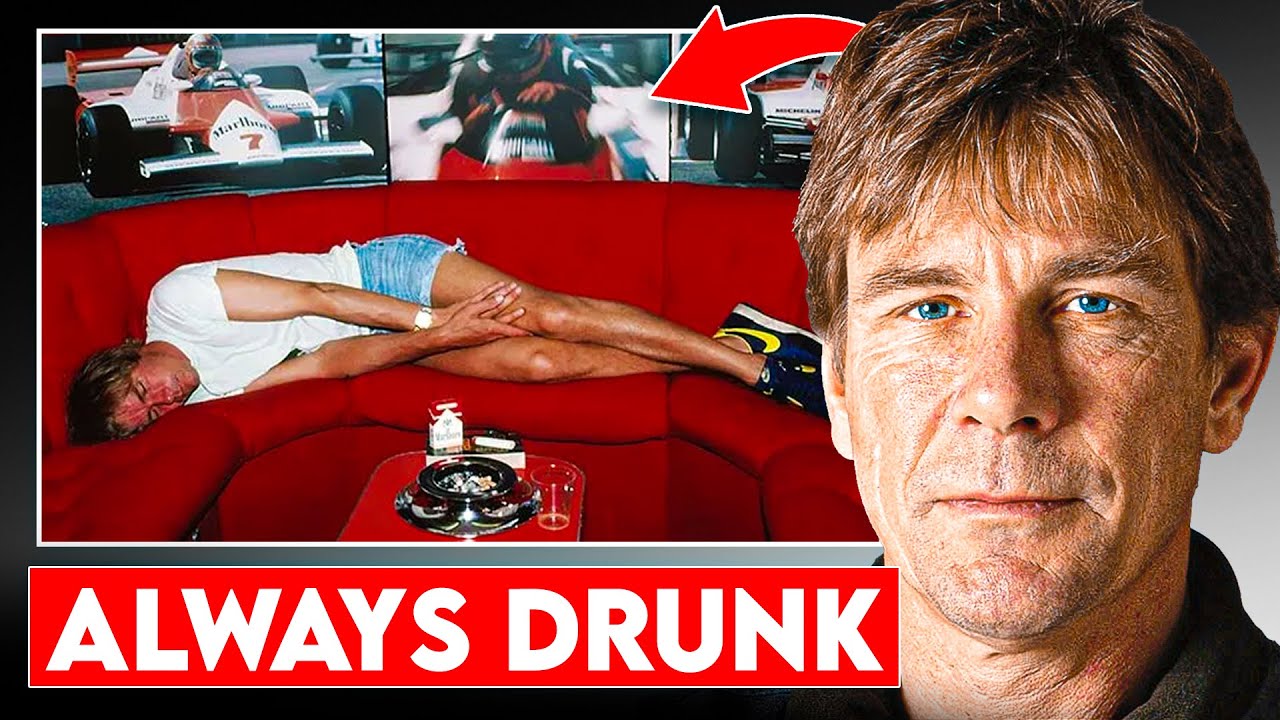
At the age of 45, he passed away due to a heart attack, a consequence of his long struggle with alcoholism and excessive drug use. During his debut as a broadcaster, he famously consumed two bottles of wine while on air in the commentary booth.
Excessive alcohol consumption claimed the life of another remarkable sportsman. His life and death serve as a reminder of the risks associated with these substances and the importance of awareness. Hunt’s legacy is twofold: a brilliant racer who conquered the world at the highest level, and a troubled soul who burned brightly but briefly.
His championship victory in 1976 remains a testament to his skill and determination, but his untimely death is a stark warning of the dangers of excess.
The motorsport world mourns a man who lived life on his own terms, often to his own detriment. Hunt’s friends recall a charismatic figure who could light up a room, yet struggled with the pressures of fame and the emptiness that followed his racing career. His commentary work brought him back into the public eye, but the bottle was never far away.
Colleagues at the BBC remember his professionalism despite his personal battles, a man who could deliver sharp analysis even while visibly impaired.
Hunt’s impact on Formula 1 cannot be overstated. He brought a rock-and-roll sensibility to a sport that was still shedding its aristocratic image. His rivalry with Lauda was legendary, a clash of personalities that transcended the track.
 The 1976 season, with its dramatic twists and turns, remains a benchmark for sporting drama. Hunt’s victory in Japan, clinched in treacherous conditions, is etched in the memory of every fan who witnessed it.
Yet, for all his success, Hunt’s life was marked by tragedy. The death of Peterson, a close friend, haunted him. He spoke openly about the dangers of the sport, but his own lifestyle was a greater threat.
His heart attack, at such a young age, was a predictable outcome of years of abuse. Friends had tried to intervene, but Hunt was resistant to change, a man who believed he was invincible.
The tributes are pouring in from across the globe. Fellow drivers, commentators, and fans have expressed their sorrow, remembering a man who was as generous as he was reckless. Lauda, his greatest rival, has spoken of his shock and sadness, acknowledging the unique bond they shared.
The 1976 championship, so bitterly contested, was ultimately a testament to their mutual respect. Hunt’s death marks the end of an era, a time when drivers were larger than life and lived on the edge.
Hunt’s family has requested privacy during this difficult time. Details of funeral arrangements are expected to be announced in the coming days. The motorsport community will undoubtedly pay its respects in grand style, honoring a man who gave so much to the sport.
But the most fitting tribute may be a simple one: a reminder that Hunt’s life, for all its brilliance, was cut short by the very excesses he celebrated.
As the sun sets on another day, the world remembers James Hunt. A champion, a rebel, a tragic figure. His story is one of triumph and downfall, a cautionary tale that resonates far beyond the world of racing.
He lived fast, died young, and left a beautiful memory. But the sadness of his passing is tempered by the knowledge that he lived exactly as he wanted, on his own terms, until the very end.
The legacy of James Hunt will endure, not just in the record books, but in the hearts of those who admired his courage and his candor. He was a man who refused to conform, who challenged the establishment, and who paid the ultimate price for his freedom. His death is a loss to the sporting world, but his life remains an inspiration to those who dare to dream.
Rest in peace, James Hunt. You will be missed.