A pair of golden eyes in the treeline may seem like a fleeting encounter, but scientists say it is part of a 30,000-year-old process in which wild animals have repeatedly chosen to live alongside humans. From ancient wolves to modern urban foxes, the decision to approach a person is not random—it is a biological and behavioral choice shaped by evolution. Archaeological evidence from the Goyet Cave in Belgium suggests that as early as 31,000 years ago, certain wolves began diverging from the wild population. Rather than being captured by humans, these wolves chose a new niche: scavenging near human camps.
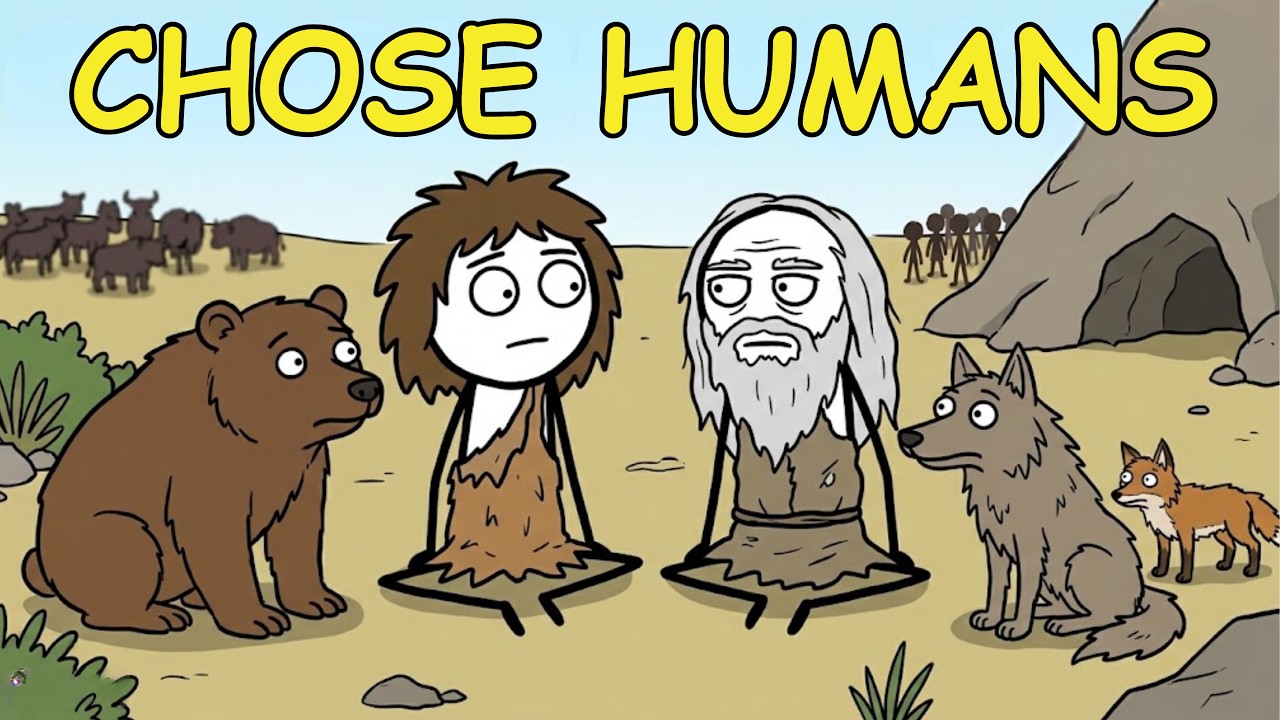
Researchers believe this was a “commensal pathway,” where animals tolerated human presence in exchange for food and warmth. Wolves with lower levels of the stress hormone cortisol were more likely to approach, and over generations, those individuals gained an evolutionary advantage through safer living and more reliable food sources. By 15,000 years ago, this self-selection had produced visible changes. Scientists like Raymond Coppinger have argued that domestication was not humans adopting wolf pups but a biological process where the animals themselves chose shorter flight distances.
These wolves developed smaller brains, floppy ears, and coat color changes. They also gained a new type of intelligence, learning to read human gestures and facial expressions, skills that even chimpanzees struggle with today. About 10,000 years ago, during the Neolithic Revolution in the Fertile Crescent, another animal made a similar calculation. Wildcats were attracted to human granaries because they drew mice.
Unlike wolves, cats had no social structure, yet in 2004, archaeologists in Cyprus found a 9,500-year-old grave containing both a human and a cat—thousands of years before the Egyptians. Genetic studies show that modern house cats are nearly indistinguishable from their wild ancestors. They did not change for humans; they simply chose to live with them for easier access to prey. Individual wild animals have also crossed this boundary on their own.
Pelorus Jack, a dolphin in New Zealand, guided ships through the dangerous waters of French Pass between 1888 and 1912. Over 24 years, this wild animal chose the company of steamships over its own pod. There was no apparent evolutionary pressure for the behavior, and he was not being fed—he seemed to find human activity more engaging than the open ocean. Laboratory work has clarified the mechanics behind these choices.
In 1959, Russian researchers Dmitri Belyaev and Lyudmila Trut began a fox-breeding experiment in Siberia. They selected silver foxes that showed curiosity rather than fear when offered food from a hand. Within four generations, the foxes wagged their tails. By the tenth generation, they whimpered for human attention and licked researchers’ faces.
The experiment demonstrated that selecting for tameness triggers a cascade of physical traits known as “domestication syndrome,” including white patches, curly tails, and shorter snouts. Research in cognition has shown that some animals actively evaluate individual humans. A 2006 study at the University of Washington found that crows recognized and remembered specific human faces, attacking researchers who wore a mask associated with a threatening experience while ignoring a neutral mask. The crows even passed this knowledge to their offspring.
Other crows have been documented leaving gifts like shiny objects for people who feed them, suggesting a form of social exchange rather than simple scavenging. Urban environments are now accelerating this process. In Berlin, wild boars have learned to navigate traffic lights and identify which humans are likely to drop food. In London, urban foxes are developing shorter snouts and changing brain shapes that mirror the domestication syndrome seen in Belyaev’s lab.
A study on urban blackbirds found they are more proactive and curious than their forest-dwelling counterparts, suggesting that city life rewards the ability to interact with humans. The underlying explanation, according to researchers, lies in human predictability. Compared to almost any other predator, humans follow rigid routines. We live in the same houses, walk the same paths, and operate on schedules.
For a cognitively complex animal, a human is a high-value, low-risk variable. A fox that learns a person’s routine knows exactly when someone will be outside and can predict their behavior. Humans also pay attention back, naming animals, speaking to them, and assigning them personalities, which creates a powerful feedback loop for social species like dolphins and dogs. Researchers have also proposed a “self-domestication” hypothesis for humans, suggesting that we, like the wolves, selected for less aggression and more cooperation over time.
This process created a social environment that invited other species to join us. The willingness of wild animals to approach humans may therefore reflect a shared history: both species traded raw violence for social complexity and seek connection beyond survival. The animal making the choice is not acting on instinct alone. A fox watching a person on a porch has likely been observing that individual for weeks, learning which door they use, when they are angry, and when they are distracted.
The decision to approach is based on a study of a specific human as an individual. Crows, for example, can distinguish between people who trapped them and those who did not, and they communicate information about dangerous humans using distinct alarm calls that differ from their hawk or cat alarms. As natural habitats shrink, researchers suggest that the choice to live alongside humans will become less a luxury and more a necessity for many species. Animals that can navigate human behavior may be the ones that survive.
The shift from fear to curiosity, a transition that began in the Pleistocene, is continuing in cities worldwide, where adaptation to human presence is becoming a requirement for survival. The most recent developments in this field point to an ongoing evolution in how wild animals perceive people. We are no longer simply a source of food or warmth. We have become a source of social interaction and even fascination.
Wild animals that approach humans are making an assessment of our character, based on how we stand, how still we are, and how we behave when we think no one is looking. The relationship is still in motion, with the wild moving closer to our doorsteps and the boundary between nature and civilization continuing to blur.