For nearly half a century, the Illinois River was defined by the absolute dominance of silver carp and bighead carp, invasive species that didn’t just adapt to the ecosystem but erased what existed before them. The fish grew to 40 pounds in months, reproduced by the millions, and at the invasion’s peak accounted for up to 90% of the total living matter in certain stretches of the waterway, the highest density of any freshwater system on Earth. The jumps alone made the river nearly unusable. The whine of an outboard motor triggered explosions of hundreds of thousands of fish launching themselves up to 10 feet into the air, fracturing bones, shattering windshields, and knocking fishermen unconscious.
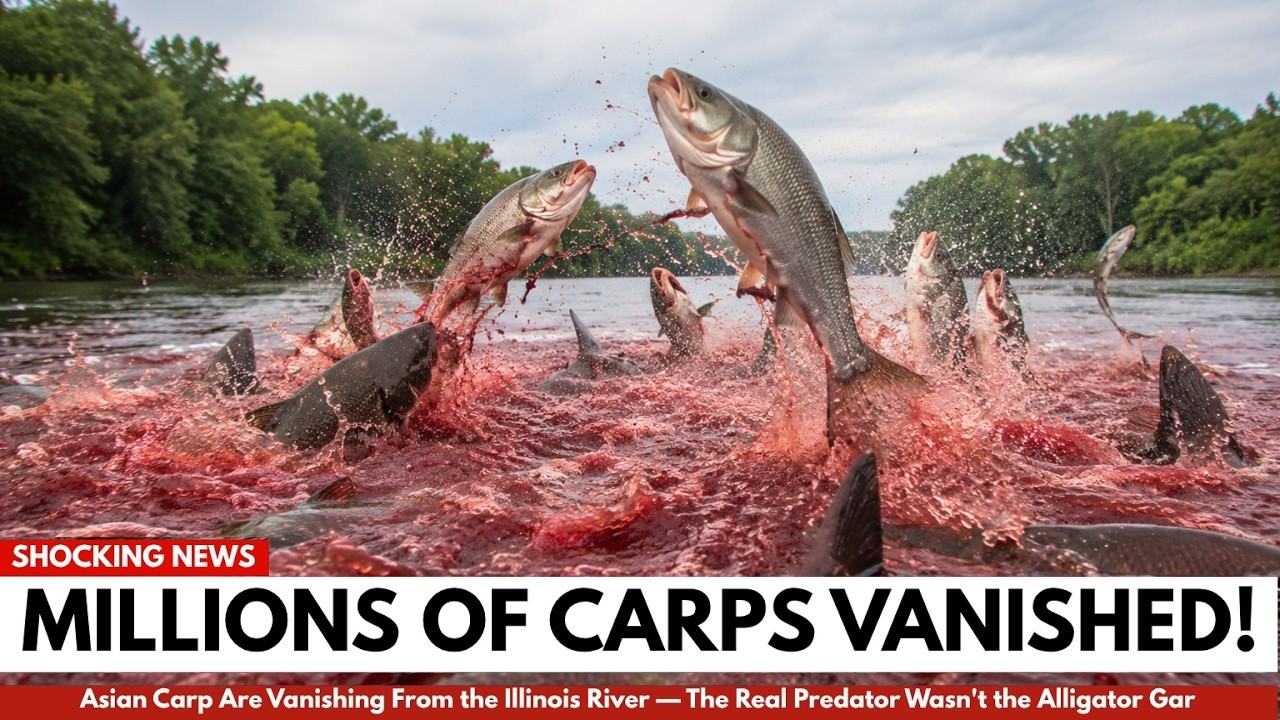
Beneath the surface, the filter-feeding carp stripped the water column of phytoplankton and zooplankton, starving out native gizzard shad, buffalo, and young bass. The invasion surged north toward Lake Michigan, appearing impossible to stop. Then the river went quiet. The violent eruptions behind passing boats grew scattered, backwaters settled into an unfamiliar calm, and sonar sweeps started coming back empty.
Locals whispered about giant gar returning to the depths. But the force emptying the Illinois River was not a natural predator. It was an engineered, industrial-scale campaign. Over 80 million pounds of Asian carp have now been removed from the Illinois River system.
Commercial harvest vessels equipped with massive seine nets and acoustic drive boats use underwater speakers to blast high-decibel frequency sweeps that panic silver carp, driving entire schools into walls of mesh. A single sweep can pull 50,000 to over 100,000 pounds of fish from the water in one afternoon. The extraction runs year-round without pause. Upstream, the river itself has been weaponized.
Steel electrodes embedded in the water column pulse direct current electricity through the channel, paralyzing any fish that attempts to swim through. Experimental acoustic soundscapes and curtains of pressurized air bubbles create what officials describe as an invisible fence stretching from riverbed to surface—frequencies that trigger panic in silver and bighead carp while leaving native species relatively undisturbed. Human engineering has also dismantled the carp’s reproductive requirements. Locks, dams, agricultural drainage systems, and industrial discharge points have transformed the dynamic, pulse-driven river into a strictly controlled shipping canal.
Operated primarily for commercial barge traffic, the constant alteration of flow velocity destroys the sustained currents needed to keep carp eggs suspended; eggs that settle into the oxygen-deprived riverbed mud smother and die within hours. For larvae that do hatch, the urbanized stretches present a lethal cocktail of agricultural runoff, wastewater discharge, and heavy industrial pollution. Hypoxia zones, heavy metals, petroleum runoff, pharmaceuticals, and synthetic surfactants wipe out entire generations of fragile juvenile carp. In many upper pools, biologists are discovering that surviving adult carp are structurally emaciated, carrying significantly lower fat reserves than their predecessors from a decade ago, literally burning more calories navigating disturbed currents than they can consume from the depleted planktonic soup.
The most transformative weapon, however, came from an unexpected quarter: profit. For years, millions of pounds of harvested carp were buried in landfills or dumped into compost pits, an expensive disposal problem. Then Illinois officials launched a major rebranding effort, renaming the fish “copi” and pitching it as a sustainable, wild-caught protein that restores local ecosystems with every bite. The fish was integrated into school lunch programs, food banks, and upscale restaurants.
The real volume now moves through industrial rendering plants that process millions of pounds of carp into high-protein meal for aquaculture, pet food additives, and organic liquid fertilizers. The pet food industry’s demand for novel proteins turned wild-caught silver carp into premium treats for dogs and cats. Direct export pipelines now ship tons of whole carp to markets in Asia and Europe, where freshwater carp remains a traditional staple. There are no quotas, no catch limits, and no closed seasons; the explicit goal of this fishery is total depopulation.
Humans do not work the shallow, tangled backwaters alone. Wildlife agencies have aggressively reintroduced thousands of alligator gar, once systematically eradicated from Illinois waters, while implementing strict protective limits on native flathead catfish. These ambush predators cannot swallow large adult carp, but they feed relentlessly on the millions of fingerlings and subadult carp crowding the backwaters, strangling the species’ recruitment rate. Above the waterline, massive flocks of American white pelicans, great blue herons, and double-crested cormorants now congregate near lock and dam structures, harvesting thousands of pounds of juvenile carp daily.
The ultimate battleground remains the Brandon Road Lock and Dam at Joliet, Illinois, the fortified high-tech choke point built to ensure no single carp ever reaches Lake Michigan. The site operates as a multi-layered defensive matrix. A high-volume acoustic deterrence system exploits the Weberian ossicles connecting the carp’s swim bladder to its inner ear, blasting custom-engineered sound waves that trigger uncontrollable panic responses that turn schools around miles before they reach the lock. An air bubble curtain creates a disorienting turbulent barrier from riverbed to surface.
A continuous electric dispersal barrier projects a field through the entire water column, incapacitating the nervous system of any fish that attempts to pass. Automated control centers monitor sound, air, electricity, and fluid dynamics in real time, adjusting output based on water temperature, conductivity, and seasonal migration triggers. What began as an emergency response to a biological invasion has permanently rewritten the rules of river management. The vanishing carp are not the result of a natural miracle or a hidden underwater predator; they are the calculated output of an artificial landscape where electric grids, acoustic cannons, commercial slaughterhouses, and reintroduced native hunters operate in synchronized suppression.
The Illinois River is no longer a pristine wilderness but a hybrid ecosystem, part machine, part security checkpoint, part chemical gauntlet, part commercial fishery. The victory forced a heavy permanent reality: once humans step in to play the ultimate apex predator, they cannot step back. The commercial nets cannot stop sweeping, the electric grids cannot go dark, and the processing plants cannot cease their grind. The exact moment intervention falters or budgets dry up, the invasive biomass can surge back through the cracks.
Across vast stretches of Europe and Asia, the narrative reverses completely. In China, bighead and silver carp are two of the revered “four major domesticated fishes,” cultivated in intricate polyculture pond systems and celebrated as accessible high-yield protein sources. In Poland, the Czech Republic, and Slovakia, carp is the unquestioned star of the traditional Christmas Eve feast, with millions of live fish transported to outdoor markets each December. In their native ranges, carp populations are constrained by natural hydrology, native parasites, specialized predators, and millennia of intensive harvesting; in fact, wild populations in Asian basins have faced severe declines, prompting conservation efforts and captive breeding programs.
When North American processing operations ship harvested Illinois River carp to markets in Asia and Eastern Europe, consumers view the wild-caught American fish as a premium, clean-water delicacy compared to pond-raised domestic alternatives. It isn’t the fish that changed, but the world around it.