England’s claim on the American colonies rested on a simple assumption: the people across the Atlantic were subjects who owed obedience to the crown. But distance had already done its work. Generations of colonists had cleared land, built homes, fought local wars, and buried their dead in American soil. They had learned to solve problems without London’s help.
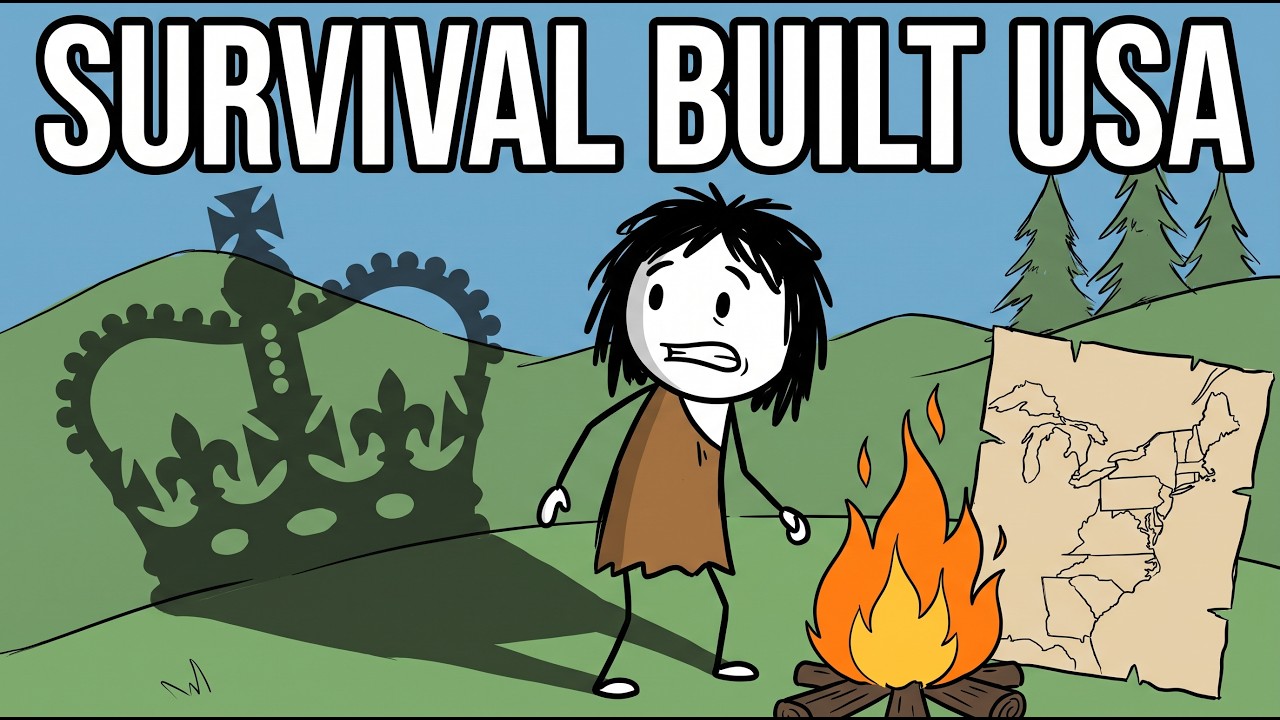
By the time Britain tried to tighten its grip, the colonists no longer felt like children of the empire, and that fracture would lead to war. Columbus sailed in 1492 expecting Asia but reached the Caribbean instead. When he returned to Europe with reports of land, people, and gold, the ocean stopped looking like a wall and started looking like a doorway. Spanish, French, Dutch, and English ships followed.
Each carried men who saw opportunity, but in survival terms, they were entering someone else’s hunting ground. The collision of old-world diseases, European weapons, and native homelands slowly redrew the map of the continent. The English colonies along the Atlantic coast were weak at first, tiny and vulnerable. Survival was not guaranteed.
Colonists worried about winter, crops, disease, and neighboring native nations who knew the land far better than they did. That hardship changed them. Trust shifted from distant rulers to local neighbors. The land under their feet began to feel like their own.
The break with Britain did not begin with a demand for independence. It began with debt. After the French and Indian War, Britain had gained territory but also a massive financial burden. London looked at the colonies and concluded they should pay for their own protection.
The Sugar Act, the Stamp Act, and later taxes on glass, lead, paper, paint, and tea followed. The colonists did not see protection; they saw a distant hand reaching into their daily lives. Tea became the flashpoint, not because of the drink itself but because it symbolized submission. When Britain sent troops to Boston, the emotional temperature rose further.
In March 1770, a crowd surrounded British soldiers. Insults, snowballs, and rocks were thrown. Panic took over, shots rang out, and five colonists died. The Boston Massacre became a story that turned anger into identity.
That identity moved closer to war in December 1773, when men boarded ships and threw tea into Boston Harbor, a public rejection of British authority. Britain responded with punishment. It closed political space, tightened control, and sent more troops. But punishing one village made the others imagine themselves next.
Delegates from the colonies gathered in Congress. Some wanted peace, some wanted resistance, and most were not ready to break away. They sent petitions. Britain refused.
Local militias began gathering weapons and preparing for the worst. In April 1775, British troops marched toward Concord to seize rebel weapons. Riders, including Paul Revere, warned the countryside. At Lexington, armed colonists faced British troops at dawn.
No one fully controlled the moment. Someone fired, and the fighting spread to Concord and then along the road back to Boston. Colonial fighters used the land to their advantage, knowing the terrain in ways the professional British army did not. The rebellion had become war.
Independence was still a dangerous word. It meant treason and possible death. Breaking from an empire meant leaving the protection of an established order. But then Thomas Paine published Common Sense, turning private anger into public language.
His argument, that an island should not rule a continent, gave people a way to voice what they already felt. In July 1776, the colonies declared independence. Birth was not safety. The British returned with warships and thousands of soldiers.
Washington’s army was inexperienced, undersupplied, and often terrified. The British struck hard, and the Americans retreated again and again. Men deserted, and hope collapsed. The revolution almost died in its early months.
Washington’s genius was not that he always won. He often lost. His genius was that he kept the army alive. Running through New Jersey, cold and hungry, the Continental Army stayed intact.
In survival terms, that mattered more than glory. Predators do not need you to lose every battle; they only need you to stop moving. Washington did not stop moving. Early America was not pure and its founders were not flawless.
Enslaved people remained enslaved, Native nations faced expansion and destruction, and women were denied political power. The promise was larger than the reality. But the survival pattern had changed. A group of colonies had looked at an empire and said no.
A distant king had demanded obedience, and a local tribe had refused. That refusal became a country. The nation would expand west, break treaties, fight itself, and bleed to end slavery. It would build cities, railroads, and armies.
But the engine behind it all was older than any flag. Liberty was the language; survival was the engine. Long before humans wrote declarations, they defended their fires. Long before they built nations, they asked who controls the ground beneath their feet.
In 1776, thirteen colonies gave their answer.