The common belief that our ancient ancestors rarely lived past 30 is fundamentally wrong, according to a growing body of archaeological and biological evidence. While the famous statistic about Paleolithic life expectancy hovering around 30 years is technically accurate, it is heavily skewed by staggeringly high infant mortality rates rather than being a reflection of how long adults actually lived. Researchers Dr. Rachel Caspari of Central Michigan University and Dr.
Sang-Hee Lee of the University of California, Riverside, conducted a major study analyzing the dental remains of 768 individuals spanning four stages of human evolution, from early hominids to early modern humans of the Upper Paleolithic. They focused on the ratio of old adults to young adults, defining an elder as someone who lived to at least double the age of reproductive maturity. The findings revealed a dramatic shift. Among early hominids, for every 10 young adults who died, only about two elders were present.
But around 30,000 years ago, during the Upper Paleolithic, that number quadrupled, with 20 elders for every 10 young adults. This demographic explosion coincided with the first major flourishing of art, complex tools, and symbolic culture. Researchers suggest this was not accidental—older individuals served as the living hard drives of their communities, storing crucial knowledge about survival strategies that younger hunters lacked. The archaeological record offers striking evidence that ancient humans cared for their frail elders rather than abandoning them.
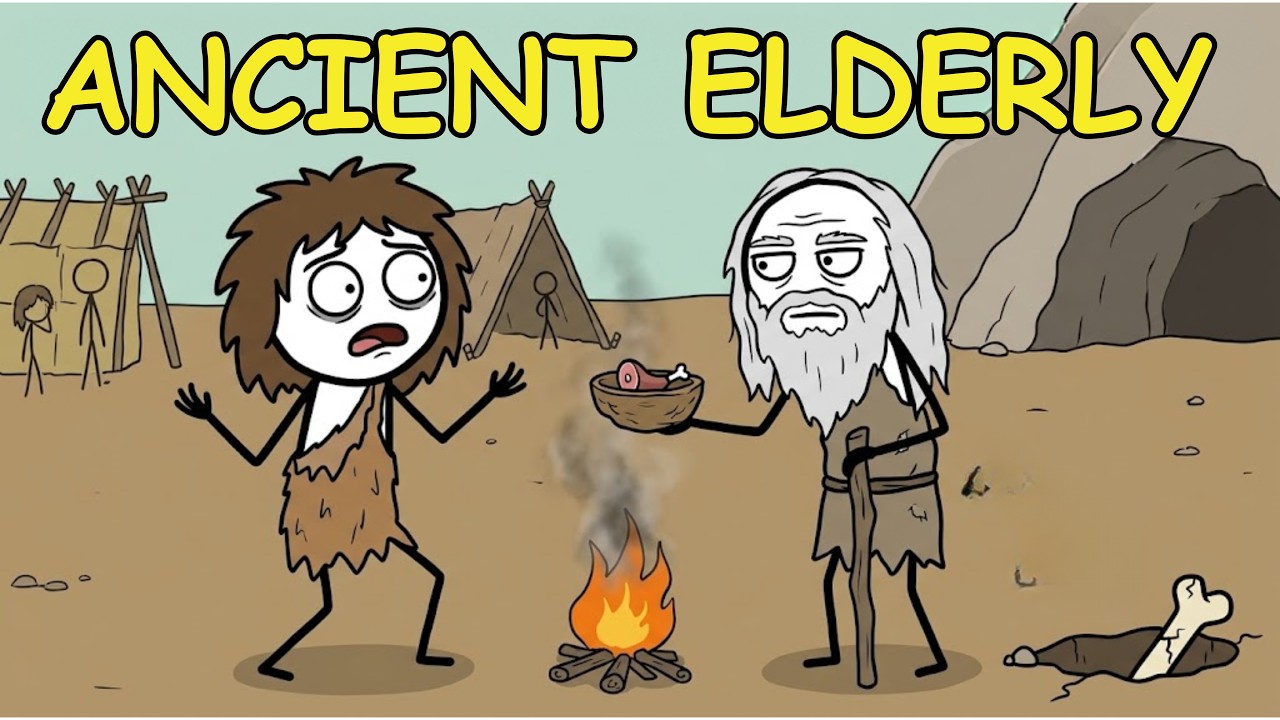
At a site in the Republic of Georgia called Dmanisi, dated to roughly 1. 8 million years ago, researchers found a skull labeled D3444 belonging to an elderly Homo erectus individual who had lost every tooth except one and lived for years in that condition. The jawbone showed signs of resorption, a process that occurs long after tooth loss. Scientists believe this individual could only have survived because other group members processed food for them, possibly by mashing or pre-chewing it.
Another remarkable case is the Shanidar 1 skeleton from what is now Iraq, dating back about 45,000 years. This Neanderthal man lived to around 40 to 45 years old despite suffering a massive blow to the left side of his face that likely blinded him in one eye, a withered right arm amputated or broken at the elbow, severe arthritis, and a debilitating leg deformity. His injuries had healed completely, indicating he lived with these disabilities for decades and was supported by his group. The evolutionary value of elders is perhaps best illustrated by the grandmother hypothesis.
Anthropologist Kristen Hawkes studied the Hadza people of Tanzania and found that grandmothers provided the bulk of calories for older children while mothers cared for new infants. This support allowed mothers to have subsequent babies sooner, increasing the reproductive fitness of the entire family. Unlike almost all other species, humans and a few others like orcas and short-finned pilot whales have females living long past reproductive age, suggesting evolution specifically favored this arrangement. The benefits of intergenerational knowledge help explain the technological leap around 30,000 years ago.
Archaeological sites show master tools lying beside clumsy apprentice pieces, evidence of deliberate teaching by elders who could no longer hunt but could pass on skills. Elaborate burials, such as those at the Sunghir site in Russia from 34,000 years ago, contain elderly individuals covered in thousands of handcrafted ivory beads, indicating deep respect rather than disposal of the aged. Some individuals at the site reached ages considered respectable by modern standards. While life in the Stone Age involved chronic pain and physical stress, and extreme environments sometimes saw instances of senicide or voluntary abandonment of elders during food shortages, these were exceptions rather than the rule.
The dominant pattern across most of human history was one of an active role for older adults in maintaining social cohesion and cultural memory, passed down through generations. As researchers interpret the fossil evidence, it indicates that our species succeeded not through physical strength but through compassion, collective care, and the preservation of accumulated wisdom across lifetimes.