A campfire alone was never what kept prehistoric humans alive through the night. Researchers studying ancient campsites argue that survival depended on a system of layered defenses, not a single flame, and that the real barrier was the combined behavior of the group itself. The central idea is that predators do not avoid humans out of abstract fear. They simply decide that attacking a particular group at a particular moment is not worth the risk of injury.
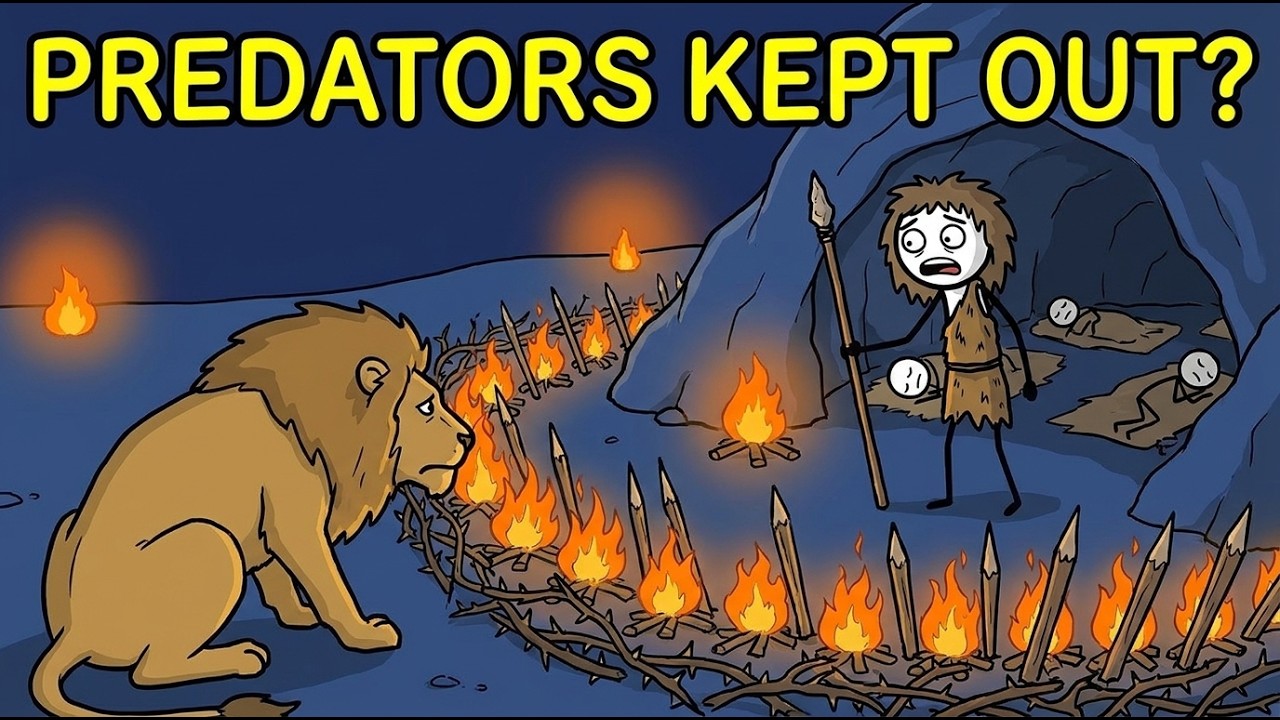
That calculation, repeated night after night, functioned as humanity’s first security system. That system began with location. A good campsite required water, fuel, stone, and shelter from weather, but it also had to balance access against visibility. While a riverbank offered resources, it also functioned as a wildlife highway.
Dense brush blocked wind but allowed predators to approach unseen. Higher ground or open slopes made stealth more difficult, and signs such as tracks, dung, or recent kills warned groups that a location already had a regular visitor. Caves were valuable but not dependable fortresses. Archaeological evidence across Pleistocene Europe shows shelters used alternately by humans and carnivores over thousands of years.
At some sites, Neanderthal activity near an entrance was followed by hyenas scavenging the remains after the humans left. A narrow entrance could restrict attack routes, but it also risked trapping people inside and filling the space with smoke. Simple structures helped even when they were not true fortifications. Huts, windbreaks, and brush barriers created physical obstacles that slowed an animal and removed the advantage of surprise.
Direct evidence for predator fences is weak because wood and thorns decay, but ethnographic comparisons show that mobile groups can build effective barriers without metal. Fire transformed the night, but it was not a magical force field. It provided light, heat, and a visible center for group organization, but it also announced the camp’s location. Its main benefit was making surprise attacks harder.
An animal entering the light no longer faced one sleeping human, but several upright figures, sudden voices, thrown stones, and sharpened points. Archaeologists caution against interpreting every hearth as part of a coordinated perimeter. Still, multiple fires could widen visibility, and embers allowed someone to revive a weakening flame quickly. This led to a critical, often overlooked defense: at least one person was usually awake.
Research on contemporary Hadza hunter-gatherers found that across 20 days of observation, someone in camp was awake during almost the entire night, with all adults simultaneously asleep for only a tiny fraction of the time. Different body clocks, combined with parents waking for children, naturally created sentinel-like coverage without a formal guard roster. Noise was another powerful tool. Shouting, clapping, and striking objects announced a coordinated group capable of following sound with consequences.
This worked because many predators avoid injury; a broken jaw or damaged limb can mean starvation. Physical advantages mattered as well. The human shoulder and torso allow accurate, high-speed throwing, letting a relatively weak animal strike from outside claw range. Spears extended this reach further.
A successful defense did not require defeating a predator in combat. It only needed to make an attack expensive. Group size changed the equation entirely. One sleeping human was a possible opportunity, but 20 alert humans surrounding children created many detectors and responders.
Language also allowed one attack to update an entire group’s behavior. Tracks observed during the day influenced nighttime choices, meaning a single encounter did not have to educate every person through personal injury. The camp created its own dangers, primarily through the smell of food. Butchery, cooking, and human scent turned a successful hunt into an advertisement for scavengers.
Groups could reduce risk by processing large carcasses away from sleeping areas, burning or breaking remains, placing refuse at the camp’s edge, and abandoning sites when waste accumulated. Mobility itself was a defense. Temporary camps denied predators a stable target. If animals learned a location, humans could simply leave.
The boundary was not a line drawn once; it was renegotiated every night. Late in prehistory, dogs added a new layer. A close human-canid relationship expanded the sensory perimeter beyond firelight. Dogs heard and smelled approaching animals before humans did, and their barking woke sleepers.
Even a dog too small to fight a lion could ruin its approach because detection is protection. Researchers emphasize that no single method worked everywhere. Open African landscapes favored visibility and knowledge of lion and hyena behavior, while northern environments required different responses to bears and wolves. Individual predators differed, too.
A scavenging hyena investigated differently than an ambushing cat, and a bear attracted to food made a different calculation than wolves testing a group. Every layer could fail. Predators did kill humans, and hominin fossils occasionally carry carnivore tooth marks. The archaeological record is biased toward caves, where bones and hearths survive, while countless open-air camps vanished under erosion and time.
Researchers reconstruct this system indirectly through hearth locations, stone tools, tooth marks, gnawing, and spatial analysis. Prehistoric humans did not stop predators by becoming physically stronger. They stopped them by destroying the conditions for a cheap attack. They chose ground that reduced concealment, placed barriers between themselves and approach routes, concentrated activity around fire, kept weapons within reach, and slept close enough to wake one another.
The camp was not a fortress. It was a threat display that lasted until morning. A lion watching from the dark might smell meat, but it also saw several fires, upright silhouettes, and movement. When one human noticed, voices changed, others rose, spears appeared, and a burning branch moved forward.
Most nights, the camp only had to make the answer to an attack cost the predator an injured eye when antelope existed elsewhere. This layered system, which modern engineers call defense in depth, allowed humans to sleep on the ground surrounded by physically superior animals. Individual vulnerability was exported into collective defense. Fire extended vision, weapons extended reach, language extended experience, group sleep extended awareness, and dogs eventually extended hearing and smell.
The development was slow. Survivors repeated useful arrangements, children copied adults, and stories preserved dangerous locations and animal behavior. Small improvements accumulated: better sleeping positions, fuel gathered before dusk, refuse moved farther away, an entrance narrowed. Culture turned individual accidents into group procedure.
Predators adapted as well, learning to scavenge abandoned camps or test the edges. The relationship was not a single victory but an ongoing evolutionary negotiation. Eventually, humans became such effective competitors that many large carnivores had more reason to fear the camp than investigate it. That dominance, however, was not an ancient default.
For much of prehistory, darkness still belonged partly to other animals. The camp created a temporary island where human rules applied, not because predators could not cross the boundary, but because crossing it activated an entire social machine of many eyes, many memories, many weapons, and one shared refusal to be taken quietly.