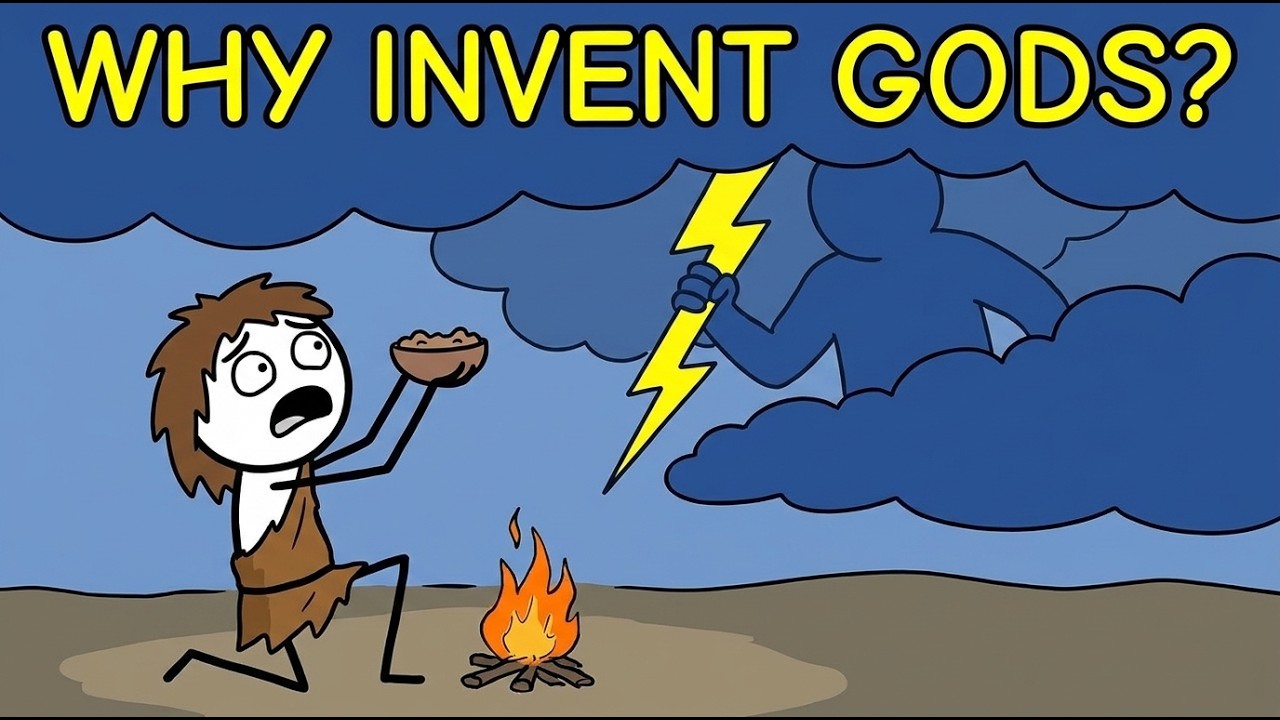
The first gods may not have been invented to explain thunder. They may have begun when someone dreamed about a dead person. Imagine living 40,000 years ago. Your brother dies.
You touch the body. It is cold, silent, unmistakably empty. You bury him and life continues. Then he visits you that night.
He speaks. He moves. He knows things. You wake in darkness with no scientific category called dream simulation and no reason to assume the experience was meaningless.
Where did he come from? If the dead can return without bodies, what else might be hiding beyond sight? The origin of religion is often told as a simple story: ancient humans saw lightning, failed to understand electricity, and invented a sky person to handle the confusion. Rain needed a rain god.
The sun needed a sun god. That explanation is not entirely wrong, but it is much too small. Humans did not build gods from ignorance alone. They built invisible societies using mental abilities that had already evolved for survival—detecting agents, reading intentions, remembering absent people, following group rules, fearing death, telling stories, and searching for patterns in chaos.
No single person sat beside a fire and announced the supernatural. There was no launch event. Gods appear to have emerged gradually from several features of the human mind, then changed as human societies changed. The spirits of mobile hunters were not necessarily the moral judges of farming kingdoms.
A being that controlled one river valley did not need to create the entire universe. An ancestor who protected one family had no reason to monitor strangers hundreds of kilometers away. Religion’s earliest history is extremely difficult to recover because beliefs do not fossilize. Archaeologists can uncover a body sprinkled with ochre, a carved figure with a lion’s head, or a structure filled with enormous stone pillars.
They can identify deliberate placement and repeated ceremonies, but they cannot excavate a thought. A burial does not come with a label saying the person believed the soul would travel east for six days. The deeper we travel into prehistory, the more every confident answer must be followed by a quiet “probably. ”
The first clue is that humans are almost aggressively sensitive to agency.
An agent is something that acts with intention. A leopard hiding in grass is an agent. Wind moving the grass is not. If you mistake wind for a leopard, you lose a few seconds.
If you mistake a leopard for wind, the leopard gains lunch. Natural selection rewarded organisms that survived. The human brain became quick to ask who caused an event, not merely what caused it. This tendency, sometimes called hypersensitive agency detection, cannot explain religion by itself, but it is an important beginning.
Nature constantly behaves as though it possesses intention. Storms chase people, rivers become angry, droughts refuse to end, the sun leaves and returns. To a mind specialized in understanding other minds, these forces are unusually tempting social partners. If an event has an intention, perhaps it can be predicted.
If it can be predicted, perhaps it can be negotiated with. Humans had already learned that gifts alter behavior. Applying that social logic to invisible powers was not ridiculous—it was the most advanced causal system available. The storm destroyed one camp but spared another.
Perhaps someone offended it. The hunt failed after a taboo was broken. Perhaps the animals withdrew themselves. A child recovered after a song or sacrifice.
Perhaps the ritual worked. Once an explanation connects an action with an outcome, confirmation becomes easy to find. Perform the ritual and rain arrives. Success.
Perform it and rain does not arrive. Someone made a mistake, the offering was insufficient, or another spirit interfered. Invisible agents possess excellent job security. Humans also evolved theory of mind, the ability to infer what another person sees, wants, knows, and intends.
This lets us cooperate, deceive, teach, and comfort. Theory of mind keeps working even when a person is absent. You can imagine what your mother would say while she is far away. You can avoid stealing because the victim might discover it later.
You can feel judged by a father who died years ago. Physical absence does not erase a social presence. Death pushes this ability into strange territory. When someone dies, the body stops immediately, but your mental model of that person does not.
You still know their voice, habits, and likely reactions. The brain can understand that a body has ceased functioning while continuing to represent the person as a thinking agent. Dreams intensify this. Grief can include vivid sensations of presence and the feeling that the deceased is nearby.
An ancestor could advise, warn, punish, or protect. If descendants prospered after honoring the burial place, the relationship appeared intact. This may help explain why care for the dead matters so much in the archaeological record. Neanderthals and early Homo sapiens sometimes deliberately buried bodies.
Burial is not automatic proof of religion—people may bury the dead to prevent scavenging, reduce smell, or express grief. But repeated treatment of bodies shows that the dead were not always handled like ordinary refuse. Some people received time, labor, pigment, tools, or ornaments. The group continued doing something for a person who could no longer provide an obvious material return.
Then came symbols. Humans can represent things that are not physically present. A mark can stand for an animal. Around 40,000 years ago, someone in what is now Germany carved a human-like figure with a cave lion’s head from mammoth ivory.
It may depict a supernatural being, a mythic character, or something we can no longer name. What matters is that the maker could imagine an impossible agent. A minimally counter-intuitive being—a person who passes through walls, an animal that speaks, a dead ancestor who still knows your secrets—is strange enough to attract attention, but familiar enough to understand. Stories gave invisible agents stable personalities.
One person’s frightening dream could become a tale repeated around the fire. Repetition removed details, sharpened others, and made the being easier to remember. Children learned it before asking where it came from. Eventually, nobody in the group had invented the story.
They had inherited it. A god does not need one inventor if thousands of minds modify the idea across generations. Memorable stories survive. Useful rituals spread.
Ideas that fit existing fears and social rules reproduce more successfully than ideas that do nothing. Ritual also addressed a deep human problem: uncertainty. Hunting, childbirth, disease, storms, migration, and warfare all contain enormous risk. Skill matters, but luck can erase skill in seconds.
A perfectly thrown spear misses when the animal moves. Rain fails after every practical preparation has been completed. Ritual gives action a shape when reality refuses to provide control. Repetitive, structured behavior can reduce anxiety or restore a sense of order under uncertainty.
Whether or not a spirit changes the animal’s path, the ritual changes the hunters. Synchrony can strengthen bonding. Singing, dancing, marching, and chanting together blur the psychological boundary between individuals. Painful or costly rites make membership difficult to fake.
If someone endures scarification, fasting, or gives away valuable resources, their commitment becomes visible. This creates what researchers call costly signaling. A person willing to pay a high cost for the group’s sacred tradition may be trusted more than someone who appears only when dinner begins. Religion became more than belief—it became proof of belonging.
Specialists likely appeared early, though the label shaman should be used carefully across different cultures. Some individuals became experts in healing, trance, dreams, ritual, divination, or communication with spirits. Unusual breathing, drumming, sleep deprivation, fasting, or psychoactive substances can produce altered states, visions, and a sense of leaving oneself. To the person experiencing it, this is not necessarily pretend.
People who repeatedly entered these states could become specialists in what their culture considered another domain of reality. The idea that one clever liar invented God to control gullible people fails to explain why religious experiences emerge so widely, why rulers themselves perform costly rituals, why believers accept suffering rather than abandon belief, or why supernatural concepts fit ordinary cognitive tendencies so well. Manipulators can exploit religion. They did not need to create the mental machinery beneath it.
By the end of the last ice age, some communities began building ritual places on a scale that complicates the old story of civilization. At Göbekli Tepe in what is now Turkey, hunter-gatherers erected massive T-shaped stone pillars more than 11,000 years ago. The pillars carried carvings of snakes, boars, birds, and foxes. Some appear anthropomorphic with arms, hands, and belts.
The site proves that people without full urban civilization could organize substantial labor around monument building. It does not prove they worshipped one specific god. Göbekli Tepe has sometimes been presented as a temple that caused agriculture. The relationship is more complicated.
The builders lived during a broader transition in which communities were becoming more settled and eventually cultivating crops. Ritual may have encouraged cooperation and feasting. Food production may have supported larger gatherings. The two processes could feed each other.
Shared sacred places could help unrelated groups meet, exchange partners, settle disputes, and coordinate seasonal work before states existed. Agriculture changed supernatural life because it changed human dependence. Farmers remain in one place. They invest months in crops vulnerable to rain, pests, flood, and disease.
They store surplus that can be stolen. Ancestors became claims to territory. Our dead are buried here—therefore, this land belongs to us. As societies expanded, gods became easier to scale than personal trust.
In a village, reputation follows you. In a city, anonymity becomes possible. A god who sees hidden behavior solves a social problem. Escaping an invisible witness is more complicated.
Research across cultures suggests belief in morally concerned, punitive, knowledgeable gods can support cooperation beyond immediate kin. Experimental work has found that concepts of supernatural punishment can influence how believers allocate resources. The historical sequence is contested. One influential idea proposed that big gods—powerful, moralizing supernatural beings—made large, complex societies possible by enforcing cooperation.
Later historical analyses argued that social complexity often rose before fully moralizing gods became prominent. The original analysis was retracted after disputes about missing data, and follow-up work continues to debate methods. The safest conclusion is that gods and civilization likely changed each other. Larger societies created demand for broader rules, standardized rituals, professional priesthoods, and supernatural enforcement.
Those institutions could then stabilize rulers, trade networks, and collective identity. Priests interpreted omens and maintained temples. Kings presented themselves as chosen by gods or descended from gods. Divine authority could legitimize hierarchy and conquest, but it could also restrain rulers by placing them under sacred obligations.
Why did different societies invent different gods? Because they inhabited different worlds. People near unpredictable rivers imagined powers tied to flood and fertility. Pastoral groups organized life around animals and migration.
Island communities faced oceans and storms. Farmers watched seasonal cycles. Hunters negotiated with prey understood as beings with agency. Social structure mattered too.
Ancestor-focused systems fit societies where descent organized property. Warrior cultures elevated divine champions. Expanding empires combined gods, ranked them, or declared one superior. The flexibility of religion explains why asking when humans invented god creates the wrong image.
A small band honoring animal spirits, a village feeding ancestors, a city sacrificing to a storm deity, and a philosopher describing one universal creator are not simply versions of one original product. They are different answers built from overlapping human capacities. Nor does an evolutionary explanation prove that any god is unreal. Explaining why humans perceive something is not the same as deciding whether the thing exists.
Vision evolved because detecting objects helped survival—that does not mean trees are imaginary. Why did ancient humans invent gods? They needed causes in a world full of effects. They possessed minds designed to detect agents, even when agents were hidden.
They could imagine what absent people knew. They continued feeling the social presence of the dead. They dreamed. They grieved.
They told stories that made impossible beings memorable. They faced danger that skill could not control. Ritual turned helpless waiting into action. It calmed fear, synchronized bodies, and transformed individuals into a group.
Then human groups grew. Spirits tied people to land. Gods organized seasons, protected cities, watched strangers, and expanded identities beyond anyone a person could personally know. Perhaps the most important reason was not fear of lightning.
It was fear of meaninglessness. Humans became capable of understanding time, loss, and mortality with unusual depth. A purely physical event ends when it ends. A meaningful event joins a story.
The storm becomes punishment, warning, or renewal. Death becomes a journey or reunion. Gods placed human life inside a larger pattern. That pattern was not always comforting.
Ancient gods could be violent and unpredictable. Religion did not remove fear—it made fear negotiable. An uncaring universe offers no appeal. An angry god might accept a goat.
Ancient humans did not invent gods because they were unintelligent. They invented them because they were intelligent enough to imagine invisible minds, socially dependent enough to need shared rules, vulnerable enough to seek control, and self-aware enough to know they would die. The same brain that could track an animal no longer visible could imagine a person no longer alive. The same social instincts that bound a hunting band could bind strangers beneath one sacred watcher.
Long before temples rose, someone looked into darkness and felt that the darkness was looking back. Archaeology cannot tell us whether something actually answered. It can only show what humans did next. They buried the dead.
They carved impossible beings. They danced together. They gave valuable things to powers they could not see. They built meeting places, then monuments, then temples.
They carried those beings into villages, cities, kingdoms, and every continent they entered. Humans did not simply invent gods to explain the world. They used gods to make the world social. A storm could be addressed.
A death could become a relationship. A rule could have a witness. A stranger could become part of the same moral universe. And an animal aware of its own ending could believe that the story continued after the body stopped.
That may be the real origin—an entire species discovering that once you can imagine another mind, there is no obvious reason that mind must be visible, mortal, or human.