A dark, heavy rock that pulls iron through empty air with no visible force would have looked like magic to anyone who found it roughly 2,600 years ago in the hills of Magnesia in ancient Thessaly. That rock, known as lodestone, is a naturally occurring form of magnetite that has been permanently magnetized. Most magnetite is not magnetic at all, and for centuries no one could explain why some pieces attracted iron while identical-looking stones did nothing. The answer, confirmed by geophysicist Peter Wasilewsky at NASA’s Goddard Space Flight Center through studies in the 1970s and 1980s, is lightning.
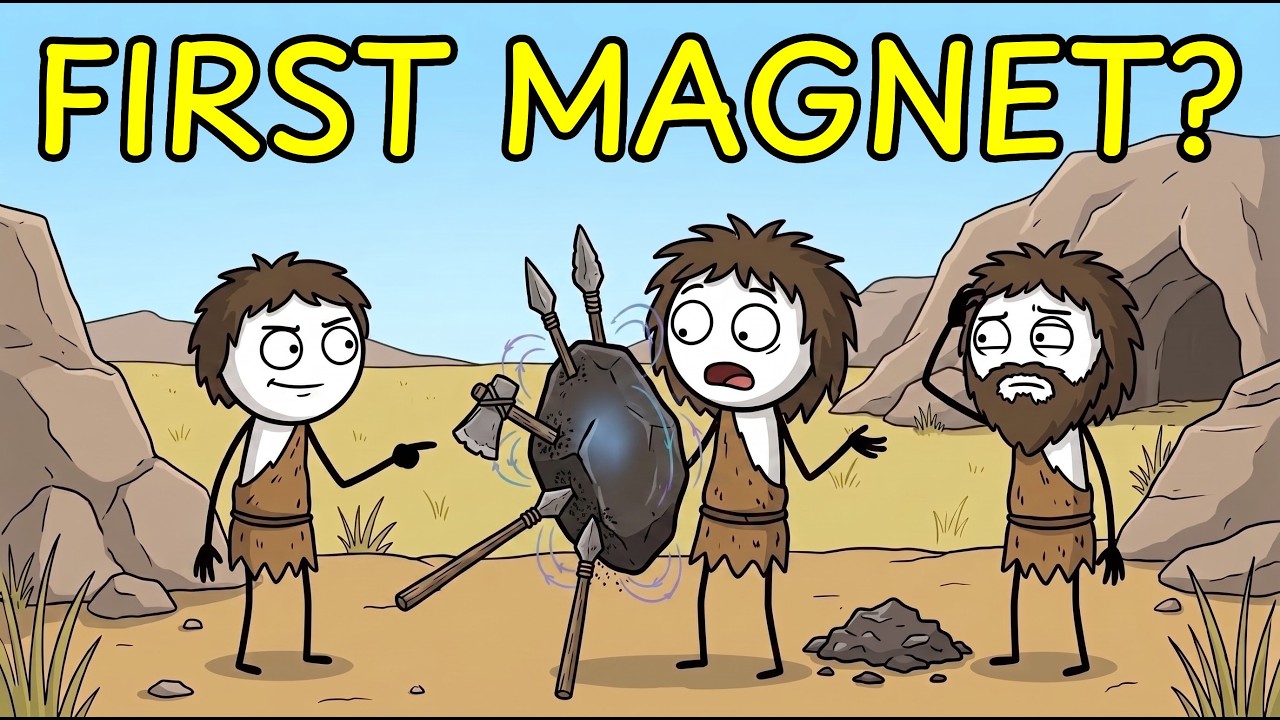
When a bolt strikes an iron-rich rock outcrop, roughly 20,000 amperes of current discharge in a fraction of a second, permanently magnetizing the surrounding magnetite. The first magnet any human ever held was not made by a person. It was made by a thunderstorm hitting a mountain. The earliest written record of magnetic attraction in the Western world comes from Thales of Miletus, a Greek philosopher born around 624 BC in Ionia, in modern-day western Turkey.
Observing that lodestone attracted iron without being touched, Thales concluded the stone must possess a soul. His reasoning was logical within the framework of his time: living things move on their own, dead things do not, and this rock moved iron without contact, therefore it was alive. No genuinely better explanation would emerge for over 2,000 years. Later Greek observers noticed even stranger behavior.
In his dialogue Ion, Plato described how a lodestone could transmit its power through a chain of iron rings, each one attracting the next without the force weakening. That was an early observation of induced magnetism, noted 2,400 years before the physics to explain it existed. Around 55 BC, the Roman poet Lucretius proposed in De Rerum Natura that lodestones emitted streams of invisible particles that pushed air away and created a vacuum that pulled iron forward. He was wrong, but his attempt to find a mechanical explanation without invoking souls or gods was a significant intellectual step.
The word itself carries part of the discovery. Magnetis lithos, meaning stone of Magnesia, refers either to the region of Magnesia in Thessaly or the city of Magnesia ad Sipylum in Lydia, both iron-rich areas that claimed the name. Pliny the Elder, writing in the 1st century AD, passed on a story from the Greek writer Nicander of Colophon about a shepherd named Magnus whose iron-studded sandals and staff stuck fast to the ground beneath him. Whether the name comes from a place or a person, the underlying story is the same: someone encountered a rock that did something impossible and remembered it.
The discovery of magnets, however, was not a single event. In China, the Lüshi Chunqiu, compiled around 239 BC, recorded that the lodestone makes iron approach. Around 83 AD, the philosopher Wang Chong described a device called the Sinan, a south-controlling spoon carved from lodestone placed on a smooth bronze divination board. Significantly, the Sinan was not used for navigation but for geomancy, orienting buildings and tombs according to feng shui principles.
Navigation came a thousand years later. The key figure bridging that gap was Shen Kuo, a Chinese polymath who published his Dream Pool Essays in 1088 AD. He described how to magnetize a steel needle by rubbing it against lodestone and tested multiple suspension methods, including silk thread, a fingernail, the rim of a cup, and floating on a reed in water. He then recorded something no one had noted before: the needle did not point exactly south, deviating slightly from true geographic south.
That observation of magnetic declination is one of the earliest precision geophysical measurements in history. By the early 1100s, the compass had moved from divination boards to ship decks. Zhu Yu, writing between 1111 and 1117 AD, provided the first explicit description of a magnetic compass used for maritime navigation. The technology then spread along trade routes through Arab merchants across the Indian Ocean into the Mediterranean and into European hands.
That single instrument, a magnetized needle floating in water, made it possible for ships to cross open oceans in overcast weather. The age of exploration ran on a piece of magnetized iron in a bowl. Elsewhere, magnetic materials found practical applications. The Sushruta Samhita, an ancient Indian medical treatise compiled in the early centuries AD, describes using magnets in surgery to extract iron arrowheads and metallic fragments from the body, more than 1,500 years before the MRI machine.
In Mesoamerica, the Olmecs, flourishing between roughly 1500 and 500 BC, carved polished mirrors from magnetite, hematite, and ilmenite. In 1975, astronomer John Carlson published a paper in Science describing an Olmec hematite bar labeled M-160 from San Lorenzo, arguing it could have functioned as a magnetic compass, potentially predating the Chinese compass by a millennium. That claim remains controversial, with many archaeologists arguing the object is a fragment of a decorative mirror rather than a navigation tool. The first European written reference to the magnetic compass appears in the work of English scholar Alexander Neckam, who described sailors using a magnetized needle on a pivot to find direction in cloudy weather around 1187 AD.
The first person in Europe to study magnetism experimentally was Petrus Peregrinus de Maricourt, a French crusader engineer who wrote the Epistola de Magnete in 1269 while stationed at the siege of Lucera in southern Italy. Working with a spherical lodestone, he systematically mapped its magnetic field by moving a small iron needle across the surface. He identified the two poles, proved that like poles repel and opposite poles attract, and demonstrated that breaking a magnet in half produces two complete magnets. His letter is considered Europe’s first true experimental study of any physical phenomenon.
In 1600, English physician William Gilbert published De Magnete after 17 years of experiments. His most famous work involved a terrella, a spherical lodestone representing the Earth, over which he moved a small compass needle. Near the equator of the sphere the needle lay flat, while near the poles it dipped steeply, matching real compass behavior at different latitudes. Gilbert concluded that the Earth itself is a giant magnet, generating its field from a molten iron core.
He also separated magnetism from static electricity, coining the term electricus for the effect of rubbed amber. That distinction would be demolished 220 years later. In the 1770s, German physician Franz Anton Mesmer built a medical career on a theory he called animal magnetism, claiming a universal magnetic fluid flowed through all living things and that illness resulted from blockages. He treated patients with magnetized water, metal wands, and an elaborate wooden tub filled with iron filings.
In 1784, King Louis XVI of France appointed a commission including Benjamin Franklin and chemist Antoine Lavoisier to investigate. Through controlled experiments with blindfolded patients, they proved the magnetic fluid did not exist and that all effects were produced by imagination. It was one of history’s first controlled scientific debunkings and an accidental early demonstration of the placebo effect. On April 21, 1820, Danish physicist Hans Christian Ørsted was setting up a lecture at the University of Copenhagen when he noticed that a compass needle swung perpendicular to a wire connected to a battery.
That single observation proved that electricity and magnetism are connected, that a current creates a magnetic field around itself. Ørsted published his findings in a four-page Latin pamphlet, and within months the scientific world changed direction. André-Marie Ampère formalized the mathematics, showing that parallel wires carrying current exert magnetic forces on each other and coining the term electrodynamics. In 1831, Michael Faraday at the Royal Institution in London discovered electromagnetic induction, the reverse of Ørsted’s finding.
He showed that a moving magnet generates an electric current in a nearby conductor. That principle of a moving magnet making electricity is the operating principle behind every generator and power plant on Earth today. Faraday had no formal mathematical training and thought in terms of invisible lines of force, an idea initially dismissed by more mathematically inclined colleagues who were later proven wrong. James Clerk Maxwell translated Faraday’s experimental results into mathematics between 1864 and 1873.
His four equations unified electricity, magnetism, and light into a single framework, predicting that oscillating electric and magnetic fields propagate as waves at the speed of light. Light itself, Maxwell realized, is an electromagnetic wave. In 1887, Heinrich Hertz proved Maxwell right by generating and detecting radio waves. Every wireless signal, every Wi-Fi connection, every satellite broadcast traces back to a Danish professor noticing a compass needle twitch.
More recent research has revealed that magnetism operates at extreme scales. In 1997, physicist Andre Geim at the University of Nijmegen placed a live frog inside a 16-tesla magnetic field, and the frog levitated, suspended by the diamagnetic repulsion of the water molecules in its body. Geim won the 2000 IG Nobel Prize for this experiment and later the real Nobel Prize in Physics in 2010 for discovering graphene. At the opposite extreme, magnetars, neutron stars with magnetic fields over 10 to the power of 15 gauss, generate fields a quadrillion times stronger than Earth’s half-gauss field.
A 2004 giant flare from the magnetar SGR 1806-20 released more energy in a tenth of a second than the sun produces in 250,000 years. The fundamental explanation for magnetism lies in quantum mechanics. Every electron generates a tiny magnetic field through its orbital motion around the nucleus and through spin, an intrinsic quantum property with no classical equivalent. In 1922, Otto Stern and Walther Gerlach demonstrated in Frankfurt that a beam of silver atoms passing through a non-uniform magnetic field split into exactly two bands, showing that magnetic properties come in discrete quantum packages.
In most materials, electron magnetic contributions cancel out, but in iron, cobalt, nickel, and some rare earths, unpaired electrons align parallel through a quantum effect called the exchange interaction, a consequence of the Pauli exclusion principle. These aligned regions are called magnetic domains, and when they align, a rock becomes a magnet. That quantum reality built the modern world. In 1825, William Sturgeon created the first practical electromagnet.
In 1982, teams at Sumitomo Special Metals in Japan and General Motors in the United States independently developed neodymium-iron-boron magnets, the strongest permanent magnets ever created. Every electric motor, every speaker, every MRI machine uses magnets. The magnets were not discovered in a single moment, but independently in at least two civilizations separated by thousands of miles with no evidence of contact. The discovery happened by accident, through a shepherd stepping on a strange rock, a philosopher picking up a stone, a sailor noticing a needle pointing south.
And humans were not the first living things to find magnetism. In 1975, microbiologist Richard Blakemore published a paper in Science describing magnetotactic bacteria, single-celled organisms that grow chains of tiny iron crystals called magnetosomes inside their bodies. These crystal chains act like compass needles, aligning the bacteria along Earth’s magnetic field lines to navigate vertically in water. These bacteria have been doing this for roughly 3 billion years, long before complex life existed.
Sea turtles read both the intensity and inclination angle of the magnetic field to determine their location, and migratory birds use a dual system involving the protein cryptochrome in the eye and magnetite-based sensors in the beak. Earth’s magnetic field itself has been generated for over 4 billion years by churning molten iron in the outer core. The poles flip roughly every 200,000 to 500,000 years, with the last major reversal, the Brunhes-Matuyama reversal, occurring about 780,000 years ago. The magnet was not waiting to be invented.
It was already woven into the structure of the planet and the biology of organisms that learned to feel it. Humans were the last ones to notice but the first ones to ask why.