The first television interview with Osama bin Laden was granted to CNN in March 1997, a time when the world had barely heard his name and the threat of global jihad was a distant concept. Veteran journalist Peter Bergen, who conducted that historic interview, has now revealed the chilling details of the secret, night-time journey into the mountains of Afghanistan to meet the man who would later orchestrate the deadliest attack on American soil. In a new account of his experiences, Bergen describes how he and his team were blindfolded, searched repeatedly, and forced to abandon $50,000 worth of professional equipment before being brought face-to-face with the al-Qaeda leader.
The encounter took place in the Tora Bora mountains of eastern Afghanistan, a region that would later become infamous as the site of a pivotal battle in the War on Terror. Bergen, who was working for CNN at the time, had pitched the idea of interviewing bin Laden to his bosses after hearing the name mentioned in connection with the 1993 World Trade Center bombing. At that point, only one or two photographs of bin Laden existed, and he was virtually unknown to the American public.
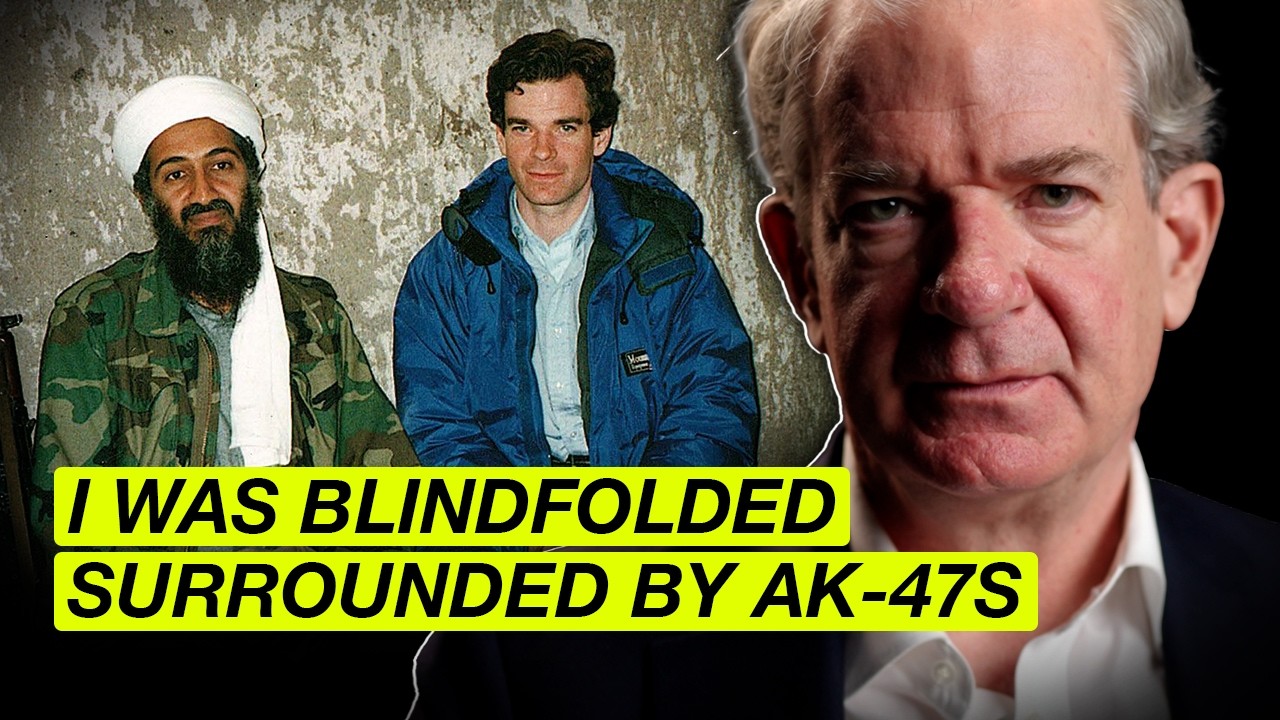 The process of securing the interview was arduous, involving intermediaries in London who were concerned about the journalists’ intentions and whether they were CIA operatives.
“We traveled through the night,” Bergen recalls. “A group of heavily armed men came to the hotel. They put us in the van.
They gave us crude blindfolds. We were searched two or three times.” The security measures were extreme, reflecting the paranoia of a man who was already being hunted by intelligence agencies around the world.
The team was told not to bring anything with them, not even a watch, and their expensive broadcast equipment was left behind. Instead, bin Laden’s men provided a high-definition camera and a generator, ensuring that no tracking devices could compromise their leader’s location.
When bin Laden finally appeared, it was around midnight. Bergen describes a man who was strikingly tall at six feet four inches, very thin, and who carried himself with the demeanor of a cleric rather than a fiery revolutionary. “He wasn’t a table-thumping revolutionary.
He seemed very low-key,” Bergen said. The al-Qaeda leader was surrounded by heavily armed followers carrying AK-47s and RPGs, who hung on his every word. The interview lasted about an hour, during which bin Laden laid out his grievances against the United States, citing American support for Israel and the Saudi royal family as primary reasons for his declaration of war.
At the time, Bergen was struck by the audacity of bin Laden’s ambitions. “I thought to myself, that was all very interesting, but how do you attack the United States from a mud hut in the middle of the night in Afghanistan, 6,000 miles away?” he said.
The country was under Taliban control, had been taken back to the Middle Ages, and had no functioning communication systems. The only way to communicate was through enormously expensive, early versions of satellite phones. The idea that this man could pose a direct threat to the United States seemed almost inconceivable.
Bin Laden denied any role in the 1993 World Trade Center bombing during that interview, though he expressed admiration for the attack. He issued an ominous warning of more terrorist attacks against American targets, a threat that would be realized four years later with devastating consequences. The interview, which was bin Laden’s first with a Western television network, would prove to be a chilling preview of the chaos to come.
Bergen and his team, including the late correspondent Peter Arnett and cameraman Peter Juvenal, had no idea at the time that they were documenting the rise of a man who would redefine global security.
The 1997 interview took place against a backdrop of growing Islamist militancy in Afghanistan. Bergen had traveled to the country in 1993 to investigate the perpetrators of the first World Trade Center attack, which killed six people. He found a landscape teeming with anti-Western militants training for future operations.
The question on everyone’s mind was what they would do next. When Bergen heard bin Laden’s name in 1996, he made the connection that the organized group behind the ’93 bombing must have a leader, and bin Laden was a likely candidate. This led to the pitch to CNN and the subsequent journey into the heart of al-Qaeda’s operations.
The security apparatus surrounding bin Laden was elaborate and effective. His associates in London, some of whom were later revealed to be al-Qaeda members, vetted the journalists extensively. They were concerned about whether the team were CIA agents and whether bin Laden would receive a fair portrayal.
After a period of deliberation, the green light was given, and Bergen’s team set off on a journey that would take them first to Pakistan and then across the Khyber Pass into Afghanistan. The final leg of the journey involved being driven through the night, blindfolded, to a location in the Tora Bora mountains.
 The interview itself was conducted in a setting that was far from the polished studios of Western media. Bin Laden’s followers sat in on the conversation, creating an atmosphere of intense scrutiny. Bergen asked bin Laden why he was at war with the United States, and the answers were rooted in American foreign policy in the Middle East.
Bin Laden cited support for Israel, which he viewed as an illegitimate state, and support for the Saudi royal family, which he believed did not rule in a sufficiently Islamic way. He was calm, measured, and utterly convinced of the righteousness of his cause.
Reflecting on the interview years later, Bergen notes that bin Laden’s low-key demeanor was deceptive. “He carried himself like a cleric,” Bergen said. “He wasn’t a table-thumping revolutionary.”
This quiet intensity, combined with the absolute loyalty of his followers, made him a uniquely dangerous figure. The interview ended as abruptly as it had begun, with bin Laden disappearing into the night. Bergen and his team were left to ponder the implications of what they had witnessed, unaware that they had just met the man who would orchestrate the September 11, 2001 attacks.
The aftermath of the interview saw bin Laden’s profile rise dramatically. In 1998, al-Qaeda bombed two American embassies in Africa, killing more than 200 people and demonstrating the group’s global reach. The attacks were a wake-up call to the international community, revealing that bin Laden had no compunction about killing large numbers of civilians.
Bergen points out that this was a departure from the behavior of many terrorist groups, which had previously tried to limit civilian casualties. Al-Qaeda was entering a new era of mass-casualty terrorism.
The Clinton administration’s response to the embassy bombings included cruise missile strikes on al-Qaeda training camps in Afghanistan, but bin Laden was not present, and the attacks killed only low-level militants. The CIA developed plans to capture or 𝓀𝒾𝓁𝓁 bin Laden, but these were fraught with difficulty. Bergen explains that the intelligence community was hampered by a lack of clear opportunities and a risk-averse culture that had developed after the Black Hawk Down incident in Somalia in 1993.
The most promising opportunity, when bin Laden was visiting a hunting camp in the Kandahar desert, was not taken due to concerns about the presence of civilians, possibly including members of the Emirati royal family.
Bergen is unequivocal in his assessment that killing or capturing bin Laden before 9/11 would have derailed the attacks. “9/11 was bin Laden’s idea,” he said. “Zawahiri, his number two, was preoccupied by overthrowing the Egyptian government.
9/11 was bin Laden’s big strategic idea.” The plot, which began to take shape seriously in 1999, required an extraordinary level of organization. Nineteen hijackers had to be recruited and trained, including pilots capable of flying commercial airliners.
The operation cost approximately $500,000, and its success depended on a level of operational security that al-Qaeda had honed over years of clandestine activity.
The attack on the USS Cole in October 2000, which killed 17 American sailors, was another missed opportunity to respond decisively. Bergen describes it as an act of war under international law, but neither the Clinton nor the Bush administration took meaningful action. This inaction, Bergen argues, emboldened al-Qaeda and allowed the 9/11 plot to proceed unimpeded.
When the attacks finally came, Bergen was not entirely surprised. He had spent two years researching bin Laden and al-Qaeda for his first book, which he had finished just a week before 9/11. The assassination of anti-Taliban leader Ahmad Shah Massoud two days before the attacks was a clear signal that something momentous was underway.
 On the morning of September 11, 2001, Bergen was heading to CNN to discuss Massoud’s assassination when his father, a former pilot, told him that a plane had crashed into the World Trade Center. By the time Bergen reached the studio, it was clear that the United States was under attack. He went on air at 12:30 p.
m. that day and stated his belief that bin Laden was responsible, citing both capability and intent. “There might be plenty of people with the intent but no capability, and there might be plenty of states with the capabilities but not the intent,” he said.
The logic was inescapable.
The subsequent US response to 9/11 was swift, with military operations beginning in October 2001. By mid-December, the Taliban had fallen, and bin Laden seemed cornered at Tora Bora. However, a combination of risk-averse military leadership and a lack of ground forces allowed him to escape.
Bergen has precisely nailed down the moment of his departure: December 12, 2001, at about 11:00 p. m. , when bin Laden and two of his sons left by horseback, doubling back into Afghanistan rather than crossing into Pakistan as most assumed.
They disappeared into the remote Kunar province, where they remained for about a year.
The failure at Tora Bora was a huge missed opportunity, according to Bergen. The CIA requested a battalion of 800 Rangers to secure the area, and General Jim Mattis offered 1,500 Marines, but neither was deployed. The Pentagon, scarred by the Somalia experience, was reluctant to commit ground forces.
Bergen argues that this risk aversion was a catastrophic error. “If bin Laden had been captured or killed at Tora Bora, a lot of the energy around the war on terror would have dissipated,” he said. The Bush administration’s principal demand of the Taliban was the surrender of bin Laden, and his escape prolonged the conflict for another two decades.
The war in Afghanistan then evolved into a nation-building exercise, with the United States helping to install President Hamid Karzai. There were early successes, including high voter turnout in the first Afghan elections and significant progress in education and women’s rights. However, the effort was chronically under-resourced because the bulk of American military and intelligence resources were diverted to Iraq.
Bergen notes that the best people in the intelligence community were assigned to the Iraq account, and White House attention was focused on Baghdad. This neglect allowed the Taliban to regroup and launch an effective insurgency.
President Obama’s response was to authorize a surge of 30,000 troops in 2009, which rolled back the Taliban in southern and eastern Afghanistan. Bergen was embedded with the Marines in Helmand Province during this period and witnessed the damage inflicted on the insurgency. However, he argues that the United States again failed to capitalize on military success by not opening meaningful peace negotiations with the Taliban.
It was not until the Trump administration in 2018 that talks began, and by then the Taliban had a much stronger hand. The Trump administration made a critical mistake by excluding the Afghan government from the negotiating table, treating the Taliban as a government in waiting.
The Biden administration compounded these errors by agreeing to the withdrawal agreement and setting a firm date for departure. Bergen is scathing in his criticism of this decision. “The Taliban won at the negotiating table what they couldn’t win on the battlefield,” he said.
 Before the withdrawal was announced in April 2021, the Taliban controlled none of Afghanistan’s 34 provincial capitals. Within months of the announcement, confidence cratered, and the Taliban swept to power, taking Kabul on August 15, 2021. Bergen dismisses President Biden’s claim that Afghans were not prepared to fight, noting that 66,000 Afghan soldiers and policemen died fighting the Taliban.
They were prepared to fight, but they were not suicidal.
The collapse of the Afghan military was accelerated by the departure of American contractors, who had been servicing the Afghan air force’s helicopters and planes. Once they left, the aircraft quickly became inoperable, and the loss of air support destroyed morale. Bergen argues that a minimal American presence, even 2,500 troops, could have maintained stability and prevented the collapse.
“The Afghans just wanted us to say we’re staying,” he said. “As soon as we said we’re leaving, the whole project collapsed.” The chaotic withdrawal also signaled weakness to America’s adversaries, and Bergen believes it influenced Vladimir Putin’s decision to invade Ukraine.
Today, Afghanistan is again a safe haven for terrorist groups. The United Nations estimates that about 400 members of al-Qaeda are living in the country, some receiving welfare payments from the Taliban and others holding government positions. An estimated 20 terrorist groups operate there, including ISIS-K, which killed 140 people at a concert hall in Moscow.
However, Bergen notes that the United States is a much harder target than it was on 9/11. Defensive capabilities have been massively enhanced, with the Department of Homeland Security and the National Counterterrorism Center created in the aftermath of the attacks. Offensive capabilities, including drone strikes, have been used effectively against groups like al-Shabaab in Somalia.
The threat from foreign terrorist organizations has receded, but a new challenge has emerged: domestic radicalization. Bergen points to attacks by ISIS-inspired individuals in Orlando and San Bernardino as examples of this phenomenon. “You can’t stop what people read online,” he said.
“It’s very hard to deal with, particularly if they’re lone actors radicalizing in their bedrooms.” This is the new front in the war on terror, one that is far more diffuse and difficult to combat than the centralized threat posed by al-Qaeda in the early 2000s.
Bergen’s new book, “All the Presidents’ Wars: 25 Years of America’s War on Terror,” examines the struggles of successive administrations to define an endgame for the conflict. He argues that the United States has consistently failed to plan for the day after hostilities cease. “Wars begin when you will but they do not end when you please,” he said, quoting Machiavelli.
The lessons of the post-9/11 era are clear: congressional authorization, NATO allies, UN resolutions, and a realistic plan for the aftermath are essential prerequisites for any military engagement. The Iraq war, which lacked these elements, and the Iran war, which is ongoing, demonstrate the consequences of ignoring these principles.
Bergen is particularly critical of the current situation in Iran, where the United States has achieved some of its war aims but has created a more hardcore leadership and given Iran control over the Strait of Hormuz. “The stakes for them are existential, and they’re going to fight in a way that we’re not,” he said. The Iran war is the least popular war at its beginning since polling began, with only 41% of Americans initially supporting it.
Bergen laments that the United States seems to have made every mistake with the Iran war that it made with its previous post-9/11 conflicts. “We seem to have very little ability to learn from our own relatively recent history, which is a shame,” he said.
Reflecting on his 1997 interview with bin Laden, Bergen acknowledges that he and his colleagues were witnesses to history in the making. The man they met in the mountains of Afghanistan was soft-spoken but utterly resolute, a leader whose vision would shape the early 21st century. The interview, which was broadcast to a world that barely knew bin Laden’s name, now stands as a chilling artifact of a time when the threat was visible but not fully understood.
Bergen’s account serves as a reminder of the fragility of peace and the enduring consequences of underestimating a determined enemy.