Science has confirmed what many suspected all along: mosquitoes genuinely prefer some people over others, and the reasons are rooted in biology rather than bad luck. Research shows that a combination of genetics, body chemistry, and even lifestyle choices determines who becomes a mosquito magnet and who is left completely untouched. The first signal mosquitoes detect is carbon dioxide. Every exhale releases a plume of CO2 that mosquitoes can sense from up to 50 meters away—half a football field—using specialized sensory organs called maxillary palps.
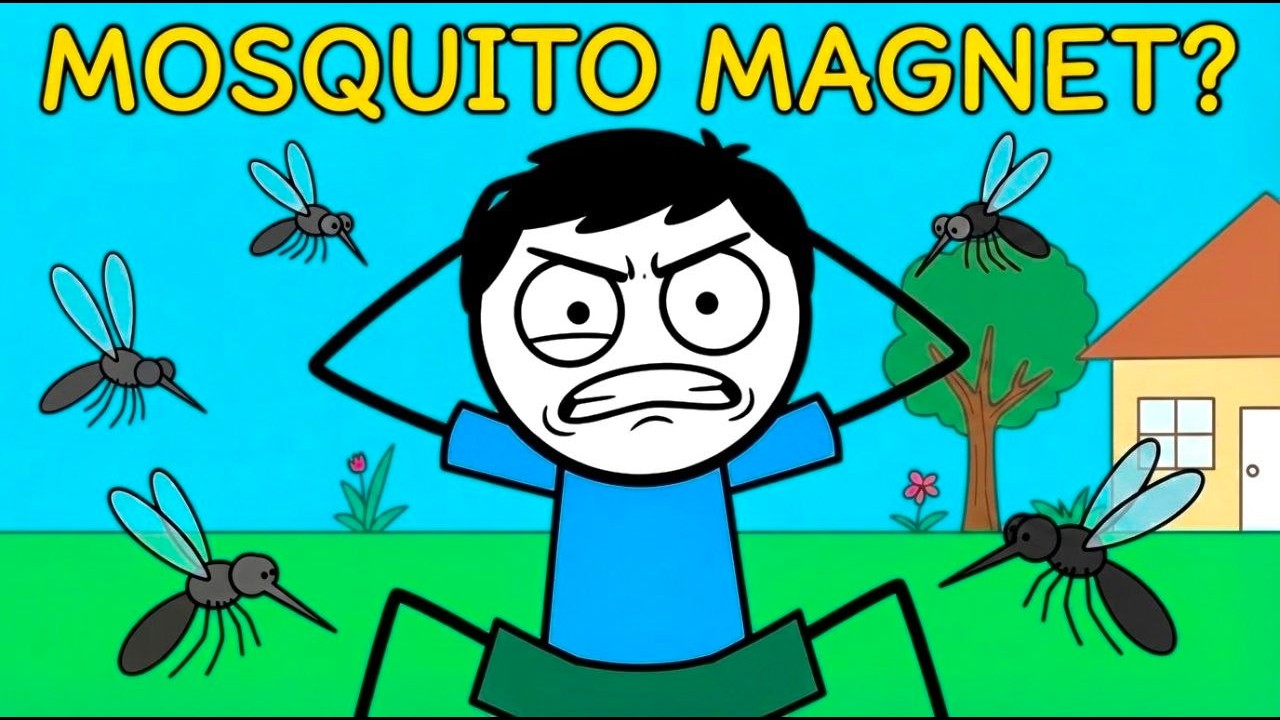
Larger people exhale more CO2 because their bodies require more energy to maintain mass, pregnant women produce elevated levels due to higher metabolic rates, and anyone exercising expels enormous amounts. Simply being out of breath after a jog effectively sends a dinner invitation to every mosquito in the vicinity. But CO2 alone does not explain why mosquitoes choose certain targets over others when levels are similar. The next layer is skin chemistry.
Human skin secretes a unique cocktail of compounds—lactic acid, ammonia, uric acid, fatty acids, and hundreds of other volatile organic compounds—that combine into what researchers call the skin microbiome. This signature is completely unique to each person, and mosquitoes react differently to different combinations. Lactic acid, produced when muscles metabolize glucose and expelled through sweat, is consistently linked to greater mosquito attraction. Athletes and people who have consumed foods that spike blood sugar produce higher concentrations.
Another compound, 1-octen-3-ol—often called mushroom alcohol for the earthy smell it gives mushrooms—is a byproduct of fat metabolism that mosquitoes find especially appealing. Traps baited with it catch significantly more mosquitoes than unbaited traps, and some people naturally produce more of it than others. Some people carry compounds that actually repel mosquitoes, such as eucalyptol and certain aldehydes. Researchers are studying these individuals hoping to identify exactly which chemicals do the repelling, with the goal of developing a new generation of longer-lasting, more effective repellents.
Blood type also plays a role. A study published in the Journal of Medical Entomology found that mosquitoes landed on people with type O blood almost twice as often as those with type A, with type B falling in between. About 80% of people secrete chemical signals through their skin that indicate blood type, and these secretors are more attractive to mosquitoes than non-secretors regardless of blood type. The bacteria residing on the skin create another layer of influence.
These microorganisms feed on skin compounds and generate their own byproducts, which become part of the chemical cloud surrounding each person. A landmark study from Wageningen University in the Netherlands found that people with a higher diversity of skin bacteria were less attractive to mosquitoes. Those with lower diversity but higher amounts of specific species, particularly Staphylococcus and Pseudomonas, were significantly more attractive. Genetics, upbringing, diet, antibacterial soap use, exercise frequency, antibiotic history, and even stress levels all shape this microscopic ecosystem.
Body temperature matters at close range. Mosquitoes use heat-sensing receptors to land precisely on areas where blood vessels sit near the skin surface. People who naturally run warmer—due to higher metabolic rates, recent exercise, or dark clothing that absorbs heat—are easier targets. Pregnant women are disproportionately affected because their body temperature is elevated, CO2 output is increased, and blood flow to the skin is amplified.
Dark clothing makes people more detectable because mosquitoes navigate partly by vision at close range, and darker colors are more visible against the horizon. Genetics underpins much of this variation. A 2015 study from the London School of Hygiene and Tropical Medicine examined identical and fraternal twins and found that identical twins showed very similar levels of mosquito attraction while fraternal twins varied much more. Researchers concluded that roughly 67% of the variation in mosquito attraction is attributable to genetic factors, meaning the majority of mosquito magnetism is decided before birth.
The genetic component influences skin secretion composition, the nature of the skin microbiome, body temperature regulation, and even immune response to mosquito saliva, which explains why some people swell dramatically after bites while others barely notice. Stress introduces another unexpected twist. Hormones released during anxiety—cortisol and adrenaline—accelerate metabolism, slightly raise body temperature, and alter skin compounds. Stress sweat is chemically different from heat sweat, containing more proteins and fatty acids, and it tends to attract mosquitoes more effectively.
This creates what appears to be a cruel biological loop: the more someone worries about being bitten, the more attractive they become to the very insects they fear. The stakes go far beyond personal discomfort. Mosquitoes are the deadliest animals on Earth, killing between 1 and 2 million people annually through diseases including malaria, dengue fever, Zika virus, West Nile virus, chikungunya, and yellow fever. Malaria alone claims hundreds of thousands of children under five every year.
Understanding mosquito attraction has direct public health implications, potentially enabling better repellents, probiotic interventions that reduce attractiveness in high-risk populations, and personalized prevention strategies for people in malaria-endemic regions. Cutting-edge research is exploring biological approaches to mosquito control. One method involves releasing genetically modified male mosquitoes carrying a gene that causes offspring to die before adulthood. Since only females bite—males feed exclusively on nectar—releasing modified males does not increase biting but can crash local mosquito populations over several generations.
Field trials in Brazil and the Florida Keys have demonstrated significant reductions in Aedes aegypti populations, the primary vector for dengue, Zika, and yellow fever. Another approach called gene drive technology involves genetic elements that spread through populations faster than normal inheritance patterns allow. Lab studies suggest gene drives could theoretically spread sterility or disease resistance through mosquito populations, though the ecological and ethical implications require extraordinary caution. Other experiments involve releasing mosquitoes infected with the naturally occurring bacterium Wolbachia, which makes them significantly less capable of transmitting dengue and other viruses.
Trial programs in Australia, Indonesia, Brazil, and Colombia have shown remarkable success in reducing dengue transmission. For individuals facing practical decisions at a summer barbecue, several evidence-based strategies exist. Repellents containing DEET or picaridin remain the gold standard. DEET works by interfering with the olfactory receptors mosquitoes use to detect CO2 and other attractants, effectively jamming their sensory signals.
A 10% concentration provides about two hours of protection, while 30% extends that to five or six hours. Picaridin performs comparably, is odorless, does not feel greasy, and is safe on plastics and fabrics. IR3535, gentler on skin, is commonly used in children’s repellents. Citronella candles offer only marginal protection because the concentration in the surrounding air is too low and localized to make a meaningful difference in any wind.
Diet evidence is mixed. Multiple studies have consistently shown that drinking even a single beer increases mosquito attraction, possibly due to elevated body temperature, increased lactic acid production, or altered skin secretions. Foods high in thiamine are popularly claimed to repel mosquitoes, but clinical trials have been largely inconclusive. Garlic similarly lacks compelling support in controlled studies.
Emerging research on gut microbiome manipulation through probiotics is promising but remains frontier science with nothing definitive yet. Other practical measures include wearing light-colored, loose-fitting clothing; avoiding outdoor activity during peak mosquito hours at dawn and dusk; and eliminating standing water around the home, as mosquitoes breed in as little as a bottle cap full of water. Bird baths, clogged gutters, old tires, and plant trays all serve as potential breeding grounds. What emerges from the science is a picture of the human body as a constant broadcaster.
The skin microbiome processes secretions and generates byproducts, breath trails behind, and diet, stress levels, genetics, and microbial passengers all converge into an invisible chemical signature that is uniquely personal. Mosquitoes have refined their sensory systems over more than 100 million years, predating the dinosaurs, and they remain exquisitely tuned to locating warm-blooded hosts. For the mosquito magnet standing at the barbecue, there is no escaping the reality that their own biology has conspired to make them the most interesting person at the party—at least to a mosquito.