More than 50 years after a man hijacked a commercial jetliner, demanded $200,000, and parachuted into a stormy Pacific Northwest night, an independent investigator reportedly claims to have obtained DNA evidence that could finally point to the man known as D. B. Cooper. According to early 2025 reports circulating in the true crime community, a private research group says it found traces of human DNA trapped deep inside the fibers of Cooper’s famous black clip-on tie.
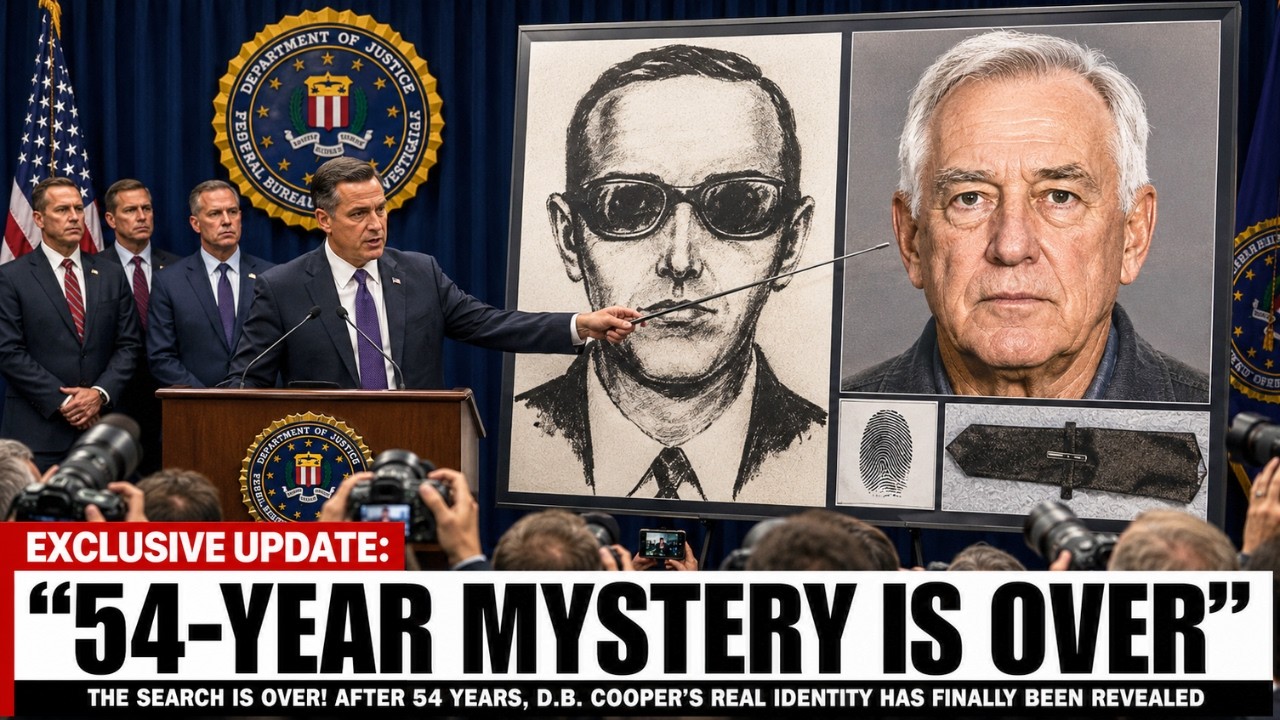
The tie has been handled, tested, and displayed for decades, and earlier FBI testing in the early 2000s failed to yield useful results. Researchers using highly sensitive modern techniques claim the DNA shows partial connections to family lines linked to aerospace engineering and technical manufacturing in the Pacific Northwest. That detail echoes an earlier clue: microscopic titanium particles were once found on the same tie, a material commonly used in aircraft manufacturing during the 1960s. The FBI, which closed the Cooper investigation in 2016, has not reopened the case or publicly confirmed the new findings.
Forensic experts caution that DNA can survive for decades inside protected materials, but others warn the tie has been touched by agents, lab workers, museum staff, and researchers over the years, meaning any trace could belong to someone other than Cooper. The titanium particles also do not prove industry ties, as the material was used in tools, bicycle paint, and office equipment. The connection to Boeing remains a possibility, not proof. The story that made Cooper a legend began on November 24, 1971, when a man using the name Dan Cooper bought a one-way ticket at Portland International Airport.
He boarded Northwest Orient Airlines Flight 305 heading to Seattle, took seat 18C, ordered bourbon and soda, and lit a cigarette. Shortly after takeoff, he handed a note to flight attendant Florence Shaner. When she put it in her pocket without reading it, he leaned over and said, “Miss, you’d better look at that note. I have a bomb.
” The note demanded $200,000 in cash, four parachutes, and a fuel truck waiting in Seattle. He opened his briefcase slightly, showing what appeared to be wires and dynamite. The plane landed in Seattle, where the money and parachutes were brought aboard. Cooper released the passengers, many of whom had no idea a hijacking had occurred.
He then ordered the pilots to fly south toward Mexico City at 10,000 feet, with the flaps down and the aircraft flying slowly. Over the forests of Washington State, in darkness and rain, Cooper lowered the rear staircase of the Boeing 727, tied the ransom money to himself, and jumped. No one saw him land. He was never seen again.
The name “D. B. Cooper” came from a reporting error. A journalist mixed up the name on the ticket, and the wrong initials stuck, becoming part of the legend.
The FBI pursued more than 800 leads over the years. Suspects ranged from veterans and skydivers to airline workers and criminals. Richard Floyd McCoy, a former Green Beret who pulled off a similar hijacking months later, was investigated but was believed to be a copycat. McCoy was caught, sentenced to 45 years, escaped prison, and was shot and killed by federal agents in Virginia at age 31.
Kenneth Christensen, a former paratrooper and Northwest Airlines employee, was another strong suspect. His brother claimed Christensen made a cryptic deathbed statement, but no money or evidence connected him to the crime. Other suspects included Dwayne Weber, whose wife said he confessed to being Cooper before his death, and William J. Smith, a World War II veteran.
None were confirmed. In 1980, a boy camping along the Columbia River found about $5,800 of the ransom money buried in sand. The serial numbers matched the cash given to Cooper. The discovery fueled theories that Cooper died during the jump or hid the money for a later return.
Conspiracy theories have ranged from Cooper being a CIA agent testing airline security to a time traveler or alien. That Cooper has become a folk hero is part of why the case endures, said people who study it. One investigator who has drawn recent attention is Dan Grider, who has named possible suspects. Grider’s research reportedly challenges the image of Cooper as a charming, smooth outlaw.
Instead, he presents Cooper as a more ordinary and practical man who took an enormous, dangerous risk rather than a brilliant criminal mastermind. The reality may be far less glamorous. Cooper jumped into cold, rainy conditions with strong winds, wearing a suit and loafers, with no helmet, altimeter, or night vision gear. If he survived, it is unclear whether he landed safely or spent the money.
As of the latest reports, the FBI has not verified the new DNA findings, and the case remains officially closed. Still, the possibility that a single strand of DNA could solve one of America’s most famous unsolved crimes continues to draw attention from investigators and amateurs alike, even after all these years.