A popular thought experiment asks who would survive longer if a modern human and an ancient human were dropped into a prehistoric wilderness without equipment. The common answer is that the ancient human dies first, but the reality is far more complex, and the result depends heavily on the rules of the contest. In a naked, equipment-free scenario, the modern human typically dies first. This is not because modern people are stupider, but because survival in the wild is not an intelligence test.
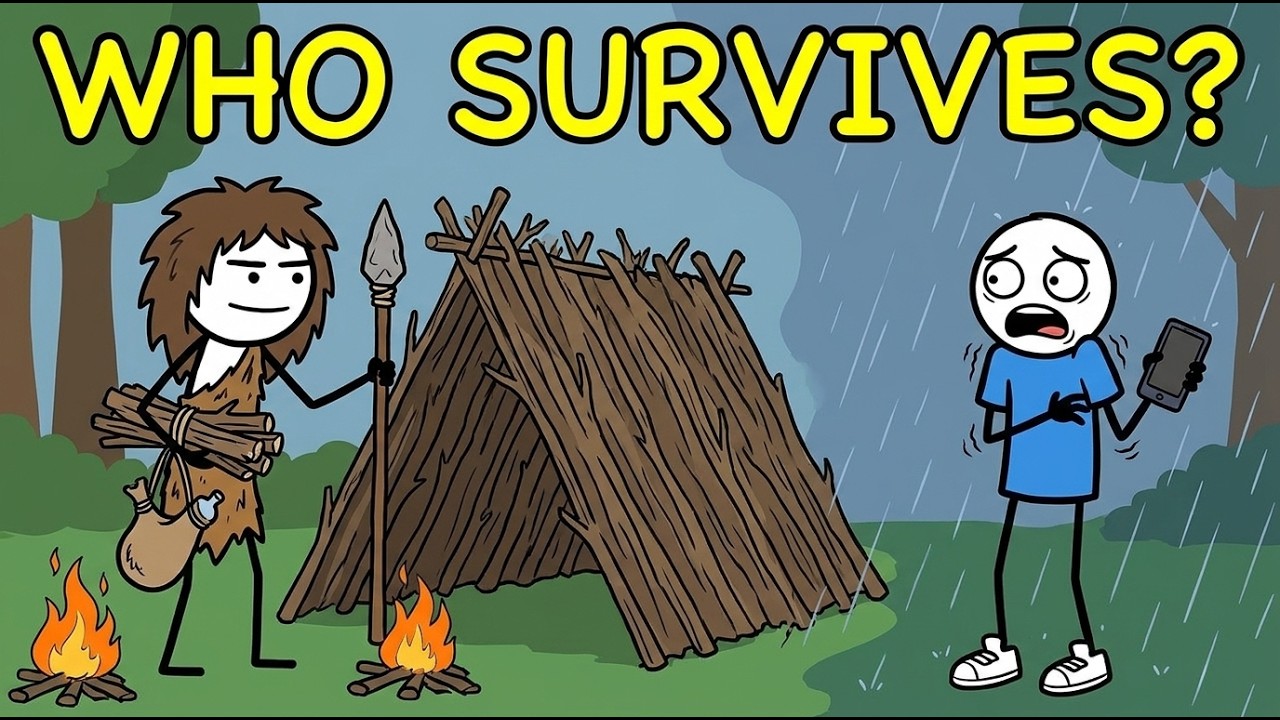
It is a knowledge test performed while cold, thirsty, injured, and frightened. A skilled hunter-gatherer from 30,000 years ago reads the landscape like a manual, noticing animal trails, edible roots, dry tinder, changing clouds, and the warning calls of birds. A modern person often sees only trees. Water is the first critical barrier.
Severe dehydration can kill within days. Ancient survivors did not simply search for water; they read the terrain, knowing where rain collects, which vegetation signals moisture, and which springs persist through dry seasons. This knowledge was local and learned from childhood through observation, practice, and stories. The modern person may know the slogans—follow birds, walk downhill, boil everything—but lacks the hidden context, such as what container to boil water in when nothing man-made exists.
Fire presents a similar challenge. Understanding the chemistry of combustion is useless without the practiced hand skills required to build a bow drill, select the correct wood, and manage friction under real-world conditions. For the ancient expert, these skills are stored in muscle memory, refined by thousands of small corrections. For the modern novice, they are facts without a foundation.
Shelter and clothing are equally unforgiving. A poorly built shelter can leak, collapse, or trap smoke, and hypothermia can set in without an Arctic blizzard. Ancient clothing was a manufacturing system, involving scraping hides, sewing with bone needles, and planning for seasons in advance. The modern human, if stripped of synthetic layers and steel tools, is not returned to a natural state—they are left without the cultural inheritance that modern civilization has externalized into objects and infrastructure.
However, the contest reverses violently when equipment is introduced. Give a modern human a lighter, a water filter, antibiotics, a steel knife, and a satellite communicator, and the balance shifts decisively. A lighter contains centuries of chemistry and manufacturing; a water filter contains materials science. The ancient human, given their own stone tools, hides, and cordage, cannot compete with a kit that compresses entire industries into a backpack.
The uncomfortable truth is that the best modern human—a trained survival expert—would devastate an average ancient human. But the best ancient human was the average. Modern society allows specialization because most people can remain alive while knowing almost nothing about local ecology, protected by farmers, engineers, doctors, and supply chains. The modern human’s apparent helplessness is actually extreme interdependence, and it becomes fatal only when the network disappears.
This is why the real winner is the group. Ancient humans rarely survived as isolated individuals. They relied on food sharing, cooperative defense, and distributed knowledge. A hunter who fails is fed by others; an elder who cannot hunt still holds ecological memory.
Modern civilization uses the same strategy at a massive scale. No single person can build a smartphone from raw earth, but millions of coordinated strangers can. If twenty ancient hunter-gatherers were placed against twenty ordinary modern adults in identical unfamiliar wilderness, the ancient group would likely win early, possessing overlapping practical skills and an existing social structure. The modern group might contain a nurse, a mechanic, or a gardener, but their knowledge fragments may not connect under pressure.
If both groups had access to their societies’ resources, the modern group would win so completely that survival stops being the relevant category. Location also matters. Ancient expertise was local science, not a universal package downloaded into every prehistoric brain. An Arctic hunter transported to a rainforest would need new knowledge.
In a completely unfamiliar environment, both contestants become students, and the outcome depends less on intelligence than on humility, observation, and the ability to learn without becoming confident too quickly. The final verdict is that neither modern nor ancient humans survive alone. The ancient human carries a community in memory, while the modern human carries a far larger community in objects. Strip both of their networks, and the contest does not reveal which human is superior.
It reveals how incomplete a human has always been by themselves. Our ancestors survived because knowledge moved between people and accumulated. Modernity did not replace that strategy—it expanded it until the hunting party became civilization.