The first thing Tessa Grant carried into my guest house was a white suitcase. The second was a box of prenatal vitamins. I saw the label when the box slipped from her grocery bag and landed beside my boots. At seven months pregnant, bending was no longer easy.
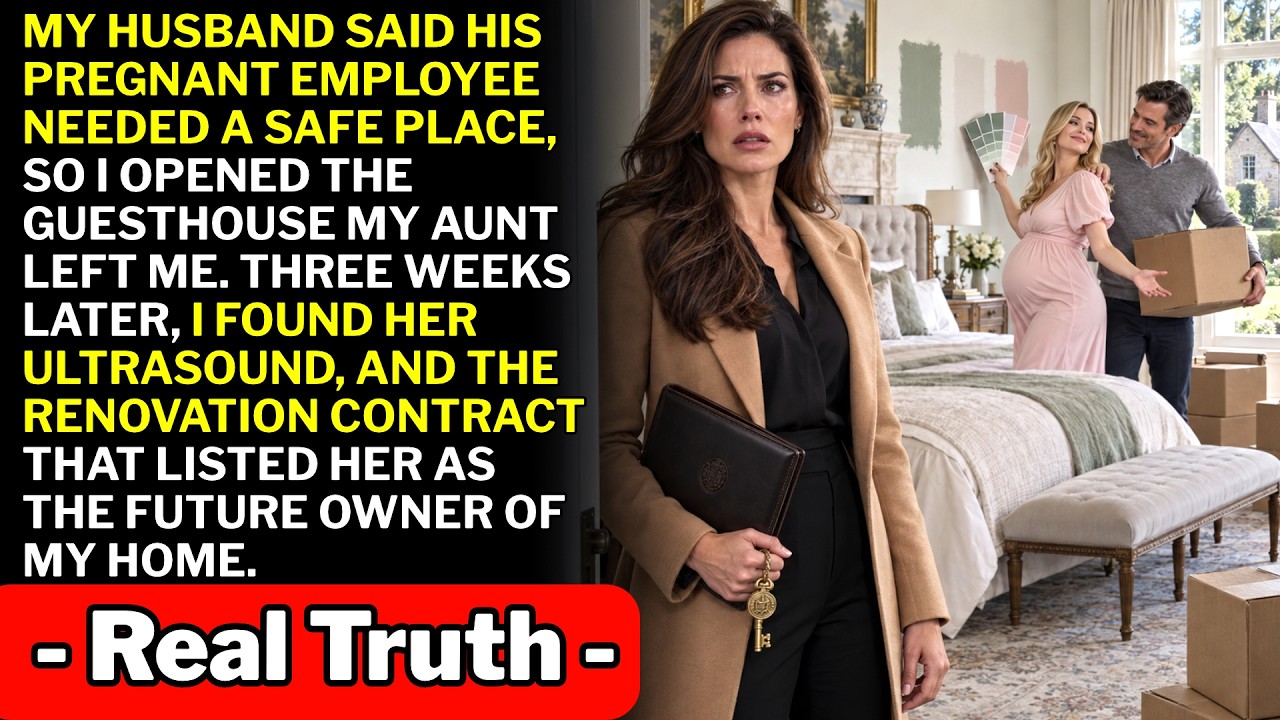
I picked them up and handed them to her. She smiled with the fragile gratitude of someone determined to appear brave. “Thank you, Mrs. Ellison.
”
“Clara,” I corrected. “If you’re staying on my property, we cannot spend every morning arguing about my name. ”
My husband Martin stood behind her carrying two more suitcases. He looked relieved that I had made a joke.
“I told you Clara would understand,” he said. What he had told me was that Tessa, his marketing director, needed a safe place for a few weeks. Her relationship had ended badly, the apartment lease was in her former fiancé’s name, and she was pregnant, frightened, and too proud to ask her parents for help. The guest house at Greystone Farm had been empty since my aunt Rose died eighteen months earlier.
It was a two-bedroom stone cottage at the far edge of the orchard, close enough to the main house for safety and far enough for privacy. Rose had called it Haven House. During my childhood, women sometimes appeared there without explanation and stayed for a week or a month. My aunt never shared their stories.
She simply left food on the porch, found them work if they needed it, and made sure nobody asked questions they were not ready to answer. When I inherited Greystone, I promised to preserve that kindness. So when Martin asked me to help a pregnant woman, I said yes before I had met her. Tessa was thirty-seven, though pregnancy made her seem younger.
Her blonde hair was pulled into a loose knot. She wore a gray sweater over black leggings and no wedding ring. I had met her at company dinners and Christmas parties, but we had never spoken for more than a few minutes. Martin ran Ellison Hospitality, a small development company specializing in historic inns.
Tessa had joined four years earlier. He described her as creative, tireless, and unusually loyal. I understood the importance of loyalty. Martin and I had been married thirty-six years.
We had raised two children at Greystone—Rachel, thirty-three, a landscape architect in Burlington, and Ben, thirty, a high school history teacher in Boston. Both complained that I kept too many rooms exactly as they remembered them. The guest house was the one part of the property I had been willing to change. I spent two weeks cleaning it before Tessa arrived.
I washed curtains, stocked the kitchen, placed fresh towels in the bathroom, and moved Rose’s old writing desk beneath the front window. On the dresser I left a vase of late-summer dahlias. Tessa touched the petals and said, “Martin said you would make it beautiful. ”
Something about the way she said his name caught my attention.
Not Martin, my employer. Not your husband. Simply Martin, spoken with the ease of repetition. I dismissed the feeling.
Suspicion is embarrassing when someone is standing before you with swollen ankles and nowhere else to sleep. “How long do you think you’ll need? ” I asked. Martin answered for her.
“A month, six weeks at most. ”
“I can find another place before the baby comes,” Tessa said. “You should not be moving furniture at eight months pregnant,” I replied. “Stay until you have something safe.
”
Her eyes filled with tears. Martin placed a hand against the center of her back. It was a small gesture, helpful, almost fatherly, but his thumb moved once beneath the edge of her sweater. Tessa stepped away.
That evening Martin praised me throughout dinner. “Rose would be proud,” he said. “You have her heart. ”
I cut my chicken and smiled.
“Do we know anything about the baby’s father? ”
His fork stopped briefly. “Only that he isn’t involved. ”
“Has Tessa said that?
”
“She doesn’t like discussing him. ”
“You seem to know a great deal about what she likes. ”
Martin laughed. “I manage twelve people, Clara.
Knowing when not to push is part of the job. ”
After dinner he carried a toolbox to Haven House because the kitchen window would not lock. He returned more than an hour later. “Difficult repair?
” I asked. “The frame is warped. ”
“Rose never had trouble with it. ”
“Rose opened that window twice a year.
”
He kissed my forehead and went upstairs. The following morning I walked toward the orchard at sunrise. Mist rested between the apple trees. Tessa’s bedroom curtain was open.
Martin stood beside her bed, his shirt unbuttoned. For one suspended second none of us moved. Then Tessa pulled the curtain closed. Martin returned to the main house twenty minutes later wearing his shirt properly.
I was waiting in the kitchen. “Tell me,” I said. He did not pretend not to understand. “Tessa became dizzy during the night.
She called me because she didn’t want to frighten you. ”
“Why was your shirt open? ”
“She spilled tea on me at six in the morning. Clara, she is pregnant and alone.
Do you want me to apologize for helping her? ”
That was Martin’s gift. He could place kindness and guilt on opposite sides of a question, then make me ashamed for standing anywhere else. “Then show me the tea stain.
”
He looked down at the pale blue shirt. There was no stain. “I rinsed it while wearing it. ”
“Listen to yourself.
”
The phrase was familiar. Martin used it whenever he wanted my question to become the problem. He took his coffee and left for the office without eating. At nine, Tessa knocked on my back door.
She looked exhausted. Her eyes were swollen and both hands rested protectively beneath her stomach. “I’m sorry,” she said. “I should have called you.
I panicked. I had cramps and thought something was wrong with the baby. Martin came over and I knocked his coffee onto his shirt. ”
She repeated his explanation with one change.
He had said tea. She had said coffee. “Are you feeling better? ” I asked.
“Yes. The doctor said I should rest. ”
“You called the doctor? ”
“Martin did.
”
“What is your doctor’s name? ”
Fear entered her eyes. “Dr. Hall.
”
“At which hospital? ”
“St. Anne’s. ”
There was no St.
Anne’s hospital within a hundred miles of Greystone. Tessa began crying. “I knew this would happen. I knew you would think I came here to cause trouble.
”
Compassion rose inside me despite everything. Pregnancy had once been the most vulnerable season of my own life. I remembered how quickly fear could make a woman sound confused. “I don’t think you came here to cause trouble,” I said carefully.
“I think someone is not telling me the truth. ”
Tessa wiped her face. “My doctor is in New York. I moved here only recently.
Martin called the nurse line, not the hospital. I said the wrong name because I’m embarrassed. ”
It was possible. Almost anything is possible when you desperately want your marriage to remain intact.
I made her tea. She sat at my kitchen table and told me about her former fiancé, Colin. According to Tessa, he had become controlling after she announced the pregnancy. He monitored her spending, criticized her weight, and threatened to take the baby.
“Is he the father? ” I asked. She stared into her cup. “Biologically?
”
“Yes. ”
The word sounded rehearsed. “Does Martin know him? ”
“Only through me.
”
Before leaving, she touched my hand. “You have been kinder than I deserve. ”
I thought it was gratitude. Later I understood it was the first honest thing she told me.
That afternoon I drove to Martin’s office without calling. His assistant said he was meeting an investor. Through the glass conference room wall I saw Tessa’s empty chair. “Is Ms.
Grant working from home? ” I asked. “She began maternity leave last week,” the assistant replied. “Before she moved to Greystone, Mr.
Ellison approved it a month ago. ”
Martin had known about her housing problem long before he mentioned it to me. On his office credenza stood a framed architectural rendering of Greystone Farm. The main house had been converted into a reception hall.
The orchard contained twelve luxury cabins. Haven House was labeled private residence, M. Ellison and T. Grant.
Martin came out of the conference room carrying a blue folder. When he saw me beside the rendering, he stopped. “What is this? ” I asked.
He recovered quickly. “A concept study for our home. For our future. ”
“Why is Tessa’s name on the private residence?
”
“Not here. ”
“You were comfortable placing it behind glass. ”
Martin took my arm. His grip was not violent, but firm enough to remind me he expected movement when he applied pressure.
“We will discuss this at home. ”
“No,” I said, removing his hand. “You will explain it now. ”
He looked at the rendering again.
“The designer reused an old label from another project. ”
“Another project with our initials? ”
“G stands for tenant guest. ”
The lie was so poor it frightened me more than a clever one would have.
Martin no longer believed he needed to persuade me. He only needed to delay me. I returned to Greystone and went directly to Haven House. Tessa’s car was gone.
The front door was unlocked. I hesitated on the threshold. The cottage belonged to me, but I had promised her privacy. Then I remembered the rendering and stepped inside.
The dahlias I had placed on the dresser were dead, their brown petals lying across the wood. Inside the top drawer of Rose’s writing desk, beneath a stack of paint samples, I found an ultrasound photograph. The baby’s profile was visible in silver and black. What held me was not the image.
It was the patient information printed along the top. Tessa Grant. Emergency contact: Martin Ellison, father of child. The room became very quiet.
I sat in Rose’s chair because my knees would no longer hold me. For thirty-six years Martin had been the first person I called with every important truth. Now I held proof that the most important truth in his life had grown for seven months without me. Beside the ultrasound lay a folder from an interior design firm.
The first page showed Haven House renovated in white oak and pale green. The second showed my bedroom in the main house. Tessa’s handwriting filled the margin. Too traditional.
Remove Clara’s wallpaper. Warm ivory walls. Expand closet after she relocates. The next page proposed converting my sewing room into a nursery.
At the bottom Tessa had written, “Martin wants the crib beneath the east window. ”
They were not only planning a life after me. They were furnishing it inside my home. The front door opened.
Tessa stood on the threshold holding a paper bag. She saw the ultrasound in my hand. Her groceries fell. An orange rolled across the stone floor and stopped beside my shoe.
“Clara,” she whispered. I placed the photograph on the desk. “How long? ”
She did not pretend.
“A year. ”
“The baby is Martin’s? ”
“Yes. ”
Saying the truth seemed to release something in her.
She closed the door and leaned against it. “He said he was going to tell you. ”
“Before or after you removed my wallpaper? ”
Her eyes moved to the design folder.
“Those are only ideas for my bedroom. Martin said you agreed to live in the smaller house after the development began. ”
“The smaller house is this house. ”
“He said you wanted a fresh start in Burlington near Rachel.
”
“Did you believe him? ”
Tessa put both hands around her stomach. “He showed me separation papers. ”
“Signed by whom?
”
“Neither of you. He said you were waiting until the investment closed. Moving into my guest house seemed reasonable. He said it belonged to the company.
”
“Greystone belonged to my aunt. She left it to me. ”
Tessa’s face changed. “He said you inherited the residence, but he controlled the development rights.
”
“There are no development rights. ”
She sat on the edge of the bed. “I gave up my apartment. ”
For one disorienting moment she sounded like the injured person.
“You moved into my family’s refuge while carrying my husband’s child. ”
“I love him. ”
“Then why did you need my kindness? ”
Tessa began to cry.
“I didn’t know what else to do. ”
“You could have told me the truth before I washed your sheets. You could have told me before I made tea while you described a fictional father. You could have refused to let me comfort you for the pain you were helping cause.
”
“Martin said stress could be dangerous for you. Your blood pressure, your heart. ”
I had mild hypertension controlled by medication. Martin had turned an ordinary diagnosis into another reason I should be managed.
“Where is he? ”
“Meeting investors for the inn at Greystone. ”
I gathered the ultrasound and the renovation plans. “Those are mine,” Tessa said.
“They concern my property and my husband. I am taking copies. ”
“You can’t throw me out. I have nowhere to go.
”
I stopped at the door. The easiest revenge would have been to order her off the land immediately. But Tessa was pregnant. The baby had done nothing wrong.
And Haven House had been created for women who had nowhere safe to go, including women whose own choices helped create the danger. “You may stay tonight,” I said. “Tomorrow we discuss terms through an attorney. ”
“Martin won’t allow that.
”
I looked around Rose’s cottage. “Martin has forgotten whose permission matters here. ”
Rose kept the rules of Haven House in a red leather ledger. I found it in the locked cabinet beneath her desk in the main house library.
The ledger began in 1968, when Rose was twenty-nine and Greystone still belonged to my grandparents. Each entry contained a first name, an arrival date, a departure date, and one sentence in Rose’s handwriting. Margaret needed train fare and three nights without questions. Helen’s husband found her once; the sheriff warned him not to return.
June stayed through winter, left with a nursing certificate. Near the back, Rose had written the formal rules she later placed inside the Greystone Preservation Trust. Haven House existed to provide temporary shelter without profit. No guest could be charged rent in exchange for safety.
No trustee, spouse, manager, or commercial partner could use occupancy to establish ownership, tenancy, development control, or financial leverage over Greystone. Any manager who knowingly misrepresented the purpose of a guest’s stay would lose all authority under the trust pending independent review. Martin was not a trustee, but Rose had appointed him property manager after we married. He had always spoken as if management made Greystone partly his.
The trust said otherwise. The property could not be sold or commercially redeveloped without my written consent and approval from an independent co-trustee. Rose had named her attorney, Lydia Park, and any successor from Lydia’s firm. I called Lydia at home.
She was seventy-two and answered on the fifth ring. “Clara, is something wrong at Greystone? ”
I told her about Tessa, the ultrasound, and the rendering. Lydia did not interrupt.
“Have you signed anything Martin brought you in the last year? ” she asked. “Tax forms. Orchard maintenance agreements.
Insurance renewals. ”
“Send me photographs of every document you can locate. Do not sign anything else. ”
“Can he have development rights?
”
“Not unless you and I granted them together. We did not. ”
“He has investors. ”
“Then either he promised something he cannot deliver, or someone gave him documents suggesting he can.
”
Lydia came to Greystone the next morning carrying the original trust file. We compared it with the papers Martin kept in the library safe. The orchard maintenance agreement I remembered signing had six pages when he placed it before me. The copy in the safe had eleven.
Page seven granted Ellison Hospitality an exclusive option to develop Greystone for twenty-five years. My initials appeared at the bottom. They were not mine. Page eleven carried my signature copied from the insurance renewal.
Lydia examined it through a magnifying glass. “This is a reproduction,” she said. “The ink pattern is identical to the signature on the insurance form, including a small break in the sea. ”
My husband had not merely cheated.
He had used my name to promise my inheritance to investors. Lydia turned to the manager removal clause. “As trustee and beneficiary, you can suspend him immediately. I recommend we record notice today.
”
“What happens to Tessa? ”
“Haven House exists for temporary shelter. Her deception does not automatically make her unsafe to house, but she must sign a truthful occupancy statement, acknowledge she has no property rights, and disclose everyone involved in arranging her stay. If she refuses, she leaves through a lawful process.
The trust protects vulnerable women. It does not reward fraud. ”
I looked at the red ledger. Rose had understood something I was only beginning to learn.
Compassion without boundaries becomes a tool for people who consider kindness permission. We filed the suspension before noon. At twelve-thirty Martin called. “What have you done?
”
“I protected Greystone. ”
“You embarrassed me in front of the trust office. ”
“You forged my signature. ”
“That option agreement was a draft.
”
“Then why did investors rely on it? ”
Silence. “Come home,” I said. “Bring every document related to Greystone.
”
“I’m not discussing this while you are emotional. ”
“I am not asking for a discussion. ”
His voice dropped. “Tessa told you.
”
“Your child’s ultrasound told me. ”
Martin exhaled slowly. “Clara, I never wanted you to find out this way. ”
“You moved her into my guest house.
Which way did you imagine? ”
“We need to think about the baby. ”
“You had seven months to think about the baby. You used that time to plan my bedroom.
”
“Tessa should not have shown you those designs. ”
There it was—not remorse that the designs existed, but anger that I had seen them. “Your authority at Greystone has been suspended,” I said. “You may collect personal clothing from the main house at four.
Lydia will be present. ”
“You cannot remove me from my own home. ”
“You were preparing to remove me from mine. ”
He began shouting.
I ended the call. Martin arrived at four with our son, Ben. That was his first defense. Not an attorney, not an explanation, but our child.
Ben came through the front door pale and angry. He had driven nearly three hours from Boston after Martin told him I had thrown a pregnant woman onto the road and removed his father from the home without warning. “Mom, what is happening? ”
“Your father is collecting clothes.
”
“He lives here. ”
“He also lives at Haven House, apparently. ”
Martin entered behind him. “Do not speak about Tessa that way.
”
The protectiveness in his voice told Ben more than I could have. He looked from his father to me. “Is the baby Dad’s? ”
Martin placed his bag on the floor.
“This is a private matter between your mother and me. ”
“You brought me here,” Ben said. “Because she is acting without considering anyone else. ”
Lydia stepped out of the library carrying the trust documents.
“Your mother is acting to prevent an unauthorized property transaction. ”
Martin frowned. “This does not concern you. ”
“The trust appoints my firm as independent co-trustee.
It concerns me quite specifically. ”
Ben sat in the hallway chair. “Someone needs to explain from the beginning. ”
I showed him the ultrasound, the renovation plans, and the false development option.
I watched him read Tessa’s note about removing my wallpaper. His anger changed direction, but not completely. “Dad, tell me this isn’t what it looks like. ”
Martin rubbed both hands over his face.
“I made a mistake with Tessa. ”
“A baby is not one mistake. ”
“The relationship happened during a difficult period. ”
“Which period?
” I asked. “The year I cared for Rose while she was dying, or the months afterward when I settled her estate? ”
He ignored me. “Greystone costs a fortune to maintain,” he told Ben.
“The retreat would preserve the land, create jobs, and provide financial security for everyone. Your mother refuses to consider it because she is emotionally attached to buildings. ”
“You forged her signature,” Lydia said. “The investors needed evidence that negotiations were serious.
I intended to obtain Clara’s approval before closing. ”
“After you moved me to Burlington, I suppose. ”
Ben looked exhausted. “Mom, are you sure there isn’t a compromise?
Dad stays somewhere else. Tessa moves. You consider the development separately. ”
The request hurt because it sounded reasonable.
Families often ask the injured person to compromise first because she is the only one still listening. “Your father did not make separate choices,” I said. “He tied the affair, the property, and my removal together. I will not untie them merely to make the truth easier to hold.
”
Martin turned toward our son. “You see? There is no speaking to her. ”
Ben looked at the forged signature again.
“Maybe because she finally heard enough. ”
It was not full support, but it was the beginning of thought. Martin packed clothes in the bedroom while Lydia’s assistant made an inventory. Before leaving, he stopped beside the family photographs in the upstairs hall.
“Thirty-six years,” he said. “Does none of that matter? ”
“It mattered enough that I deserved the truth before you designed its replacement. ”
He lifted our wedding photograph from the wall.
“This belongs to me too. ”
“Take it. ”
He seemed disappointed that I did not fight for it. Ben followed him outside, then returned alone ten minutes later.
“He’s staying at the inn,” he said. “Not the guest house? ”
“Tessa told him she needed space. ”
That surprised me.
“Are you all right? ” Ben asked. No one had asked me that since the truth appeared. “No,” I said.
“But I know where I am. ” He looked toward the orchard. “Why are you letting her stay? ”
“Because Rose did not build Haven House only for women who made perfect choices.
”
“She helped Dad betray you. ”
“And I will not let their betrayal decide what kind of woman I become. ”
Ben hugged me. He had not done that without a holiday or funeral as an excuse in years.
Tessa signed the occupancy agreement the following morning. Lydia sat at Rose’s desk while Tessa initialed each condition. Temporary shelter for sixty days. No rent, no property interest, no commercial use, complete disclosure of anyone involved in arranging the stay.
When she reached the disclosure page she stopped. “If I write everything, Martin could lose his company. ”
“Martin risked his company when he forged Clara’s approval,” Lydia said. “He said the signature was temporary.
”
“A temporary forgery remains a forgery. ”
Tessa looked at me. “Do you want to destroy him? ”
“I want him prevented from using my name.
”
“Investors will sue. ”
“Then he should tell them the truth before they spend more money. ”
She signed. Her written statement described an affair that began eleven months earlier during a hotel development conference in Montreal.
Martin told her our marriage had become a friendship and that I planned to live near Rachel after Greystone was converted. Three months into the affair Tessa became pregnant. Martin promised to divorce me after Rose’s estate settled. He said a public separation would alarm investors, so they needed to wait until financing closed.
“Why did you agree to move here? ” I asked. “My lease ended. Martin said staying nearby would let us prepare the project without anyone seeing us at hotels.
”
“You came here to hide more efficiently. ”
She nodded. “And the story about Colin? ”
“He was my fiancé three years ago.
He was controlling. That part was true. ”
“Is he the baby’s father? ”
“No.
”
“Does he know you used his name? ”
“No. ”
Tessa’s confession did not transform her into an innocent woman. But as she spoke, another truth emerged.
Martin controlled more of her life than I understood. He approved her maternity leave but delayed filing the company paperwork. Her health insurance remained tied to his authorization. He encouraged her to give up her apartment, moved her savings into an investment account managed through Ellison Hospitality.
The vehicle she drove was leased by the company. “If the development ends,” she said, “I have no job, no apartment, and maybe no insurance before the baby comes. ”
“Did Martin explain that before you surrendered those things? ”
“He said we were building one life.
”
I recognized the method. Martin had not taken my independence at once. He handled one task then another until inconvenience made his control look useful. “Why didn’t you ask for your own attorney?
”
Tessa laughed bitterly. “He said lawyers turn love into negotiation. ”
Men usually say that when negotiation would reveal the price. Lydia helped Tessa contact an employment attorney and apply for independent health coverage.
I offered no emotional comfort. Kindness did not require intimacy. That evening Rachel arrived from Burlington. She did not bring Martin.
She brought anger. “Why did I hear this from Ben? ”
“Everything happened in two days. ”
“Dad called me yesterday.
He said you were overwhelmed and Lydia was pressuring you. ”
“Did you believe him? ”
Rachel looked away. I showed her the evidence.
She cried when she saw the nursery planned inside my sewing room. “Sophie sleeps there when we visit. ”
“Apparently not in their version of the future. ”
Rachel wanted Tessa removed immediately.
“That woman is thirty-seven. She is not a helpless girl. ”
“No, she is an adult who made harmful decisions and is eight months pregnant. You do not owe her shelter.
”
“Haven House is not a reward. It is a boundary between danger and desperation. Rose taught me that those things can exist even when someone is guilty. ”
Rachel stared toward the cottage lights.
“What if she and Dad get back together? ”
“Then she leaves under the agreement. ”
“And if she has the baby here? ”
“Then a child will be born.
We will survive the fact. ”
Rachel began to cry. “How can you be this calm? ”
“I am not calm.
I am deciding what my anger is allowed to control. ”
She sat beside me on the library floor and we read Rose’s red ledger until midnight. Three black cars arrived at Greystone on Monday morning. Martin had invited six investors to tour the property before I suspended his authority.
No one told them the meeting was cancelled. They entered the drive expecting a development presentation and found Lydia, two attorneys, and me waiting beside the gate. Martin arrived five minutes later. “You cannot ambush my partners.
”
“They are standing on my land with plans bearing my false signature. ”
The lead investor was a woman named Evelyn Brooks, a former hotel executive in her late fifties. She carried a leather portfolio and looked from Martin to me with controlled alarm. “Ellison represented that Greystone’s owner approved the option.
”
“I did not,” I said. Martin interrupted. “Clara approved the concept repeatedly. We are resolving a technical problem with documentation.
”
Lydia distributed copies of the trust restrictions and the duplicated signature. “The problem is not technical. ”
Evelyn examined both pages. “Mr.
Ellison, did Mrs. Ellison sign this? ”
“She authorized me to proceed. ”
“That is not what I asked.
”
He turned toward me. “Tell them we discussed a retreat after Rose died. ”
“We discussed repairing the barn and perhaps hosting small weddings. I never approved cabins, conversion of my home, or a private residence for you and Tessa.
”
At the sound of her name the investors exchanged looks. One of them had seen the rendering. Martin’s face reddened. “My personal life has no bearing on the project.
”
“Your personal life is labeled on the site plan,” I said. Evelyn closed her portfolio. “We are suspending all funding pending investigation. ”
“You will lose the deposits,” Martin warned.
“Deposits paid to whom? ”
Another silence. Lydia had discovered that investor deposits totaling four hundred thousand dollars were paid to Greystone Renewal Partners, a company Martin created nine months earlier. Ellison Hospitality owned sixty percent.
Tessa owned forty. The company had already spent nearly half the money on design fees, travel, and consulting payments. None of it went to Greystone. “Where is the remaining money?
” Evelyn asked. Martin looked at his attorney. His attorney had not yet arrived. The investors left without touring the property.
Martin remained at the gate. “Do you understand what you’ve done? ”
“I stopped strangers from investing in land you do not control. ”
“You destroyed years of work.
”
“You built those years on my forged consent. ”
He stepped closer. “Greystone will drain you. Taxes, repairs, orchard losses.
You don’t know how to manage it. ”
“Rose managed it for fifty years. ”
“Rose lived alone and died in a house she could barely heat. ”
His cruelty surprised me.
Rose had treated him like family. “She died in the home she chose,” I said. “You planned for me to live in one you chose. ”
Martin lowered his voice.
“The baby needs security. ”
“Then use what belongs to you. ”
“After thirty-six years, everything we have belongs to both of us. ”
“Not Greystone.
Rose made sure of that. ”
His expression changed when I mentioned the trust. He had known about its existence but never read the manager removal clause closely. “You used Haven House against me.
”
“You used Haven House to hide your mistress. The trust responded exactly as Rose intended. ”
He looked toward the guest house. Tessa stood behind the curtain.
Martin raised one hand, expecting her to come outside. She let the curtain fall. Two weeks passed without Martin returning to Greystone. He stayed at the inn, hired attorneys, and sent messages asking to discuss our marriage privately.
Lydia advised me to communicate only in writing. Tessa’s baby was due in five weeks. We developed a strange routine. She remained in the guest house.
I delivered no meals, but I made sure the refrigerator worked and the heat was reliable. Lydia’s office connected her with legal and medical services. Rachel visited each weekend and avoided the cottage. One afternoon I heard a crash inside Haven House.
Tessa had climbed onto a chair to reach a box on the wardrobe. The chair tipped and she caught herself against the wall. “What were you doing? ”
“Looking for baby blankets.
Martin said Rose stored some here. ”
“You could have asked. ”
“I didn’t think you wanted to speak to me. ”
“Not wanting conversation is different from wanting you injured on my land.
”
I found the cradle Rose used for Rachel and Ben. My grandfather built it from maple. Rose had wrapped it carefully in cotton sheets. As I uncovered it, memory struck with physical force—Martin painting the nursery, his hand on my stomach, his tears when Rachel came home, Ben asleep with one fist above his head.
I sat on the attic floor and cried for the man who had once built a family with me. Grief did not mean I wanted him back. It meant the marriage contained something real enough to mourn. Tessa waited at the bottom of the stairs.
“I can buy a bassinet,” she said when she saw my face. “This belongs to my family. ”
“The baby is part of Martin’s family. ”
“Do not ask me to define that today.
”
She nodded. I did not give her the cradle. Instead I helped her locate an affordable bassinet through the support center. The child deserved safety.
Tessa did not automatically inherit my family’s history because she carried Martin’s baby. Later that evening Ben called. “Dad says the investors may accuse him of fraud. ”
“They may.
”
“He wants you to confirm he believed he had permission. ”
“He knew he did not. ”
“Could you say there was confusion? ”
“Was there?
”
Ben was silent. “Mom, he could lose everything. ”
“He tried to use my everything as collateral. ”
“He’s still our father.
”
“And I am still your mother. ”
The words came more sharply than I intended. Ben apologized, but the call left me shaken. Adult children often want the injured parent to rescue the guilty one because it promises to restore the familiar family.
I understood his fear. I could not let it become my duty. The next morning Ben arrived with Martin. They carried a settlement proposal.
Martin would waive any marital claim to the main house if I validated the investor option for a reduced development. Haven House and four acres would become a private parcel for him, Tessa, and the baby. “You are offering not to claim what the trust already excludes you from claiming,” Lydia said after reading it. Martin ignored her and looked at me.
“Four acres, Clara. You would keep almost everything. ”
“Almost everything includes the house you used for your affair. ”
“It is a guest house.
”
“It is a refuge. You turned it into leverage. ”
Ben unfolded a site plan. The proposed parcel cut across the orchard road and included the family cemetery where Rose and my grandparents were buried.
“Did you see this? ” I asked him. He looked down at the plan for the first time. “Dad said it was the east meadow.
”
“It includes Aunt Rose’s grave. ”
Martin spoke impatiently. “The boundary can be adjusted. ”
Ben folded the plan.
“You asked me to convince Mom to give your girlfriend the land where our family is buried. ”
“She is not my girlfriend. She is the mother of your brother. ”
“Then provide for him without taking Mom’s inheritance.
”
Martin stared at our son. Ben placed the proposal back in his father’s hands. “I’m done carrying messages. ”
The county zoning hearing was scheduled for the first Thursday in October.
Martin’s attorneys could have withdrawn the application. Instead they argued that Ellison Hospitality held a valid development option and that the dispute between husband and wife should not delay public review. Martin wanted legitimacy. A favorable zoning recommendation would make the false option look real enough to attract new investors.
The hearing room filled before seven. Orchard neighbors came because they feared traffic. Employees from Martin’s company came because their jobs were threatened. Local reporters attended after someone discovered the proposed resort involved historic farmland.
Tessa sat in the back beside her attorney. Martin presented first. He spoke about preserving rural heritage, creating sixty jobs, and converting underused property into an economic asset. His drawings showed restored barns, elegant cabins, and families walking beneath apple trees.
He did not mention that the family in his private residence was not the one he had brought to Greystone thirty-six years earlier. When my turn came I carried Rose’s red ledger to the table. “Greystone is not underused. The orchard is leased to two local farmers.
The main house is my residence. Haven House has served as temporary shelter for women in crisis for more than fifty years. ”
I explained the trust restrictions and Martin’s suspension. Lydia submitted the original documents, the duplicated signature, and Tessa’s occupancy disclosure.
One commissioner asked why a private family conflict belonged in a zoning hearing. “It belongs here because the applicant used that conflict to claim authority he did not possess. The application is signed by a property manager who had no right to seek commercial development without two trustees. One of those trustees is me.
I said no. ”
Martin’s attorney stood. “Mrs. Ellison discussed hospitality uses with her husband for years.
”
“Discussion is not consent. She benefited from preliminary design work. ”
“Designs included removing me from my home. ”
The chair warned everyone to remain focused on land use.
Then Evelyn Brooks, the lead investor, requested permission to speak. She testified that Martin presented the option agreement as fully authorized. He repeatedly said his wife had approved the resort but preferred to remain outside negotiations. When Evelyn asked to meet me, Martin claimed I was recovering from heart problems and found business conversations exhausting.
I had attended a charity auction with him the same week. “Would your group have invested if you knew Mrs. Ellison opposed the project? ” the commissioner asked.
“No,” Evelyn said. “Her consent was essential. ”
The commissioners dismissed the application without prejudice, meaning a lawful owner could apply again someday. Martin followed me into the hallway.
“You made me look like a criminal. ”
“I described what you did. ”
“The signature was only meant to keep the process moving. ”
“A road built over someone else’s name is still trespassing.
”
He glanced toward the reporters. “Do you want our grandchildren to read this? ”
“I want them to know consent still matters after marriage. ”
Tessa approached slowly.
Her face was pale. “Martin, I need to speak with you. ”
He turned on her. “You had no reason to submit that statement.
”
“The trust required it. ”
“Clara’s attorney frightened you. ”
“No. You did.
”
She handed him a letter. “My attorney has requested the return of my savings and unpaid maternity benefits. Do not contact me except through counsel. ”
Martin looked at her stomach.
“You cannot keep me from my child. ”
“I can keep you from managing me. ”
The words might have come from my own mouth. For the first time Martin stood between two women who had compared what he told them.
Neither moved toward him. Tessa went into labor twelve days early, during a storm. At one in the morning wind tore a branch from the old pear tree and knocked out power to Haven House. I woke when the emergency light in my bedroom began flashing.
Then someone pounded on the back door. Tessa stood in the rain wearing a nightgown beneath Rose’s old yellow coat. “My water broke. ”
The road toward town was flooding.
An ambulance was already responding to an accident on the interstate and warned it might take forty minutes. I called Rachel, who had stayed overnight, and we moved Tessa into the main house. Rachel spread towels across the library sofa while I spoke with the hospital nurse. “Call Martin,” Tessa said.
I handed her my phone. He did not answer. She called again. Voicemail.
For months Martin had spoken of the baby whenever he needed sympathy. On the night the child arrived, his phone was turned off. The contractions came four minutes apart. Tessa gripped my hand hard enough to leave marks.
“I’m scared. ”
“I know. ”
“Why are you helping me? ”
“Because labor is not a courtroom.
”
For forty minutes betrayal became less important than breathing. I remembered Rose guiding frightened women through the same library before Haven House had reliable heat. Whatever I felt toward Tessa, I would not make a child enter the world surrounded by punishment. The ambulance arrived at one-fifty-two.
Rachel rode with Tessa because I needed to secure the house after the storm. I called Martin six times. He answered at three-twenty. “What happened?
”
“Your child is being born. ”
“Where? ”
“County General. ”
“Why didn’t Tessa call me?
”
“She did. ”
Martin arrived at the hospital shortly before dawn. He wore yesterday’s clothes and smelled of whiskey. Tessa had already delivered a healthy boy.
The nurse would not let him enter until Tessa gave permission. She refused. Martin turned to me in the waiting room. “What did you say to her?
”
“I told her to breathe. ”
“You poisoned her against me. ”
“You gave her independence and called it poison. ”
He paced beside the vending machines.
“That is my son. ”
“Then behave like his father instead of his owner. ”
Rachel came through the maternity doors. “The baby’s name is Noah Grant.
”
Martin stopped. “Grant? ”
“Tessa chose her name. ”
He looked genuinely stunned.
In the future he designed, Tessa and the baby already carried Ellison. He had mistaken promises for possession. Tessa remained in the hospital three days. I visited once, bringing clothing and the bassinet sheet she left at Haven House.
She held Noah against her chest. He had Martin’s dark hair. “Would you like to hold him? ” she asked.
The request opened a confusion I was not prepared to enter. “No,” I said gently. “Not today. ”
She nodded without offense.
“Martin says he wants custody. ”
“Speak to your attorney. ”
“He says you are paying her to keep us apart. ”
“Lydia’s firm connected you.
I do not control your decisions. ”
Tessa looked down at the child. “I thought being chosen by Martin meant I had won something. ”
“So did I once.
”
“Do you hate Noah? ”
“No. Children are not evidence against themselves. ”
Her eyes filled.
I left before compassion became a promise I could not keep. Rachel’s anger grew after Noah’s birth. She had helped Tessa through labor, but afterward she refused to speak about the baby. When Ben suggested that Noah would someday be Sophie’s uncle, Rachel left the room.
“Dad replaced us,” she said during a walk through the orchard. “A new child does not replace an adult one. ”
“He planned a nursery in your sewing room. He planned to live here with them.
”
“That was his plan. It is not what happened. ”
“What if he expects us to celebrate? What if he brings Noah to Christmas?
”
“Then we decide what we can accept when the question is real. ”
Rachel kicked a fallen apple from the path. “You always make room for everyone, even people who hurt you. ”
“Making room is not surrender.
”
“Sometimes it is. ”
Her words stayed with me. Had I let Tessa remain because of Rose’s values, or because I still believed a good woman must absorb everyone’s crisis? Had my compassion protected a pregnant woman or prevented Tessa from facing the full weight of her choices?
I took the question to Lydia. “Boundaries are not measured by how angry they look. You required truth, suspended Martin, protected the property, and gave Tessa a deadline. You did not surrender.
But Rachel may need permission to be less generous than you. ”
That evening I told my daughter she did not have to meet Noah or forgive Martin on my schedule. “There is no schedule. You may feel differently next year or never.
The baby is innocent, but innocence does not require immediate closeness. ”
Rachel began crying. “I’m afraid if I love him, I’m betraying you. ”
“Loving a child cannot betray me.
”
“And if I love Dad? ”
“Your father’s choices ended our marriage. They do not command your heart. You may love him and still demand truth.
”
She leaned against me as she had when she was little. “Do you still love him? ”
I looked toward the main house. Martin had repaired every shutter, planted half the orchard with my father, and held me through both my parents’ funerals.
Love did not vanish simply because trust did. “Some part of me will probably love who he was with me. But I cannot build a future with someone who treated my consent as an obstacle. ”
Rachel eventually agreed to meet Noah when he was six weeks old.
Tessa brought him to Haven House with her attorney’s assistant present because communication with Martin had become hostile. Rachel stood over the bassinet for a long time. Noah opened his eyes and wrapped one hand around her finger. She cried.
Not because everything was forgiven, but because human beings rarely remain inside the simple categories betrayal creates for them. The investors filed claims against Martin and Greystone Renewal Partners. Tessa surrendered her ownership interest and provided records showing Martin created the company, controlled its accounts, and told her the property option was valid. She returned the portion of investor money still held in her account.
Martin insisted she had been a full partner. “He wants someone beside him when the consequences arrive,” Lydia said. “For years that person was you. ”
Ellison Hospitality entered financial distress.
Two projects withdrew. Martin sold his interest to his business partner to resolve part of the investor claims. The company did not disappear, but the name he had spent thirty years building no longer belonged to him. He blamed me.
In mediation, Martin’s attorney argued that Greystone increased in value during our marriage and that Martin’s management entitled him to compensation. The trust protected ownership, but marital contributions still required careful accounting. I did not want revenge disguised as mathematics. Martin had supervised repairs and negotiated orchard leases.
Some of that work had value. Lydia helped separate legitimate contribution from the control he imagined it purchased. “Fairness does not weaken your case,” she reminded me. “It makes the boundary credible.
”
We offered compensation for documented management services, reduced by unauthorized expenses and legal damage caused by the false development agreement. Martin rejected it. He demanded Haven House and five acres. “Why that house?
” I asked during mediation. “I need a residence suitable for Noah. ”
“You can purchase one. ”
“My money is tied up in litigation you caused.
”
“Litigation caused by promises you made. ”
He looked at Lydia. “Could we speak as husband and wife? ”
“We stopped doing that when you brought your mistress into my inheritance.
”
Martin leaned toward me. “You let her stay. You helped deliver my son. You act as if you are morally superior, but some part of you enjoys keeping them dependent on you.
”
The accusation found the fear Rachel had raised. For a moment I doubted myself. Then I remembered the occupancy agreement. Tessa had independent counsel, health coverage, returned savings, and a departure date.
She was no longer dependent on Martin or me. “Tessa is leaving Haven House next week. She has rented an apartment through her attorney. I did not tell you because her address is not yours to manage.
”
Martin’s face tightened. “She cannot take Noah away. ”
“Custody will be decided separately. Greystone is not part of it.
”
He had believed my kindness toward Tessa created a pathway back to the property. Instead it had helped her leave both of us. The mediation ended without agreement. Two weeks later forensic document review confirmed my signature had been digitally copied.
Faced with civil claims, investor testimony, and Tessa’s records, Martin accepted the original settlement. I kept Greystone. He received payment only for verified contributions, not ownership. He waived all management authority and acknowledged the development option had never been authorized.
Our divorce became final eleven months after Tessa arrived with the white suitcase. Outside the courthouse Martin asked whether I regretted destroying the family over one affair. “The affair wounded the family. Your belief that you could replace my life without asking destroyed our marriage.
”
“You could have forgiven me. ”
“Forgiveness was possible. Continued access was not. ”
He looked older than sixty-three.
“What will you do alone at Greystone? ”
“Find out what I choose when no one is forging the answer. ”
The week after the divorce, Lydia found an envelope hidden inside the back cover of Rose’s ledger. It was addressed to my aunt in handwriting I recognized from old Christmas cards.
Evelyn Ellison, Martin’s mother. She had died nine years earlier. I remembered her as a quiet woman who disliked closed doors and always kept enough cash in her purse for a taxi. Martin said those habits came from growing up poor.
The letter revealed another history. Dear Rose, I do not know whether Martin remembers the winter we stayed with you. He was only nine. I told him the stone cottage was part of a holiday because I could not tell a child his father had threatened to kill me.
My hands began to shake. Evelyn described arriving at Haven House with Martin and his younger sister during a snowstorm in 1969. Rose gave them the back bedroom, found an attorney, and hid their car in the barn so Evelyn’s husband could not locate them. They stayed eleven weeks.
Martin had lived in the refuge he later used to hide his mistress. The letter continued: You never asked me to prove I was good enough to help. You asked only whether my children were safe. If Martin becomes a decent man, part of the credit belongs to the door you locked behind us.
I sat in Rose’s library until evening. Martin had spoken about Haven House as an unused building. He called Rose sentimental and described the trust as an obstacle. He never told me the cottage once protected him.
I called Ben and Rachel. We read the letter together. “Did Dad know? ” Rachel asked.
“Evelyn wasn’t sure he remembered. ”
Ben stared at the date. “He was nine. He remembered something.
”
Lydia found the matching ledger entry. Alyn, Martin, Diane arrived during first snow. Children believed they were visiting. Left when new locks and court order were secure.
The entry explained why Rose appointed Martin property manager years later. She had not done it because he married me or because she admired his business experience. She did it because she believed a child once protected by Haven House would protect its purpose. He had betrayed more than me.
I sent a copy of the letter to Martin through his attorney. Three days later he asked to meet Lydia and me at Haven House. He stood outside the cottage for several minutes before entering. “I remembered the bedroom,” he said.
“Not why we were there. The wallpaper had blue birds. ”
Rose had removed that wallpaper in the 1980s. “Why did you never ask her?
”
“My mother became upset whenever I mentioned that winter. She said my father was sick and we needed space. ”
“Did you remember Rose locking the door? ”
He looked toward the old brass bolt.
“Yes. ”
“And you still use this house to deceive me. ”
Martin sat at Rose’s desk. For once he did not defend himself immediately.
“When Tessa needed somewhere to stay, I thought of this place. Because it was safe. ”
“Yes. You understood its purpose well enough to use it.
”
His face tightened. “I told myself the trust was outdated. I thought if the resort succeeded, I could restore the cottage somewhere else. ”
“A refuge is not the stone.
It is the promise that the person with power will not exploit the person who enters. ”
He lowered his head. “Rose trusted me. ”
“So did I.
”
Martin began to cry. I had seen my husband cry at funerals and weddings, but never from a clear view of himself. Part of me wanted to comfort the nine-year-old boy who arrived during a snowstorm. Another part understood that the boy’s pain could not excuse the man’s choices.
“Your mother believed this place helped you become decent,” I said. “What happened afterward belongs to you. ”
“Can I keep the letter? ”
“The original stays with the trust.
You may have a copy. ”
He nodded. At the door Martin touched the old brass lock. “I am sorry.
Not only for Tessa. For making you unsafe in the place that once made me safe. ”
It was the first apology that named what he had done without asking me to reduce it. I accepted the words.
I did not invite him home. Tessa left Haven House on a cold November morning. Her new apartment was small, but it was near the hospital and within walking distance of a grocery store. The lease was in her name.
The deposit came from savings Martin returned after her attorney threatened action over the account he controlled. She packed the white suitcase she carried in three months earlier. This time it was joined by a stroller, a bassinet, and six boxes of baby supplies. Noah slept in a carrier against her chest.
“I cleaned the kitchen,” she said. “The sheets are in the washer. Thank you. ”
She handed me Rose’s cottage key.
“Martin says the divorce is my fault. ”
“What do you say? ”
“That I helped him lie. But your marriage was not mine to end alone.
”
It was a more honest answer than the woman who arrived would have given. Tessa looked toward the orchard. “I used to imagine living here. I saw myself walking with the baby beneath those trees while Martin worked at the inn.
I never imagined where you would be. ”
“That was necessary. ”
“What do you mean? ”
“To enjoy someone else’s life, you had to keep its owner outside the picture.
”
She nodded. “I’m sorry. ”
I believed she was sorry. Belief did not create obligation.
“I hope you become a good mother,” I said. “But we will not be friends. ”
“I understand. ”
“And Haven House will not be part of any custody arrangement.
Martin cannot visit here, claim residence, or use the address. ”
“I signed the agreement. I need to hear you say it. ”
Tessa met my eyes.
“I have no right to Greystone. Neither does Martin. You gave me temporary shelter, not a future on your property. ”
The clarity settled something inside me.
Before she placed Noah’s carrier in the car, she asked again if I wanted to hold him. I looked at the sleeping child. He had done nothing except arrive inside a story adults created before he could breathe. “Yes,” I said.
Tessa released the straps and placed him in my arms. Noah was warm and surprisingly heavy. He opened dark eyes, frowned at the November light, and closed them again. I felt no instant miracle.
I did not become his mother, grandmother, or guardian. I felt sadness, tenderness, and distance at the same time. That was enough. “Hello, Noah,” I whispered.
“None of this belongs to you. ”
Tessa began crying. I returned him. She drove away without looking back.
I stood beside the empty cottage for a long time. When I finally entered, the rooms looked larger. Paint samples remained inside Rose’s desk. Tessa had forgotten them.
Warm ivory, soft sage, morning cream. I carried them to the wood stove and almost burned them. Then I stopped. Destruction would not restore the room.
Choice would. Rachel helped me repaint Haven House the same pale blue Rose selected decades earlier. Ben repaired the window Martin claimed was warped. It took him fifteen minutes.
The problem had never been the frame. During the winter I read every page of the red ledger. Some entries were only one line. Others included letters women sent years later.
Margaret became a teacher in Maine. Helen opened a bakery with her sister. June, who left with a nursing certificate, returned twenty-two years later and paid for a new roof on Haven House. Rose never described herself as a rescuer.
She gave people time, privacy, and a locked door. Then she expected them to make their own decisions. I realized Haven House had become inactive during Martin’s management. He disliked strangers on the property and worried that offering shelter created liability.
For fifteen years the cottage hosted business guests, visiting relatives, and storage. The purpose survived on paper, but not in practice. Tessa had entered under false circumstances, yet her stay forced the trust awake. I met with a local women’s resource center and established a formal partnership.
Haven House would provide transitional accommodation for one woman or small family at a time. The center would manage referrals and support. Greystone would provide the house without rent for up to ninety days. Lydia helped create policies Rose had carried only in instinct: privacy, safety, written boundaries, and independent legal advice when needed.
We named the program Rose Haven. The first resident was a fifty-eight-year-old woman named Maryanne. Her husband emptied their accounts after thirty-one years and told their adult children she abandoned him. She arrived with two grocery bags of clothing and apologized for needing help.
“Needing a door that locks is not a moral failure,” I told her. For the first week Maryanne barely left the cottage. Then she began walking through the orchard each morning. By spring she had found work at the town library and rented a small apartment.
Before leaving she wrote in the ledger. Maryanne arrived believing thirty-one years had disappeared. Left understanding they still belong to her. I cried when I read it.
Rachel asked whether I would write my own entry. “I never stayed in the guest house. ”
“No,” she said. “You stayed in a marriage that stopped being safe.
”
I resisted the comparison. Martin had never struck me or prevented me from leaving the house. We had shared good years, raised children, and built a life that looked secure. But safety includes the right to know what is being done in your name.
It includes the right to sleep without someone planning your removal. It includes confidence that kindness will not be used as an unlocked door. On the next blank page I wrote: Clara inherited a refuge and discovered she needed its lesson. Stayed at Greystone.
Left the lie. Martin’s relationship with Rachel remained broken for nearly a year. Ben met him for lunch once a month but refused to carry messages. When Martin complained that the children had chosen me, Ben answered, “We chose facts.
You are welcome to join us there. ”
Noah complicated everything. Martin obtained scheduled parenting time after establishing paternity. Tessa insisted on neutral exchanges and prohibited him from taking the baby to Greystone.
She sent Rachel occasional photographs but never asked for contact. When Noah turned one, Ben wanted to attend his birthday. “He’s my brother,” he told me. “Even if saying that feels strange.
”
“Then go. ”
“Will it hurt you? ”
“Some truths hurt whether you act kindly or not. That does not mean kindness is wrong.
”
Rachel was not ready. She sent a wooden puzzle but stayed home. I did not attend. My relationship to Noah did not have a name, and I refused to invent one for the comfort of others.
But I chose the maple cradle from the attic and had it restored. On the underside I asked the carpenter to add a small brass plate: built for children, not for secrets. I sent the cradle to Tessa with no message beyond its history. She called that evening.
“Are you sure? ”
“Yes. It belongs to your family. Noah belongs to my children’s family.
That is not the same as belonging to me, but it is enough for the cradle. ”
Tessa was silent. “Thank you. ”
Giving it away did not feel like surrender.
The cradle had carried Rachel and Ben. Its history could hold another child without erasing them. Martin wrote after seeing it. For the first time his letter contained no defense.
He said he understood that providing for Noah did not require taking Greystone. He admitted he used the baby as an argument whenever he wanted sympathy. He apologized for placing our children between us and for making my compassion part of his plan. I read the letter twice, then placed it in the wedding album beside the photograph he took from the wall and later returned through his attorney.
An apology can become part of the record without becoming a key to the door. Rachel eventually agreed to see her father in Lydia’s conference room. She returned shaken but calmer. “He apologized,” she said.
“Did he ask you to forgive him? ”
“No. He said he hoped to become someone I could speak to again. ”
“That is more honest.
”
“Do you think he can change? ”
“People can change. We are not required to stand close enough to supervise it. ”
Our family did not return to its old shape.
Holidays were divided. Photographs contained absences. Conversations required boundaries that once seemed unnecessary. But no one had to pretend.
That became its own form of peace. Two years after Tessa carried the white suitcase into Haven House, we held the first Rose Haven harvest dinner. A long table stretched between the orchard and the stone cottage. Former residents returned with children, friends, and dishes from new kitchens.
Maryanne brought apple bread. June, now eighty-four, traveled from Maine with her daughter and sat beneath a blanket near the fire. Rachel designed a small garden beside the cottage using plants Rose had grown: lavender, yarrow, peonies, and white climbing roses. Ben created a display telling the history of Greystone without naming women who requested privacy.
Sophie, my six-year-old granddaughter, carried the red ledger from guest to guest and asked everyone whether they were famous. “Some are,” I told her. “Most are brave in ways that never reach newspapers. ”
During dinner Lydia raised a glass to Rose.
“She understood that refuge is not ownership. It is time returned to someone whose choices have been taken. ”
I looked toward Haven House. The kitchen window stood open.
Ben had repaired the latch, but we no longer kept it closed unless weather required it. Warm light fell across the grass. Martin was not present. He lived outside Burlington and worked for a smaller hotel company.
His relationship with Tessa had ended before Noah’s birth, but he remained involved with their son. He saw Rachel and Ben carefully, one honest conversation at a time. I no longer measured my healing by his regret. After dessert Rachel asked everyone to gather for a photograph.
Former residents stood near the cottage. Ben lifted Sophie onto his shoulders. Lydia held the ledger. I stood in the center wearing Rose’s pearl earrings.
Before the camera clicked, a car stopped near the gate. Tessa stepped out carrying Noah. He was two, dark-haired, and determined to walk without holding her hand. Tessa remained beside the car.
“I can leave,” she called. “Ben said former residents were invited. I should have asked you directly. ”
Every face turned toward me.
Two years earlier I might have answered according to what kept everyone comfortable. That evening I answered according to what was true. “You were a resident,” I said. “You may join the dinner.
The photograph is your choice. ”
Tessa approached slowly. Rachel stiffened beside me, then exhaled. She was not ready to embrace Tessa, but she moved a chair so Noah could sit near Ben.
The child reached for an apple from the centerpiece. “That one is sour,” Sophie warned him. He bit it anyway and made a terrible face. The table erupted in laughter.
For one moment the complicated adults disappeared, and two children understood each other perfectly. Tessa helped Noah stand for the photograph. She chose the far end of the group. I did not invite her closer.
Boundaries remained even inside grace. The camera flashed. Later, after everyone left, I walked through the cottage. On Rose’s desk lay a folded page from the ledger.
Tessa had written: Tessa entered by lying about who endangered her. Left after learning that the man I chose had made dependence look like love. Clara gave my child safety without giving me innocence I had not earned. Below it she had added: Noah was born owing no apology.
I returned the page to the ledger. Outside, the orchard was quiet. The main house windows glowed across the field. It was still my home, not because a trust document said so, though that mattered, and not because Martin had finally surrendered his claim.
It was my home because I could choose who entered, who stayed, and when a closed door needed to remain closed. For thirty-six years I believed love meant building enough space for everyone else’s needs. Martin saw that space and tried to move another life into it. He mistook my generosity for vacancy.
He was wrong. A woman can offer shelter without surrendering her house. She can protect an innocent child without excusing the adults. She can forgive without returning a key.
And she can mourn a marriage while refusing to be buried inside it. I locked Haven House for the night and slipped the key into my pocket. Then I walked home beneath the apple trees Rose planted, carrying the red ledger against my heart.


