Some of my colleagues call me paranoid, but I prefer to think of myself as methodical. For years, I worked as a residential real estate appraiser, the person the bank sends to walk through a condo and decide what those walls are actually worth. I learned long ago that there is one golden rule in my profession: never trust the voice describing the property. Only trust the paperwork.
The voice is almost always prettier than the paper, but the paper is almost always more honest than the voice. This habit bled into my personal life without my permission. So when the man I planned to marry sat down one evening and started talking about our shared future, I slipped out of the role of a fiancée and into the role of an analyst without even realizing it. It was that invisible occupational instinct that ultimately decided the outcome of my story.
It is a story about a wedding that was supposed to be the beginning of my new life but became the hardest stress test I have ever had to pass. My name is Sloan, and I spent years grinding to buy my own condo in a quiet Chicago neighborhood. No inheritance, no trust fund, no stroke of luck. I bought it with skipped vacations, side hustles, and a pathological habit of saving pennies while other people dreamed.
My colleagues called me a cheapskate behind my back. I just smiled, knowing my frugality would eventually become my own square footage. It was a stubborn, systematic path born from a childhood of bouncing between rentals, watching landlords hike the rent or sell the property out from under us. Every move meant a new school, new classmates, and the sinking feeling that our family had no solid ground beneath our feet.
So I set a goal early: no luxury spending until I had my own roof over my head. When I finally held the keys, the feeling was so personal and powerful that I still cannot fully explain it to anyone who has never lived with the anxiety of shifting floorboards. I met Vance through mutual friends at a birthday party. From the first minute, he struck me as easygoing, witty, and appropriately confident.
He looked at you in a way that made the noisy background chatter of the West Loop rooftop bar fade away. For the first time in a long while, I allowed myself to drift on the current of my feelings without switching on my internal risk assessment meter. Looking back, that was my one true moment of weakness. It was a conscious decision to trust someone without running a background check, simply because I wanted to.
Vance worked in sales for a company that distributed commercial restaurant equipment. He spoke about his work with the breezy confidence of someone who genuinely had his life together. He claimed to live in a nice condo he was renting, in the final stages of a rent-to-own agreement with the developer, almost paid off. I was happy for him.
I was thrilled I wasn’t dating a manchild living off his parents’ dime. Now, replaying those conversations word for word, I can see there were rarely any specifics. Only vague phrases like, “I’m closing on it soon” and “Just a little left. ” Phrases that sound convincing exactly until you ask to see the settlement statement.
The first time I went to his place, about two months into dating, I had a dual impression which I chalked up to typical bachelor messiness. He had decent furniture and nice appliances. It looked like a normal modern living space. But in the spare room he called his home office, I caught a glimpse of a Manila folder on the coffee table bearing a financial company’s logo.
As Vance walked in right behind me, he made a swift, casual motion, tossing his Patagonia fleece right over the folder. When I asked what the paperwork was, he smiled and said it was his mom’s car loan documents. “She forgot to give them back to me. It’s a never-ending saga with her auto loan,” he chuckled.
At the time, it sounded perfectly natural. I just nodded and forgot about it. I did not suspect that the casually tossed fleece was covering up the first piece of hard evidence in this story. I met his mother, Lorraine, a little later.
She was a well-groomed, talkative woman with a mature sense of self-assurance and a specific, slightly overbearing habit of showering her future daughter-in-law with unsolicited advice. She told me the best way to French press coffee for a man, which ergonomic pillow prevents neck pain, and what flowers to buy for anniversaries. I took it all in stride as harmless maternal care. She immediately started asking me questions about the Chicago real estate market with genuine interest, so I assumed she just wanted to understand her son’s world.
I didn’t realize she was quietly sizing up my market knowledge for a long-term agenda. Another character entered my life through Vance: his old college buddy Theren. He always seemed a bit detached, preferring to sip his IPA and observe the banter. One night at a craft brewery, after a few too many beers, Theren cornered me.
He asked if I knew that Vance used to have a pretty severe gambling habit. Not just the occasional twenty bucks on a sports parlay, but a serious addiction. It had gotten so bad a few years ago that he had to borrow heavy cash from mutual friends just to climb out of the hole he’d dug. Theren quickly backpedaled, adding that it was ancient history and Vance had completely sworn off the apps and bookies.
But that piece of information dropped into my mind like a lead weight. Riding in an Uber home that night, I sat in silence doing the math. His shifting eye contact whenever we discussed his condo. The fleece thrown over the folder with the lender’s logo.
A handwritten Post-it note I spotted on his fridge a week prior that said, “Pay by 15th or default penalty. ” A fragment of a phone call I overheard where he whispered, “I’ll clear the balance after the wedding. ” Lorraine’s weird comment about how someone in our family is always getting themselves into a financial bind. And now this confession from a college buddy about a massive sports betting problem.
Looking out at the blurry city lights, my professional instincts finally drowned out my romantic ones. If a client brought me a property with this specific cocktail of circumstantial red flags, I would not hesitate for a second to advise a deep-dive background check. Yet when it came to my own life, I kept delaying the audit. Wedding dress shopping unexpectedly became another glaring stroke on the canvas.
Lorraine insisted on coming with me to the bridal boutique. As she critically evaluated one silhouette after another, she casually remarked that after the wedding, we would obviously need to tighten our belts. “Honestly, it would be smart for you two to consolidate, not waste money on two places since you already own that beautiful, spacious condo. Vance could just move in with you.
All that extra cash could go towards something the family actually needs. ”
In that moment, I felt a distinct chill. This was not a spontaneous thought uttered aloud. This was part of a pre-calculated strategy that mother and son had clearly mapped out behind my back.
Standing on the pedestal in front of the floor-to-ceiling mirror, I stared at my reflection in the white satin, not thinking about the wedding at all. I was thinking about how a person can look like an absolutely radiant bride while internally running a highly complex data analysis that nobody in the room even suspects. That duality, the beaming bride on the outside, the hyper-focused analyst on the inside, became my default state in the weeks that followed. Driven by the need for a complete picture, I decided to use the professional tools at my disposal.
I logged into the Cook County Recorder of Deeds website and ran a public property record search on Vance’s address. A few days later, I found exactly what my subconscious was bracing for: an active lien on the property. The lien holder was the exact same company whose logo was on the folder under his fleece. But the most damning part was the date.
The lien was recorded years before Vance and I ever met. This proved the debt hadn’t sprouted from some recent automotive tragedy involving his mother. It was anchored deep in his own past, right around the era of his sports betting addiction that Theren had mentioned. In an instant, the entire fable about mom’s car loan disintegrated.
Armed with this knowledge, I faced a difficult choice. I could spark an immediate confrontation, slam the printed deed on the table, and demand answers. Or I could exercise restraint and wait for him to voluntarily pitch me the grand plan I already knew was coming. I chose the latter, not out of weakness, but out of cold, professional calculation.
My years as an appraiser taught me one golden rule: the best proof of a person’s dishonesty isn’t gathered when you shove facts in their face, but when you give them the floor to speak freely, completely unaware that you already hold the receipts. About six months into our relationship, Vance proposed beautifully. A rooftop restaurant overlooking the Chicago skyline, a live string quartet, a ring he later bragged took him three weeks and multiple consultations with jewelers to select. That night, I was genuinely happy.
For a fleeting moment, I thought maybe I could finally put away my professional paranoia and just be a bride. But deep in the basement of my consciousness, the memory of the hidden folder sat quietly, waiting for its hour. Wedding planning kicked off immediately, and here, for the first time, I began noticing subtle shifts in his behavior. Vance suddenly became much more eager to discuss what would happen after the reception rather than the party itself.
He’d gently probe about my commute, whether I liked my neighborhood long-term, or if I ever got lonely in such a big condo by myself. I initially took these questions as standard premarital nesting talk. Lorraine also started inserting herself with increasing frequency, complaining about her health, the rising cost of utilities, and the deteriorating state of her old car, which she claimed was on the verge of falling apart on the highway. Each complaint sounded pathetic and human, eliciting genuine sympathy.
But when stacked together, they formed a pattern. One specific detail lodged itself in my brain deeper than the rest. I had dropped by Vance’s place unannounced one evening and caught him mid-phone call. He snapped, “I already told you I will clear the balance after the wedding.
Do not call this number again. ” When he saw me standing in the doorway, his tone flipped instantaneously. He hastily hung up and complained about a bank’s aggressive telemarketing department. “These spammers are relentless,” he laughed off.
I didn’t push for details, but the sheer panic in his voice echoed inside me with a sharp, prickly resonance. My best friend Greer was the only person I allowed myself to voice these doubts to. She’s as ruthlessly pragmatic with other people’s lives as she is occasionally reckless with her own. I brought up the jacket over the folder incident and the phone call casually, expecting her to say, “Let it go.
” Instead, Greer set her coffee cup down, looked me dead in the eye, and said that in her line of work, details like that are almost never coincidental. A man whose money is actually in order doesn’t panic-throw outerwear over documents when his fiancée walks in. That brief chat buried itself deeper than I wanted to admit. Work didn’t leave me much free time for agonizing.
Ironically, it was during those weeks that a file crossed my desk that played a strange, almost prophetic role. The bank assigned me to appraise a property for a client looking to take out a massive home equity line of credit. During due diligence, I discovered the client had already leveraged the same property through a predatory private hard money lender, hiding this fact from the primary bank. The cash wasn’t spent on renovations, as he assured his family, but on paying off massive credit card debts fueled by a year-long gambling addiction.
His own wife only found out when aggressive collection agents physically showed up at their front door. As I typed up the official rejection report, I was hit with a nauseating wave of déjà vu. It felt like I wasn’t reading a stranger’s file, but an early draft of my own unwritten future. At our engagement dinner, Lorraine, flushed after a generous pour of pinot noir, launched into a monologue about how hard it is for people of her generation to survive.
Then, turning directly to me, she slurred, “I am just so relieved Vance finally found such a level-headed, financially literate girl. In our family, somebody is always getting tangled up in some mess and has no idea how to dig themselves out. ” Vance nearly snapped his own neck changing the subject, aggressively proposing a toast to our future. His mother had just lifted the corner of the tarp he was trying so desperately to keep tied down.
A few days later, I found myself back at Vance’s apartment to grab documents for joint insurance policies. While waiting in the living room, my eyes drifted to a Post-it note held up by a magnet on the refrigerator. It looked like a to-do list: “Pay the Wi-Fi, pick up the suit from the dry cleaners. ” But at the bottom, heavily underlined, was the phrase, “Pay by 15th or default penalty.
” Right next to that line was a company name. It was the exact name printed on the manila folder he had hastily covered with his jacket six months ago. Without even processing what my hands were doing, I pulled out my iPhone and snapped a photo. That night, I spent an hour going down an internet rabbit hole.
The company, Apex Equity Solutions, wasn’t a traditional bank. It was a private hard money lender specializing in high-interest title loans for clients blacklisted by standard financial institutions. A quick scan of consumer forums revealed a ruthless reputation: pages of complaints about hidden exorbitant interest rates and borderline illegal harassment from their collection department. Staring at my laptop screen, I forced myself to ask the ugly, honest question.
What if the collateral on this loan wasn’t Lorraine’s sedan, but Vance’s actual condo? What if this so-called help for his mother was actually a desperate attempt to use my resources to secretly service his own toxic debt? I didn’t rush to conclusions or throw a hysterical fit. My years in the industry taught me one absolute truth: before you accuse someone of fraud, you must compile an airtight portfolio of facts.
But viewing my future husband through a forensic lens permanently altered our interactions. Outwardly, I maintained perfect composure, discussing catering menus and seating charts with breezy enthusiasm. Occasionally, I dropped specific, seemingly innocent questions about the title and deed status of his condo. Without fail, he deflected with the same nebulous script.
“Everything’s fine, babe. Don’t stress your pretty head over it. We’ll sort out the paperwork after the honeymoon. ”
I gave my older sister Blythe a very sanitized overview of my anxieties.
Her reaction was not what I expected. Instead of telling me to stop overthinking, her face dropped. She told me a horror story about a sorority sister who let her new husband move into her premarital home while he sorted out business debts. Three years later, he had subtly co-mingled their assets, tricking her into signing a quit claim deed that put his name on her title to leverage a line of credit.
When the marriage imploded, the girl spent years in brutal litigation just to keep her own house. Blythe looked at me across my kitchen island, dead serious. “You’re an adult, Sloan. But please, before you agree to co-mingle your living situations, talk to a family law attorney.
Get everything in writing. Do not rely on ‘I love you’ when it comes to the equity you bled for. ”
That conversation galvanized my resolve. I quietly booked a consultation with a family law attorney and learned the mechanics of asset co-mingling, the legal distinction between separate premarital property and marital property in Illinois, and the ironclad ways to shield my solely owned real estate from future claims.
Outwardly, the wedding prep rolled on. We booked the limos, picked the signature cocktails, did engagement photos. But behind my radiant smile, I was mentally compiling a dossier far more damning than the folder Vance hid under his fleece. Lorraine, meanwhile, believed her grand strategy was already victorious because her hints dropped all pretense.
One Sunday, she came over for coffee and literally brought a printed Kelley Blue Book pricing sheet for used SUVs, laying the printouts directly on my kitchen counter. “As soon as Vance gets his condo situation finalized, we’re going straight to the dealership,” she practically purred. Watching her gleefully flip through photos of Honda CR-Vs, all my lingering doubts evaporated. All the threads of this conspiracy converged on one single point.
My condo was going to be the sacrificial lamb used to quietly bail out their financial disaster, all cleverly disguised as building a family future together. Shortly before D-Day, I met Greer for a late dinner and laid out the entire uncensored case file. Her face darkened with every sentence. When I finished, she put her fork down and said something that will stay with me for the rest of my life.
“Sloan, I see this exact scenario in my brokerage all the time. Smart, fiercely independent women who spend years convincing themselves not to rock the boat. They gather evidence, then tell themselves they need more evidence before they confront him. The second you have enough facts to be absolutely sure, you pull the trigger immediately.
Because waiting any longer isn’t being cautious anymore. It’s voluntarily consenting to be a victim. ”
The day before Vance finally decided to formally pitch his master plan, a small but explosive incident occurred. While helping him look for an old W-2 in his messy desk drawer, I accidentally uncovered a mailed envelope bearing the Apex Equity Solutions logo.
Inside was a formal notice of intent to foreclose. The document stated in stark legal language that due to persistent failure to meet the repayment schedule, the company was initiating legal proceedings to seize the collateral: Vance’s condo. This wasn’t an annoying high-interest loan he could slowly chip away at. This was the imminent catastrophic loss of his primary asset.
It was this ticking time bomb that was forcing Vance and his mother to escalate from subtle hints to direct action. Two days prior, an old colleague, a mortgage underwriter at a major bank, called me. He casually asked if I was still engaged to a guy named Vance. He mentioned Vance’s name had crossed his desk during an internal risk assessment meeting regarding a client with a highly radioactive credit history.
Bank secrecy laws prevented him from giving me exact numbers, but the mere fact that this call happened was the final nail in the coffin. My professional world was now colliding with my private disaster. That night, lying awake next to a snoring Vance, I finalized my battle plan. If my suspicions were confirmed by his own mouth, I wasn’t going to scream or cry.
I was going to maintain absolute terrifying composure and counter his proposal with a mirror-image offer built on the exact same logic he was trying to use against me. As I mapped out the conversational chess moves, for the first time in months, I didn’t feel fear. I felt the icy, dialed-in focus of a professional gearing up to dismantle a fraudulent claim. The morning of the day that would change everything, I went to work as usual.
I inspected two properties and wrote a massive valuation report. All day I was accompanied by a strange sensation of impending culmination, exactly like the moment before you hit calculate on a massive complex valuation model. Taking an Uber home that evening, I asked the driver to stop at a wine shop. I bought a bottle of the expensive Cabernet we usually saved for special occasions.
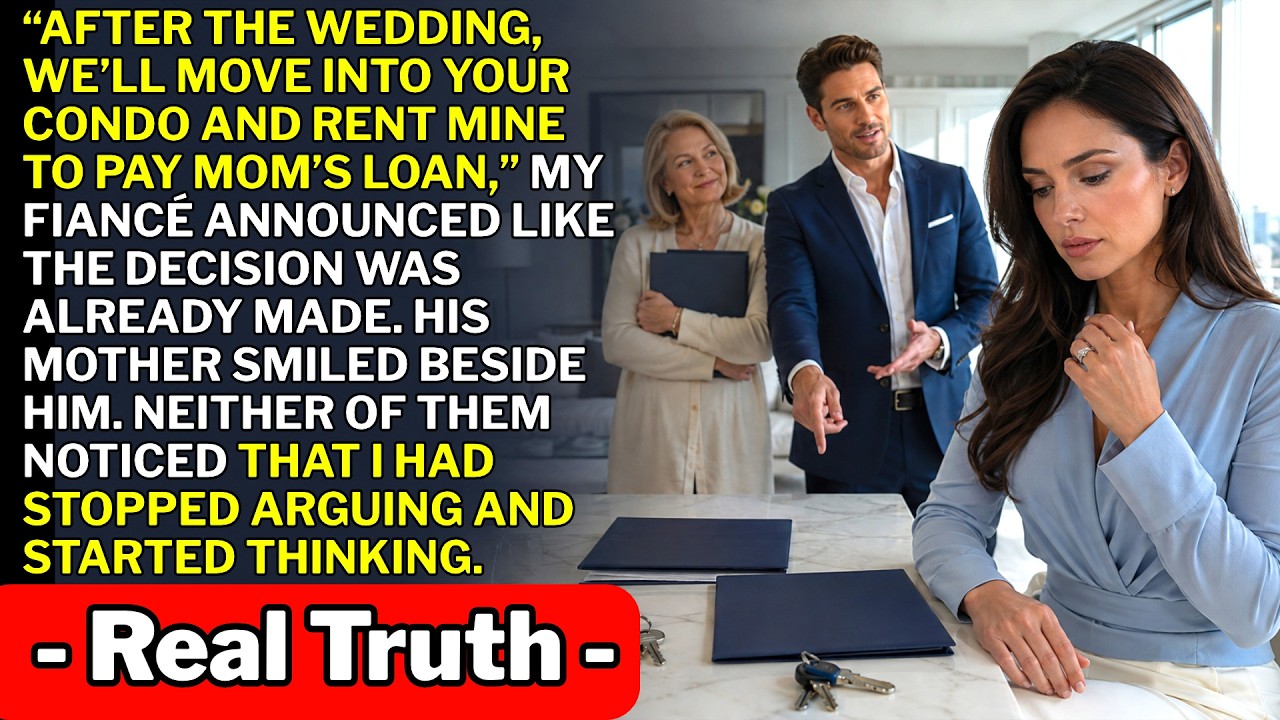
That evening, as we sat on the couch with our wine, allegedly finalizing the seating chart, Vance suddenly put his phone face down on the coffee table with a slow, almost ceremonial gravity. He flashed me that disarming smile, the exact smile that months ago at a rooftop bar convinced me this guy was a straight shooter. Then he said the words I had been waiting weeks to hear. “Babe, I was thinking after the wedding it just makes sense for us to consolidate at your place.
We can rent my condo out and use that rental income to finally pay off my mom’s underwater car loan. ” He said it so breezily, as if he wasn’t dictating the financial fate of our entire marriage, but suggesting we order Thai food instead of pizza. In the single second that stretched between the end of his sentence and my reply, all the disparate anomalies I had collected for months snapped together into a flawless, logically undeniable, and incredibly ugly picture. Outwardly, I remained perfectly placid.
So placid, in fact, that Vance’s face twitched with brief confusion. He was clearly expecting either starry-eyed gratitude or easily crushed resistance. Instead, I took a slow sip of my Cabernet, placed the glass on the coaster, and asked him a question in my flat, polite appraiser voice. “Is the principal balance on your mother’s auto loan truly so massive that it requires leveraging real estate to pay it off?
Wouldn’t it be easier if you just showed me the loan origination documents and the amortization schedule? I work in finance, Vance. I could run the numbers. ”
Vance froze.
He recovered quickly, waving a hand dismissively. “It’s a mess, honestly. Multiple missed payments, crazy APRs. You don’t need to stress your head with the numbers, babe.
The total amount is manageable. What matters right now is that we are on the same page about the move. We’re about to be a family. We need to make decisions like a family, not like we’re running an accounting firm.
”
That defensive jab confirmed he had zero intention of ever showing me a single digit. He couldn’t, because the real numbers would blow his entire operation out of the water. It was then that I deployed the counter-offer I had mapped out while lying awake at 3 a. m.
“I agree that family is about stepping up when things get hard. I take your proposal very seriously, but I think we should do it the other way around. Instead of moving into my place and leaving your condo as a rental, let’s lease my condo out. If your place is in good enough shape to command top dollar rent, it’s good enough for us to live in temporarily.
We’ll take the rental income from my place and send one hundred percent of it directly to your mom’s creditors. But before I sign any landlord-tenant agreements, my background in real estate requires me to do standard due diligence. I’ll need to see the clear title and deed to your condo to ensure there are no active liens or encumbrances. ”
Vance’s face underwent a violent transformation.
The arrogant ease evaporated, replaced by poorly masked panic. He stalled for time. “Uh, well, the thing is, the condo is actually still in my grandmother’s name in a trust. The probate and title transfer hasn’t been fully recorded yet by the county.
It’s a whole legal nightmare. ” Just two months ago, he had explicitly bragged about completing his rent-to-own buyout directly from the developer. The collision of his own lies was deafening. I didn’t corner him on the contradiction.
I smiled gently. “Oh, probate issues. That’s easily solved. I have a fantastic title attorney in my contacts.
She can expedite the recording process in days. Just give me an ETA on when you can have the grandmother’s trust docs pulled. ”
Completely stripped of his confident facade, Vance mumbled something incoherent about it depending on the lawyers. Then, like a drowning man grabbing driftwood, he dramatically shifted tactics, attempting to weaponize guilt.
“I don’t understand why you’re being so intensely bureaucratic about this. We are talking about my mother, a woman who raised me alone, practically killing herself working two jobs, and you’re sitting here acting like a cold, calculating auditor when my family needs support, not an interrogation. ”
I didn’t take the bait. I kept my voice perfectly level.
“My concern for your mother is genuine, Vance. But transparency isn’t bureaucracy. It’s the baseline for any healthy marriage. If we are going to co-mingle our assets, both partners need full access to the ledger.
”
Right on cue, Vance’s phone rang. It was Lorraine, and he slammed the phone onto speaker, clearly seeking backup in a war he was rapidly losing. He heavily distorted my counter-proposal, framing it as me flat-out refusing to help his family and demanding humiliating financial audits just to assert dominance. Lorraine immediately began wailing through the speaker about modern ungratefulness.
“Honestly, Vance, I am starting to wonder if she is truly the right woman for you. If she’s willing to destroy our family’s peace over some meaningless paperwork. ”
I let her monologue run its course. When she finally paused for breath, I leaned toward the phone and spoke in a crisp, unbothered tone.
“Lorraine, I am more than happy to sit down with you personally to discuss your auto loan. However, that discussion will be based on hard financial documents, not emotional theatrics. If you genuinely need my help, the fastest way to get it is to email me a PDF of your original loan agreement and the current amortization table. I await your email.
” Dead silence fell over the line. When Lorraine finally spoke, her tone had plummeted from righteous fury to panicked retreat. “I don’t have the papers handy. I’ll have to dig for them later.
Honestly, my blood pressure is spiking from all this arguing. I need to go lie down. ” The line went dead. Vance sat in silence, utterly bewildered that his tag-team manipulation tactic had been vaporized in thirty seconds.
Realizing anger wasn’t working, he deployed his third strategy: the wounded martyr. “I just can’t believe you have so little faith in me. I feel like a suspect in a police station. Maybe we should table this.
I can’t talk to you when you’re being this hostile. ” The old Sloan would have rushed to comfort him. The new Sloan simply nodded. “Tabling it is fine by me.
We can resume the conversation the exact minute you produce the documents I asked for. ”
The next few days passed in tense, frigid silence. Vance was remarkably subdued, giving one-word answers to texts. I used the ceasefire to pour concrete over my defensive perimeters.
I went back to the family law attorney and officially drafted an ironclad prenuptial agreement that explicitly ring-fenced my condo as sole and separate property, immune to any co-mingling or marital debt claims. A week after our disastrous wine night, Vance reinitiated the conversation playing peacemaker. He offered a compromise. “Look, the paperwork on my grandma’s trust is going to take months to clear.
Why don’t we just move into your place temporarily, like two months tops after the wedding, just until the lawyers sort my deed out? ”
I recognized this tactic immediately. It’s a classic negotiation retreat. He was voluntarily sacrificing a secondary detail, renting his place, to secure his main goal: getting a foothold in my property.
“Temporary living arrangements are fine,” I replied, “but they come with one mandatory condition. We will sign a legally binding prenuptial agreement and a use-of-property waiver stipulating that the condo remains my sole and separate property regardless of our cohabitation, and that you waive any rights to claim marital equity in it. ”
His reaction was thermonuclear. Vance leaped off the couch and began pacing like a caged animal.
“You don’t even see me as your partner. You’re literally prepping our divorce papers before we’ve even cut the cake. This is psychotic, Sloan. Normal people don’t do this.
” His voice sounded like the frantic, desperate roar of a con artist watching his mark walk out the door. I let him scream himself out. When he was done, I delivered a line that hit him like a physical blow. “I’m not preparing documents for a divorce, Vance.
I’m preparing documents for honesty. If your intentions are truly as pure as you claim, signing this piece of paper changes absolutely nothing about our daily lives. But if someone’s intentions are not pure, this document is the only thing protecting me from what I am already beginning to suspect. That this entire campaign to move into my home has nothing to do with your mother’s car and everything to do with you trying to gain leverage over my real estate to bail yourself out of a catastrophe.
”
Vance froze. He didn’t offer a single fact to refute my accusation. He just looked at me hollow-eyed and muttered, “I never expected you to be this toxic. ” He turned and shut the bedroom door behind him.
I sat alone in the living room, and oddly enough, I felt no anxiety. Only the profound, weightless relief of a person who has finally stopped pretending not to see the elephant in the room. The next morning, my phone buzzed with a wall of text from Lorraine. Abandoning her usual haughty tone, she completely broke down.
She confessed that this wasn’t just about the car. Vance had been drowning in debts for years, so massive she was terrified to say the number out loud. She claimed she was just trying to help her son dig himself out before “those people” did something much worse than simply foreclosing on his condo. The phrase “those people” confirmed that this was a potential threat to physical safety.
I immediately defaulted to crisis management protocol. I called Greer and asked a massive favor. One of her high-net-worth clients was a guy who used to run a specialized collections agency that handles toxic, unrecoverable debt for shadow lenders. She set up a meeting for the next day at a quiet diner.
The guy introduced himself as Silas. He looked like a retired linebacker who had traded in a jersey for a tailored suit. I gave him the high-level summary. Silas’s face turned dead serious.
He confirmed my darkest theories. Apex Equity Solutions was technically licensed, but in the industry, they were known as a feeder. When a borrower defaults, they bundle and sell that toxic paper to unregulated third-party fixers who operate outside the legal framework, resorting to aggressive intimidation. I asked if stories about physical intimidation were real.
Silas didn’t sugarcoat it. “In cases involving chronic gamblers dodging massive six-figure debts? Yes. Slashed tires, broken windows, guys showing up at your office, threatening your spouse.
It happens. You need to get the exact payoff number to gauge your actual threat level. ”
I needed the final puzzle piece before I blew this whole thing up. Months ago, Vance had been driving and hastily asked me to log into his Gmail on his iPad to pull up a QR code for a concert, shouting his password at me over the radio.
I remembered it. Waiting until he left for a night out with his friends, I opened his iPad. In less than two minutes, I found the mother lode: a chain of emails from Apex detailing the exact payoff balance. The number made me physically nauseous.
It was over four times the amount he had vaguely suggested his mother owed. Digging deeper, I found the origination documents. Lorraine wasn’t on the loan at all. Vance had taken out a cash-out refinance at a predatory interest rate, leveraging his condo to the hilt.
Banking alerts showed the money went out in massive wire transfers to offshore sports books and Venmo accounts belonging to local bookies. The exact debts Theren had warned me about. If this were a loan file sitting on my desk, I would stamp it with one word: Denied. The day before we were scheduled to attend a combined family Sunday dinner at Lorraine’s house, I woke up with eerie, crystalline clarity.
There would be no screaming, no crying. I would present the dissolution of this relationship exactly like an appraisal report: chronological, objective, fact-based, and undeniable. That afternoon, I meticulously organized my evidence into clear plastic sleeves inside my leather work portfolio: the deed extract, the foreclosure notice, the email printouts, and the unsigned prenuptial agreement. Vance, oblivious to the radioactive material sitting on my lap, was in a phenomenal mood during the drive, blasting music and talking about our honeymoon in Cabo.
His delusional cheerfulness was the hardest thing to stomach. It only cemented my resolve. Lorraine’s suburban home was buzzing with relatives and the smell of pot roast. It was the perfect audience: her younger sister, Vance’s aunt and her husband, a nosy neighbor, and Vance’s cousin and his wife.
I waited until dessert, until the table hit that comfortable post-meal lull. I cleared my throat and spoke in a clear, carrying voice. “Since we have the core family gathered here today, I think it’s the perfect time to discuss a critical logistical issue regarding Vance’s and my future living arrangements. ”
Vance’s posture went instantly rigid.
He shot a look of pure terror at me, then darted his eyes to his mother. In that split-second exchange, I saw the silent, desperate SOS of a manchild begging his mommy to clean up his mess. But I didn’t give them a microsecond to hijack the narrative. I reminded the table of Vance’s proposal: live in my condo, rent out his, use the cash to pay off Lorraine’s burdensome car loan.
Lorraine tried to interrupt with her trademark trembling voice. I cut her off gently but with absolute authority. “Please allow me to finish. ”
I unzipped my portfolio and pulled out the county deed extract, sliding it to the center of the dining table.
“This document is public record. It shows a massive lien placed on Vance’s condo years before he and I ever met. Therefore, the narrative that this financial crisis is related to a recent auto loan for Lorraine is fundamentally false. ” Then I slapped the printed emails on the table.
“This is correspondence between Vance and his predatory lender, Apex Equity. It details a six-figure payoff balance. ” I read the exact dollar amount out loud, enunciating every syllable. “These attached ledger screenshots show that the equity pulled from the condo was not used for family emergencies, but wired directly to offshore sports betting accounts and local bookies.
”
Vance’s cousin broke the silence, looking disgusted. “Bro, is this true? ” Vance, ghost-pale and sweating, stammered out a pathetic word salad about complex financial instruments and temporary liquidity issues. His voice was shaking so violently that even the nosy neighbor exchanged a deeply disturbed look with her husband.
I turned directly to Vance. “I would have moved mountains to help you fix this if you had just come to me like a man and told me the truth. But you didn’t. You tried to secretly hijack my real estate and my financial security to bail yourself out with loan sharks, using your mother as a human shield.
”
Lorraine lost her mind, shooting up from her chair and unleashing a torrent of hysterical screaming. She accused me of humiliating them and airing dirty laundry. Suddenly, her younger sister slammed her hand on the table. “Lorraine, stop it.
If you had the guts to actually address his gambling years ago, instead of secretly bailing him out and lying to the rest of us, this poor girl wouldn’t have to hold a tribunal to protect herself. ” Seeing that even his own aunt was disgusted, Vance resorted to his nuclear option. “You know what? If you have so little respect for my family that you’d pull this psychotic stunt, maybe we shouldn’t rush into a wedding.
Maybe I need to re-evaluate if I even want to marry someone this cold. ” He thought the threat of a canceled wedding would terrify me into submission. He had no idea who he was dealing with. I replied, my voice steady as stone.
“I completely agree. You should absolutely re-evaluate. We can discuss the future of our relationship in private, but only after you provide a fully audited, CPA-verified accounting of every single debt you owe. ” I stood up, calmly gathered my documents, slid them back into their plastic sleeves, and zipped my portfolio.
“There is nothing to postpone. All the relevant data has been submitted. ” I called an Uber, walked out the front door, and left him sitting in the wreckage of his own lies. Riding back to the city alone, I knew the climax was still to come.
The darkest, most dangerous variable, the shadow collectors Silas warned me about, was still out there. The catalyst arrived exactly three days later. I had just walked into my condo when my phone rang. It was an unknown local number.
A dry, raspy, overly polite male voice introduced himself as an account resolution specialist for the partners of Apex Equity Solutions. “Sloan, we are aware you are the domestic partner of the borrower. It would be highly beneficial for your own future peace of mind to encourage him to liquidate his balance. Extended delays in our recovery process have a way of complicating the lives and careers of everyone in the borrower’s immediate household.
”
It was a perfectly crafted, legally ambiguous threat. I didn’t feel a drop of panic. I pressed record on my Apple Watch and replied, my voice cold as liquid nitrogen. “Listen to me very carefully.
I am not a signatory on any loan document. I hold zero liability for his debts. If you or your organization attempt to contact me again, I will have you prosecuted under the Fair Debt Collection Practices Act for illegal harassment of a third party, and I will hand the audio file of this conversation to the Illinois Attorney General. ” Before he could respond, I hung up.
I made a vow right then and there: I would never delay again. The cost of acting too slowly is always inevitably higher than the cost of acting too quickly. I called the precinct and spoke to a detective I had met during an unrelated real estate fraud case. An hour later, I was sitting in a sterile police precinct, laying out the timeline and handing over the files, the emails, and the recording.
From the precinct, I took a cab straight to the bridal boutique where Vance and I were scheduled for my final dress fitting. When he finally burst through the glass doors, looking flustered, I stood up and said loudly and clearly, “The wedding is canceled. Not postponed. Not ‘we need a break.
‘ Canceled. I got a call from your debt collectors an hour ago threatening my safety. I just left the police station. I am done.
I will not spend a single day of my life tethered to a man whose lies require me to file police reports. ”
Vance went the color of wet ash. “Babe, wait. Please.
I talked to a lawyer. I’m fixing it. Just give me a little more time. ” I said, “You are out of time.
Your time expired the second a loan shark threatened my future. ” The boutique manager hurried over, looking concerned. I turned to her, my voice perfectly steady. “I need to officially cancel my order and release the hold.
The wedding is off. ”
The sheer brutal finality of me handling the logistics in front of a stranger finally broke through Vance’s delusion. I looked down at my left hand, slid the custom-designed engagement ring off my finger, and pressed it firmly into his palm. “Fix your life, Vance.
But do it with your own money. And without lying to the people who love you. ” I turned around, walked out the glass doors, and got into the Uber I had ordered while he was begging. The entire interaction took exactly eleven minutes.
Twenty minutes into the ride home, my phone erupted with calls from Vance and Lorraine. I didn’t read them. I put my phone on do not disturb, logged into my bank, and initiated a total freeze on my credit profile. I revoked any shared access apps and changed every password to my financial accounts.
When I finally walked into my condo that night, I was truly alone for the first time in months. I didn’t feel heartbreak. I felt the overwhelming, breathless relief of dropping a hundred-pound weight I had been carrying on my back. Before bed, I checked my messages one last time.
Lorraine had sent a vitriolic text accusing me of destroying her son’s life. I typed a single reply. “Decent mothers don’t try to use another woman’s hard-earned real estate to secretly bail out their son’s gambling debts. Do not contact me again.
” I blocked her number, then blocked Vance’s. The drawbridge was pulled up. The next morning, I got a call from Theren. He wasn’t calling to defend his buddy.
He was calling to apologize. He admitted the debt was much, much worse than he had initially let on at the brewery, and that illegal bookies were turning up the heat on Vance. He confessed that Vance’s sudden desperation to marry me and merge our assets was largely driven by his belief that having a wealthy wife on paper would buy him leverage with the loan sharks. I thanked Theren for his honesty, hung up, and felt the final lingering trace of guilt evaporate.
Lorraine made one last desperate play. She showed up unannounced at my condo building a few days later, slipping past the doorman. She broke down crying, confessing she had been co-signing loans for Vance since he was a sophomore in college, terrified of the neighborhood gossip if he went bankrupt. She begged for advice.
I stood in the doorway. I didn’t invite her in. “Lorraine, I pity you as a mother, but I am not taking responsibility for your son’s actions or your decades of enabling him. Hire a bankruptcy attorney, and for the first time in his life, let him face the consequences of his own math.
” I closed the door. It was the last time I ever saw her. Over the next few weeks, I handled the grim logistics of unplanning a wedding. To my surprise, when I concisely explained that I was canceling due to discovering severe financial fraud, most of the vendors were incredibly empathetic and refunded a large chunk of my deposits.
My own mother, when I told her, didn’t offer pity. True to the pragmatic women in our family, she asked for the sequence of events, nodded approvingly, and said, “I am incredibly proud of how ruthlessly you protected yourself. My only regret is that you wasted six months trying to play the polite bride instead of trusting your gut on day one. ”
Greer came over with a bottle of Veuve Clicquot, declaring that dodging a financial bullet warranted a celebration.
“Do you regret the money and time you lost on the wedding prep? ” I told her, “Not for a second. If we hadn’t planned this wedding, the pressure wouldn’t have forced him to reveal his hand. It was the price of admission to find out who he really was.
And I walk away with my condo, my savings, and my self-respect entirely intact. ”
Vance tried to ambush me outside my office building a month later. He stood on the sidewalk holding a pathetic bouquet of bodega flowers, launching into a rehearsed speech about going to rehab and hiring a debt consolidator. I didn’t even break my stride.
“My decision in the bridal salon was final, Vance. No amount of financial rehabilitation changes the fact that you spent a year plotting to steal my equity behind my back. I don’t rebuild trust out of pity. ” Glancing back, I saw him on the pavement, slowly lowering the flowers, finally comprehending the absolute permanence of his loss.
Through the grapevine of mutual friends, I heard the epilogue. Prompted by the fallout at the Sunday dinner, Vance’s aunt forced a full family intervention. The sheer scale of his gambling debts was exposed. Most of the family cut ties with Lorraine and Vance.
Lorraine’s SUV was eventually repossessed, cementing her ultimate nightmare of becoming the subject of neighborhood gossip. Vance’s cousin reportedly told him to his face that he was a sociopath for trying to drag an innocent woman into a mob debt. Meanwhile, my career skyrocketed. Unburdened by the crushing stress of investigating my own partner, I poured my focus into work.
I successfully appraised a massive multi-unit luxury development that earned me a commendation from the bank’s VP of risk management. But the victory felt hollow compared to the quiet satisfaction of sitting in my own living room, knowing it belonged solely to me. It has been a year since that fateful night with the Cabernet. Recently, while packing up my home office, I found the unsigned prenuptial agreement at the bottom of a drawer.
Even though it was never signed, the act of drafting it, of consulting lawyers and drawing a line in the sand, was the armor I needed to survive. If anyone asked me what the moral of this story is, I wouldn’t say it’s about learning to spot red flags on a bank statement. It’s about something much harder. It is about a woman’s absolute right to pull the emergency brake the exact second she realizes the train is heading off a cliff.
Regardless of how much money has been spent on the tickets, how many guests are seated in the dining car, or how embarrassed the conductor will be. Other people’s embarrassment should never outrank your own survival. A few weeks ago, I was appraising a starter home for a young, newly engaged couple. As I was packing up my laser measurer, I watched the girl happily getting ready to sign a stack of complex mortgage disclosures without even reading them, laughing as her fiancé said, “Don’t worry, babe.
I checked all the math. ” I couldn’t help myself. I stopped at the door and turned to her. “Before you sign a thirty-year mortgage or a marriage license, ask yourself one question.
Are you absolutely sure you’ve seen all the paperwork, all the numbers, and all the truth? If you feel even a shadow of a doubt, put the pen down. And if he gets mad at you for asking to see the ledger, that reaction tells you more than the numbers ever will. ”
Walking out to my car, I felt a deep, profound peace.
The scars of the past year had fully healed, transforming from a wound into armor. I had canceled a wedding I spent nine months planning in exactly eleven minutes. And it was the greatest, most profitable decision I will ever make.