The earliest confirmed evidence of people deliberately inhaling psychoactive cannabis comes not from a palace or an ancient medical text, but from blackened wooden bowls found in a high-altitude cemetery in Central Asia. Around 500 BCE, mourners at the Jirzankal Cemetery on the Pamir Plateau in what is now western China placed hot stones inside wooden braziers, added cannabis, and inhaled the smoke during funeral ceremonies. Chemical analysis of charred wood and stones from the site detected cannabinol, a byproduct formed as THC degrades, indicating that cannabis with relatively high levels of psychoactive compounds had been burned there. The markers appeared on nine of ten braziers recovered from eight tombs.
Jirzankal sits about 3,000 meters above sea level, near ancient routes connecting communities across Central Asia. Isotope evidence suggests some people buried there had grown up elsewhere, a sign that people, goods, and practices moved through these mountain corridors. Researchers cannot say whether the plants were cultivated for their intoxicating effects or gathered from unusually strong wild populations, though mountain stress may have boosted cannabinoid production. Either way, the careful preparation of multiple braziers across multiple tombs points to deliberate, shared knowledge rather than accident.
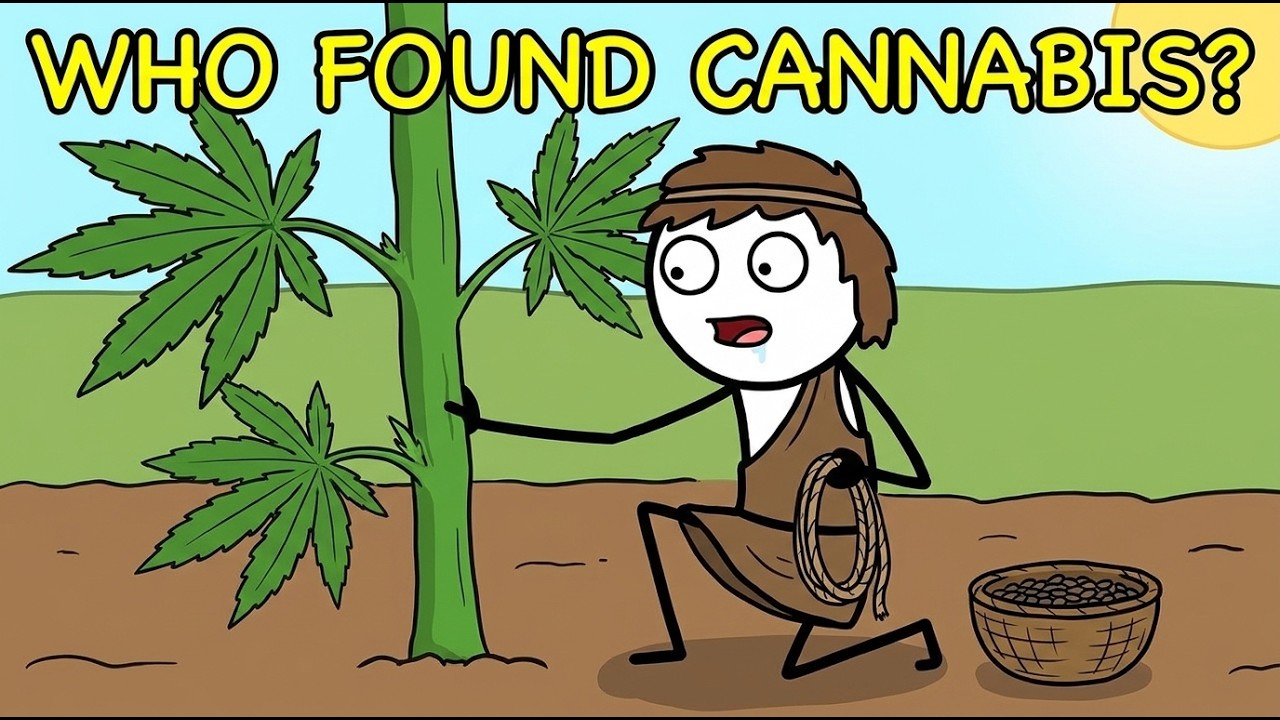
The Jirzankal find is among the earliest chemically verified evidence of ritual cannabis use, but it is almost certainly not the true beginning. Reconstructing when humans first discovered cannabis is a deeply difficult problem because the plant offered many uses—fiber, food, medicine—long before anyone may have gotten high from it. Cannabis evolved in Asia and thrived in disturbed ground, often volunteering near human settlements. Its stem produced strong fibers for rope and cloth, and its seeds were nutritious.
But psychoactive potency varies wildly among plants, and ancient forms generally carried far less THC than modern drug varieties. Heat is essential to unlock the intoxicating effects. Fresh cannabis mostly contains THCA, an acidic precursor that converts to active THC through heating. Even then, an open campfire would disperse smoke and destroy active compounds.
A noticeable effect likely required the right plant, enough resinous material, controlled heat, and some kind of enclosed space. That demanding combination helps explain why humans could live beside cannabis for centuries without developing intentional use. Fiber was probably cannabis’s first great attraction. A rope helps you carry tomorrow—a psychoactive experience lasts only hours.
Fiber evidence is rare, however, because it rots and disappears. Seeds survive better, especially when charred, yet a seed does not reveal intention. Genetics adds another layer, with one genomic study proposing that ancestors of modern hemp and drug varieties separated from a basal domesticated population roughly 12,000 years ago in East Asia. That estimate places early domestication near the dawn of agriculture, but it is a model based on living plant genomes, not proof of an ancient smoke session.
Chinese tradition attributes the first medical cannabis discoveries to the legendary ruler Shennong, sometimes dated to around 2700 BCE. The herbal works associated with him were compiled much later, probably in the early centuries of the common era. Earlier Chinese texts do show hemp as a culturally important crop and seed food, but the terminology is ambiguous and does not necessarily indicate a high-THC plant. More direct physical evidence appears at the Yanghai tombs near Turpan in northwestern China, where a man buried about 2,700 years ago was accompanied by roughly 789 grams of prepared cannabis.
A leather basket and wooden bowl contained leaves, shoots, fruits, and flowering material preserved by the dry desert. The plant had been processed to remove larger stems and male parts while retaining resin-producing structures, and chemical analysis revealed traces of THC-related compounds. That the plant was deliberately selected for potency is clear, but no pipe or obvious smoking device was found, so exactly how it was used remains unknown. Jirzankal supplies the missing smoke.
The practice of burning cannabis on heated stones beneath coverings was described centuries ago in the West as well. The Greek historian Herodotus, writing in the fifth century BCE, claimed the Scythians placed hemp on red-hot stones beneath felt coverings and shouted with delight during a cleansing bath after burial. Archaeology later found related equipment in Scythian contexts, showing that cannabis fumigation had spread across the Eurasian Steppe by the first millennium BCE. Why use cannabis at a funeral?
Altered states can reshape how people experience grief, music, memory, and the presence of the dead. Smoke transforms a space physically and creates a shared sensory experience among participants. Researchers cannot recover the belief system behind the Jirzankal ceremonies, but the plant was clearly embedded in rituals involving death and community, not casual recreation in the modern sense. Cannabis had other paths into human use.
Medicinal testing could have revealed mental effects, though oral consumption behaves differently from inhalation, and raw plant material is far less intoxicating until heated. Deliberate selection likely played a role, as farmers noticed variation and saved seeds from plants with desirable traits. Contact between cultures offered another route, when a community growing low-THC hemp encountered traders carrying resin-rich cannabis from elsewhere. By the Greek and Roman periods, physicians described hemp more clearly.
Dioscorides discussed cultivated and wild cannabis in the first century CE, focusing on seeds and medicinal uses. But written records typically begin after ordinary people have already done the dangerous research phase. Cannabis entered societies with very different moral systems, some treating it as sacred, some medicinal, some ordinary, and some suspicious. European powers later spread hemp worldwide for rope and sailcloth, while psychoactive traditions traveled through migration, medicine, and underground markets.
The question of first discovery depends on what “discovery” means. Encountering the plant likely happened deep in Asian prehistory. Domesticating it may date to around 12,000 years ago. Using it for food or fiber probably stretches back many millennia.
Collecting potent cannabis for ritual purposes has physical evidence from about 2,700 years ago. And deliberately heating it so a group could inhale it has its earliest secure proof at Jirzankal, from around 500 BCE. That date marks the earliest moment archaeology can confidently see, not the moment the idea was born. The first users may have lived centuries or millennia earlier, leaving no surviving evidence.
What is clear is that the discovery was not a single event but a sequence—finding the plant, then its fiber, then its seed, then its medicine, and finally, somewhere in smoke, finding that it could change the person using it. By the time the mourners at Jirzankal placed hot stones in their braziers, they were no longer experimenting. They knew exactly which weed to bring to a funeral.