Nobody set out to invent the dog. There was no ancient breeding program and no prehistoric human who looked at a wolf and imagined a companion for the couch. According to the leading scientific consensus, dogs are an accident—a massive, species-altering accident that began with garbage and ended with the animal that now guards your living room. The story starts somewhere between 15,000 and 40,000 years ago, when ancient human camps began producing something new: consistent piles of leftover food waste.
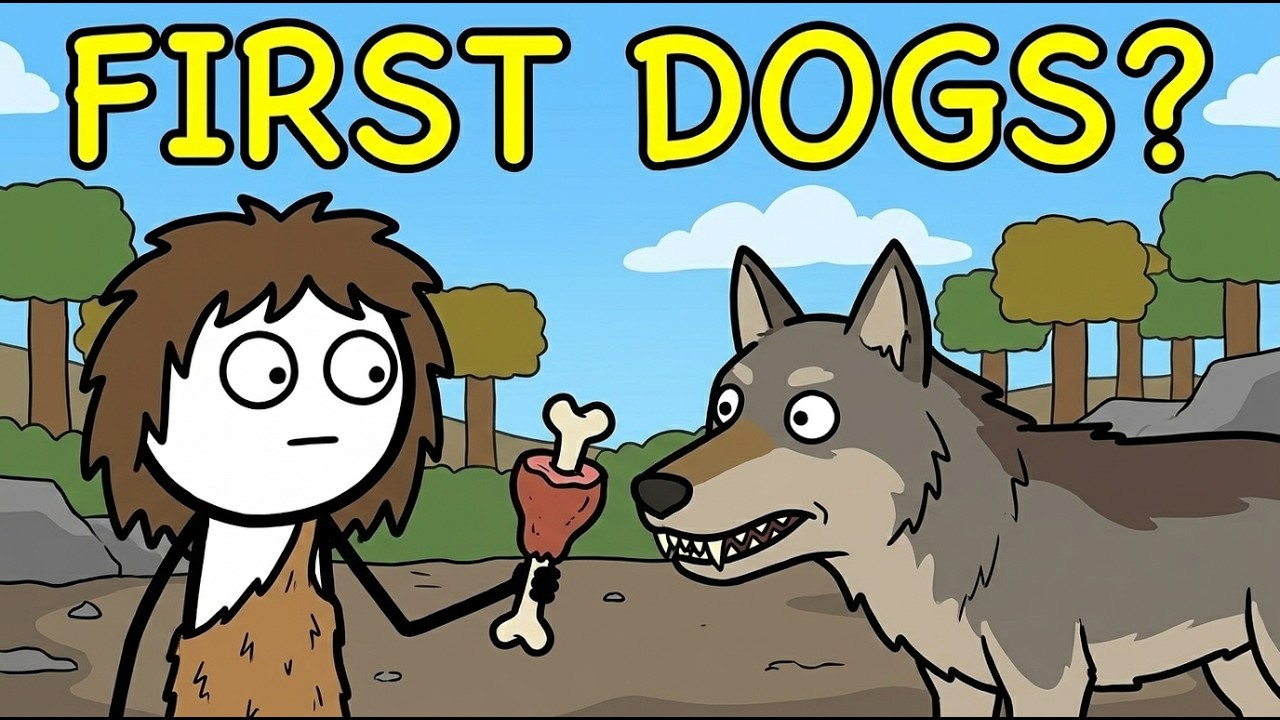
Bones with meat scraps, discarded organs, and inedible hunt remains created an enormous, low-effort calorie source for any hungry wolf willing to approach. Most wolves sensibly kept their distance. Approaching a human camp is objectively terrifying for a wild animal, which risks rocks, weapons, and a generally hostile reception. But within any wolf population there is natural variation in temperament, and the bolder, calmer individuals were willing to take that risk for the reward of an easy meal.
This created a powerful natural selection pressure. The wolves that could tolerate human proximity got consistent access to food, which meant better survival and more offspring. Over generations, the wolf population around human settlements became progressively tamer—not because any human chose a single breeding pair, but because the wolves were effectively selecting themselves. Scientists call this the commensal scavenger hypothesis.
It directly challenges the older, more romantic image of early humans deliberately capturing wolf pups and hand-raising them into companions. That model runs into practical problems, since raising a wild wolf pup is risky and resource-intensive. The garbage-pile version requires no deliberate human decision at all. Remarkable supporting evidence comes from a Soviet experiment that had nothing to do with wolves.
In the 1950s, geneticist Dmitri Belyaev began breeding silver foxes based solely on one trait: how calm they were around humans. Within just a few generations, the foxes weren’t just tamer—they developed floppy ears, curly tails, white patches of fur, shorter snouts, and changes in stress hormone development. They started looking eerily like dogs. This demonstrated what researchers call domestication syndrome, a cluster of physical traits that appear together across domesticated species even when those traits were never deliberately selected.
The likely link is the neural crest, a group of cells that influences both adrenal gland development—which controls stress and fear—and the development of pigmentation, ear and tail cartilage, and other physical features. Selecting for tameness drags this entire package along as an accidental side effect. This matters because it means ancient humans never needed to breed for floppy ears or juvenile faces. Selecting generation after generation for calmness automatically produced dogs’ increasingly puppy-like appearance.
That connects to neoteny, the retention of juvenile traits into adulthood. Dogs generally keep flatter, rounder, more puppy-like facial structures than mature wolves, and they retain playful behaviors far longer. Since juvenile wolves are naturally less fearful and aggressive than adults, heavy selection for calmness essentially nudged these animals toward a more permanently juvenile state. Archaeology and genetics provide the detective work confirming this timeline.
Researchers have found ancient skeletal remains with shorter snouts and crowded jaws—early dog-like features—in direct association with human settlements. A roughly 14,000-year-old burial site in Bonn-Oberkassel, Germany, contained a young dog buried alongside two humans, with evidence the animal survived a serious illness for an extended period. That would only make sense if humans were actively feeding and caring for it. Genetic studies add another layer.
Dogs show enhanced starch digestion compared to wolves, a practical adaptation for animals whose ancestors scavenged human food scraps, which increasingly included starchy plant waste after agriculture developed. The cognitive angle is equally striking. Dogs show a remarkable ability to read human gestures, such as following a pointing finger to hidden food—a task at which chimpanzees, despite being far more closely related to humans genetically, perform considerably worse. This suggests selection favored animals that were unusually good at navigating human social environments.
A genuine scientific debate remains unresolved: whether dog domestication happened once or multiple times independently. Some genetic studies point to a single origin in Eurasia, while others suggest separate events in Eastern and Western Eurasia. The precise picture has not been nailed down with complete consensus. A common counter-argument asks whether deliberate later breeding proves humans were always involved.
Researchers distinguish between domestication—the initial, gradual, largely accidental process—and subsequent selective breeding, which was clearly intentional. The evidence strongly suggests the beginning was accidental and wolf-driven. Only once a stable population of tamer proto-dogs existed did humans begin deliberately selecting for hunting ability, herding instinct, guarding behavior, and eventually aesthetics. The entire process unfolded across an enormous span of time, likely hundreds or even thousands of wolf generations.
From any single generation’s perspective, the change was imperceptible, but accumulated across millennia it produced a dramatic transformation. The same underlying pattern appears in other domesticated species. Selection for reduced fear followed by a cascade of physical changes shows up across mammals, suggesting the mechanism connecting tameness, stress response, and physical development is a deeply conserved feature of biology. Fear response in mammals is regulated by the hypothalamic-pituitary-adrenal axis, which controls stress hormone release.
Animals with naturally lower baseline reactivity in this system remain calm enough to investigate opportunities rather than flee. Because this system is influenced by relatively few interconnected pathways, selecting for reduced fearfulness produces relatively fast population-level shifts. Wolves were also unusually well positioned for this transformation. They already lived in cooperative, hierarchically organized social groups with complex communication and bonding.
A solitary predator would have been far less prepared to integrate into human social structures. Dogs didn’t need to evolve new cognitive capacities—they redirected existing wolf social machinery toward a new target. Human tolerance was also essential. Ancient humans could have killed or driven off lingering wolves, and in many cases almost certainly did.
But some groups evidently tolerated the calmer individuals, perhaps because they posed little danger, provided incidental benefits like alerting to approaching threats, or simply because letting them stay cost less effort than chasing them away. The timing overlaps with significant changes in human society. This domestication window coincides with a period when human populations were forming more permanent settlements—a necessary precondition, since you can’t accumulate a consistent garbage pile if your group never stays put long enough for waste to build up. Dogs stand as a genuine outlier among domesticated species.
Cattle, sheep, goats, and chickens were domesticated deliberately for practical resources like meat, milk, and wool. Dogs were the earliest domesticated animal, predating agriculture itself, and appear to have been domesticated for no deliberate purpose at all. The relationship emerged from proximity, tolerance, and mutual adaptation, with practical benefits like hunting assistance and guarding emerging only after the core process had already taken hold. The honest answer to how ancient humans accidentally created dogs is that they mostly didn’t—not deliberately.
They created an ecological opportunity by producing food waste, and a specific subset of wolves selected themselves into a new evolutionary trajectory by being brave enough to exploit it. Natural selection did the rest, producing a calmer, more juvenile, better-adapted animal as an accidental package deal. Humanity’s oldest and closest animal companion was not the product of careful planning.
It was the product of leftover bones, a few unusually brave wolves, and tens of thousands of years of evolution rewarding whatever strategy happens to work—whether or not anyone involved meant for it to happen.