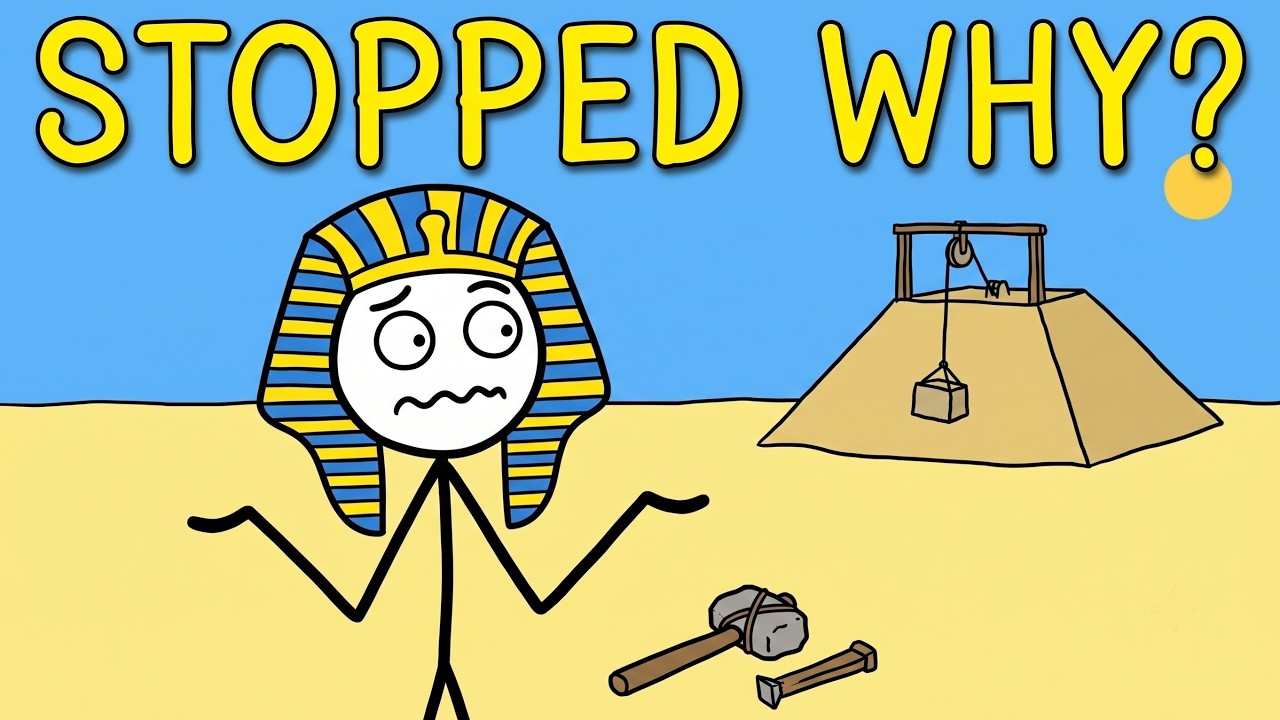
The Great Pyramid of Giza once shone like a mountain of pure light, its white Tura limestone casing blinding under the desert sun. For over a thousand years, the ancient Egyptians built these colossal structures, each one a resurrection machine engineered to transform a dead king into a living god. Then, they simply stopped.
There was no decree, no sudden ban, but after millennia of construction, the greatest civilization of the ancient world walked away from its ultimate symbol of power. The reason is not just about money; it is a story involving grave robbers, a vanished river, political collapse, and the first labor strike in human history.
 To understand why they stopped, you must first understand what a pyramid actually was. It was not a monument or a flex. It was a highly engineered piece of technology designed to preserve the pharaoh’s soul and guarantee the cosmic order known as Ma’at.
The ancient Egyptians viewed the soul as a complex mechanism with moving parts. The ka, or vital life force, stayed in the tomb and required food offerings. The ba, or personality, was a mobile bird-headed spirit that could travel between worlds.
The ultimate goal was for the ka and ba to reunite and form the akh, an immortal spirit. For this to work, the physical body had to be preserved, and the pyramid was the eternal housing unit for the ka. If the pyramid was destroyed or the mummy torn apart, the pharaoh’s soul could be lost forever, and the stakes were unbelievably high.
The pharaoh was the literal bridge between humanity and the gods. His successful resurrection was the only thing guaranteeing the sun would rise and the Nile would flood. If he failed to become a god, the universe itself might fall into chaos.
So, how do you build a machine to save the universe? You do not start with a pyramid. Before the pyramids, kings were buried in mastabas, rectangular, flat-roofed mud-brick structures.
Then, around 2630 BC, a polymath named Imhotep changed everything. As vizier to Pharaoh Djoser, he looked at the flat mastaba and had a revolutionary idea. What if we stacked them and used stone instead of mud?
The result was the Step Pyramid of Djoser at Saqqara, the first monumental stone structure in human history. It was a theological statement, a literal staircase for the pharaoh to climb into the sky and join the gods.
The transition to true pyramids happened under Pharaoh Sneferu, Khufu’s father. He was technically the greatest pyramid builder in history, not because he built the biggest, but because he built the most and failed spectacularly. His first attempt, the Meidum pyramid, collapsed in a massive landslide of stone.
His second attempt, the Bent Pyramid, shows the builders panicking halfway up, changing the angle from 54 degrees to 43 degrees to prevent catastrophic structural failure. Finally, Sneferu got it right with the Red Pyramid, the first stable, smooth-sided true pyramid. That blueprint allowed his son Khufu to build the Great Pyramid of Giza, 2.
3 million stone blocks, 146 meters tall, the tallest man-made structure on Earth for nearly 4,000 years.
The precision is terrifying. The base is so perfectly flat that the margin of error is just a few centimeters across over five hectares of desert rock. And let us clear something up right now.
Slaves did not build it. Forget the movies and the guesses of Herodotus. Archaeological evidence from the workers village of Heit el-Ghurab tells a completely different story.
This was not a prison camp. It was a highly organized company town. The workers ate premium cuts of beef, sheep, and goat, a massive luxury in the ancient world.
Their skeletons show signs of extreme physical stress, but also advanced medical care. Fractures were set properly, amputations healed successfully. You do not perform complex surgery on a disposable slave.
These were Egyptian citizens participating in a corvée system, a form of national service during the Nile flood season. They organized themselves into teams with names like the Friends of Khufu Gang, competing with each other. This was the ancient equivalent of the Apollo program.
 But here is a fundamental truth about human engineering. You can have all the workers and political will in the world, but if the geography fights you, you lose. In 2024, a team of international researchers led by Dr.
Eman Ghoneim published a study that fundamentally changed our understanding of pyramid construction. Using radar satellite imagery and deep soil sediment coring, they found a massive 64-kilometer-long lost branch of the Nile River, named the Ahramat Branch. All 31 pyramid complexes were built right along the banks of this lost river.
Without this river, the pyramids do not happen. The granite for the internal chambers came from Aswan, over 800 kilometers away. You do not drag 80-ton granite blocks across sand; you float them down the river.
The limestone casing, the food, the tools, all of it rode the water. The valley temples were not just religious structures; they were industrial loading docks.
But rivers move. Around 4,200 years ago, a massive catastrophic drought hit the region. The Ahramat branch started migrating eastward before silting up completely and disappearing beneath the windblown sand.
The Egyptians did not just lose their water source; they lost their only highway and the entire logistical supply chain that made building these megalithic structures physically possible. You cannot build a mountain of stone if you cannot deliver the stone to the mountain. The death of this river branch was not an isolated incident.
That massive drought dried up the entire Egyptian state, marking the violent chaotic collapse of the Old Kingdom. It started with Pharaoh Pepi II, who ruled into his 90s and outlived most of his competent heirs. The government eroded into absolute uselessness, and a massive power vacuum emerged.
Enter the Nomarchs, provincial governors who originally were appointed by the Pharaoh. As central authority weakened, these bureaucratic positions became hereditary. Local families built up deep entrenched power bases, stopped taking orders, raised their own militias, and collected their own taxes.
When the drought hit and famine spread, the Pharaoh could not help. The Nomarchs handed out grain from their own storehouses and fed their own people. In the ancient world, if you feed the people when they are starving, you own the people.
Egypt fractured into two competing power bases, a period known as the First Intermediate Period, a time of civil war and profound political instability. The brutal economic reality is that you need a unified state to build a pyramid. When the state fractures, you cannot build a 146-meter-tall resurrection machine.
The pyramids did not stop because people forgot how to build them; they stopped because the socioeconomic engine required to fund them had shattered.
There was an unexpected side effect to this political collapse, a democratization of death. Before this, the afterlife was an exclusive VIP club for the pharaoh. But when central power collapsed, the secrets 𝓵𝓮𝓪𝓴𝓮𝓭 out.
We start seeing coffin texts, magical spells painted on the insides of wooden coffins belonging to regular, non-royal people. Suddenly, eternal paradise was for anyone who could afford a decent carpenter. This fundamentally changed the psychology of the pyramid.
The pyramid was the ultimate symbol of the pharaoh’s exclusive monopoly on divinity. Once the afterlife became accessible to the middle class, that monopoly was broken, and the theological justification for spending the entire GDP of a nation on one man’s tomb started to look a lot less convincing.
 But there was another, far more pragmatic reason the Egyptians started to hate pyramids. It was the most obvious design flaw in the history of architecture. The entire purpose of a pyramid is to protect the pharaoh’s body and wealth for eternity, but you are building a gigantic glowing white mountain in the middle of a flat desert.
It is visible from dozens of kilometers away. A pyramid is a giant neon sign screaming, unlimited wealth buried exactly here. Grave robbing was a systemic multi-generational industry.
Almost every single pyramid was broken into and looted, often within decades of the funeral. The architects tried everything, false corridors, granite portcullis blocks, dead ends, and trapdoors. It did not matter.
The thieves always got in because in many cases, the people robbing the tombs were the exact same people who had just finished building them. They knew where the real burial chamber was and how to bypass the traps. Tomb robbing was an inside job, a shadow economy that thrived on institutional corruption.
After centuries of watching their most sacred monuments get cracked open like piggy banks, the Egyptian elite realized a harsh truth. The grander the tomb, the faster it gets robbed. Monumental architecture does not protect the dead; it advertises them.
If they wanted their kings to actually survive eternity, they had to change their entire strategy. The answer was not to build bigger; the answer was to hide. When the New Kingdom began around 1,550 BC, the capital moved south to Thebes.
The geography there is entirely different, with sheer cliffs, hidden canyons, and hostile valleys. The New Kingdom pharaohs completely abandoned the pyramid structure and began carving their tombs deep into the solid rock of a remote, desolate wadi, a place we now call the Valley of the Kings. This was a brilliant tactical shift.
Instead of a massive monument, you had a secret hole in the ground. The valley had only one narrow entrance, making it incredibly easy to guard.
But building secret tombs requires total secrecy. You cannot hire a thousand random farmers and expect them not to tell anyone where it is. So, the state created a maximum security village called Deir el-Medina, known as the Place of Truth.
They took the greatest artists and stone cutters in the empire and isolated them in a walled community. These workers lived incredibly privileged lives. They left behind thousands of ostraca, limestone flakes used as scrap paper, which tell us they were highly literate, paid heavily in grain, meat, and beer, and lived in tight-knit multi-generational households.
But they were also trapped. They held the most dangerous secrets in the state. And that reliance on an elite specialized workforce eventually backfired in spectacular fashion.
In the year 1170 BC, during the reign of Ramesses III, the system broke. The Egyptian economy was struggling, and the grain shipments to Deir el-Medina were delayed. The workers were starving.
So, the workers did something that had literally never been done before in recorded history. They dropped their chisels, walked out of the necropolis, and staged a sit-in at the local temples. They went on strike.
This is the first recorded labor strike in human history. It was a highly organized labor dispute by skilled government contractors demanding their back pay. And they won.
 The vizier scrambled to secure a partial payment, and the workers went back to the tombs. But the psychological damage was done. As the New Kingdom slowly collapsed, the economy tanked completely.
Rations stopped arriving altogether. The workers of Deir el-Medina were desperate. So, the very same men who had carved the secret tombs, the men whose entire ancestral purpose was to protect the dead kings, quietly packed up their tools, walked into the valley in the dead of night, and robbed the graves they had built.
The system designed to stop tomb robbing ended up breeding the most efficient tomb robbers in history.
Before the pyramid completely disappeared, there was a brief depressing attempt to bring it back. During the Middle Kingdom, some pharaohs tried to revive the old traditions, but they could not afford millions of solid limestone blocks. They cheated.
They built the core of the pyramid out of cheap mud bricks and slapped a thin veneer of limestone casing on the outside. It was the ancient equivalent of a cheap knockoff. As soon as tomb robbers stripped away the limestone, the mud brick core dissolved.
Today, most Middle Kingdom pyramids look like melted piles of dirt. The absolute last royal pyramid ever built belongs to Pharaoh Ahmose the First, built at Abydos around 1,525 BC. And the most telling thing about it is that it was not even a tomb.
It was a cenotaph, a memorial. He was likely buried somewhere else entirely. Today, it is a pile of rubble about 10 meters high.
It was a pathetic, quiet end to a thousand-year architectural obsession.
But the strangest part of this entire story is that the pyramid did not actually die, it just moved. Hundreds of miles to the south, in what is now modern-day Sudan, the Kingdom of Kush watched the Egyptians abandon their greatest tradition. The Kushites were heavily influenced by Egyptian culture.
Their kings, the black pharaohs of the 25th dynasty, eventually conquered and ruled Egypt. And when they returned to their homeland in Nubia, they took the pyramid with them. Long after Egypt had completely given up on pyramids, the Nubians started building them.
They kept building them for over a thousand years, right up until around 350 AD. The Nubian pyramids are smaller, with incredibly steep angles, and the burial chambers are dug underneath the structure. There are actually more than 200 pyramids in Sudan today, more than double the number in Egypt.
The Egyptian pyramid did not go extinct; it just found a new home.
There is a final, bitter lesson in all of this. The Egyptians abandoned the pyramids because they realized that monumental architecture just attracts thieves. They moved to the Valley of the Kings because they believed secrecy was the ultimate defense.
They were wrong. Almost every single tomb in the Valley of the Kings was systematically looted in antiquity. The only reason we know so much about Tutankhamun is because his tomb was accidentally buried under debris from a later tomb built directly above it.
His survival was a clerical error. The ancient Egyptians stopped building pyramids because of a disappearing river, a collapsing economy, a shift in theology, and the brutal reality of human greed. They looked at the greatest things they had ever built, realized they did not work, and walked away.
They adapted, and that is the actual brilliance of their civilization. The pyramids standing at Giza are not just monuments to the dead. They are 4,500-year-old reminders that no matter how much stone you stack, no matter how much gold you bury, and no matter how desperately you try to engineer eternity, nothing lasts forever.

